Best Band Saws with Quick Blade Changes for Furniture Work
What's inside
As an Amazon Associate I earn from qualifying purchases. This post may contain affiliate links at no extra cost to you.
A band saw used for furniture work needs more than a quick-release lever. Blade changes should be easy, but the machine also needs a rigid frame, reliable tracking, enough resaw capacity for your stock, and guides that can be set close to the blade. A quick-release tension system saves time when you switch between a narrow curve-cutting blade and a wider resaw blade; it does not compensate for poor setup or a blade that is too dull.
For most small shops, a 14-inch floor-standing saw is the practical starting point. Smaller benchtop saws can handle curves and thinner parts, but their limited resaw height and lighter frames constrain furniture work. Larger saws offer more capacity and stability, at a higher price and with greater space and electrical demands.
As an Amazon Associate we earn from qualifying purchases at no extra cost to you.

Contents
What quick blade changes actually mean
On a saw with a quick-release tension lever, you set blade tension with the main adjustment, then use the lever to release it when the saw is idle. This reduces stress on the blade and tires, and makes switching blades less tedious. On some saws, the lever is easy to reach; on others, it sits behind a door or requires awkward hand placement. Check the mechanism in person if possible.
Quick release does not mean tool-free setup. After installing a blade, you still need to check that it tracks near the center of the tires, set the thrust bearing and side guides close to the blade, and confirm the blade runs without rubbing. A change can take a few minutes once you know the saw. A first change on an unfamiliar machine may take longer.
Look for clear access to the upper and lower guides, a tension indicator suited to the blade width, and a lever that positively engages and releases. A tension indicator is a starting point, not a precision gauge: blade thickness and manufacturer recommendations matter, and many indicators are approximate.
Choose by the work you do
For curved furniture parts, a 1/4-inch blade is a useful general choice; tighter curves may need a narrower blade. For ripping and resawing, a 1/2-inch or 3/4-inch blade with an appropriate tooth pattern is more stable. Confirm the saw can accept the blade width you plan to use—some smaller machines cannot tension wide blades adequately.
Resaw capacity is the maximum board height that fits between the table and upper guide assembly. A 6-inch capacity is enough for many chair parts and modest stock. An 11- or 12-inch capacity gives more flexibility for book-matched panels, but requires a tall fence or resaw attachment and a suitable blade. Capacity alone does not guarantee clean results: frame stiffness, motor power, blade sharpness, and a square, steady feed all matter.
Before buying, check the blade length and availability, throat capacity, table size, motor voltage, and whether the saw fits through your shop door. A 1-horsepower saw on a 120-volt circuit is convenient for many home shops, while heavier resawing may favor a more powerful machine and a 240-volt circuit. Do not assume a larger motor fixes a flexible frame or poor guides.
Compare the main options
| Type | Typical furniture use | Advantages | Trade-offs |
|---|---|---|---|
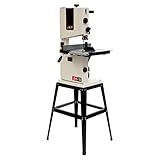
| Benchtop, roughly 9–10 inches | Small curves, thin parts, occasional light work | Lower cost, compact, often runs on household power | Limited resaw height; lighter frame and table can make wide cuts harder to control |
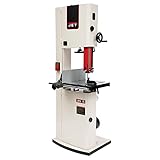
| 14-inch floor-standing saw | Curves, joinery parts, moderate resawing | Broad blade choice and useful capacity; a good shop-size compromise | Stand, guides, and fence quality vary; some models need upgrades for demanding resaw work |
| Large-frame saw, 17 inches and up | Tall resawing and frequent production work | More capacity, mass, and often more power | Higher cost, larger footprint, and possible 240-volt requirement |
Buying priorities for furniture work
Among similarly sized machines, prioritize a quick-release tensioner, an easy-to-adjust guide assembly, and a fence that can be aligned with the blade. A fence that tilts or adjusts for drift is useful when resawing, but a straight, rigid auxiliary fence can also work. The stock fence supplied with a budget saw may be short or flimsy; inspect it rather than assuming it will track a tall board reliably.
Wheel alignment and tire condition affect tracking. The blade should not wander off the tires during a test run, and the wheels should turn smoothly without obvious wobble. Guides should support the blade without pinching it. If the saw vibrates heavily, makes a persistent scraping sound, or cannot hold a setting after adjustment, treat that as a warning rather than a minor inconvenience.
A 14-inch band saw with quick-release tension is the sensible category to start with for a typical furniture shop. Compare actual resaw height, blade-width range, guide access, and voltage—not just the advertised motor rating.
If you mostly cut small curves and rarely resaw stock, a benchtop woodworking band saw can be the cheaper, space-saving choice. It is fine for thin parts and occasional light cutting. Avoid buying one expecting it to resaw thick hardwood accurately: short capacity and a lighter frame make that job frustrating.
Change blades and set up safely
Unplug the saw before opening the doors. Release tension, remove the old blade carefully, and wear gloves when handling a coiled blade; it can spring open. Install the new blade with the teeth pointing down at the front of the saw, then tension it according to the blade maker’s guidance. Check tracking by turning the wheels by hand before powering up.
Set side guides just behind the gullets, with a small clearance—about the thickness of a sheet of paper is a common starting point. Set the thrust bearing close enough to support the blade under cutting load, but not touching it while the saw runs freely. Guide designs differ, so follow the manual. Close and latch both wheel doors before switching on.
Test on scrap of similar thickness. If the cut curves away from the fence, check blade sharpness, tension, tracking, fence alignment, and feed pressure before blaming the machine. A dull blade or forcing the stock can deflect even a well-set saw. For resawing, feed steadily and let the blade cut; slow down if the motor labors or the cut begins to drift.
Where to spend—and where not to
Pay more for capacity and a rigid, well-guided machine only if your work needs them. For occasional curves and stock under about 4 inches thick, a sound 14-inch saw with quick release is often a better buy than a large production machine. If you regularly resaw tall hardwood, prioritize frame stability, guide adjustment, and motor supply, then budget for a sharp, suitable blade. The lever makes blade changes faster; the rest of the saw determines whether those changes lead to clean furniture parts.