Best Band Saws with Quick-Release Blade Tensioning
What's inside
- What quick-release tensioning does
- Best band saw types with quick release
- Best for most woodworkers: a 14-inch floor-standing saw
- Best for small shops: a compact benchtop model
- Best for resawing: a heavy-duty 14- or 18-inch saw
- Features that matter more than the lever
- How to use the quick release correctly
- What quick-release tensioning does
- Best band saw types with quick release
- Best for most woodworkers: a 14-inch floor-standing saw
- Best for small shops: a compact benchtop model
- Best for resawing: a heavy-duty 14- or 18-inch saw
- Features that matter more than the lever
- How to use the quick release correctly
As an Amazon Associate I earn from qualifying purchases. This post may contain affiliate links at no extra cost to you.
A quick-release blade tensioning lever is one of the most useful convenience features on a stationary band saw. It lets you remove tension when the saw is idle, then restore a repeatable setting before the next cut. That reduces fatigue, protects the tires and wheel bearings, and makes blade changes much less irritating.
It does not, however, make a poor band saw accurate. Frame stiffness, wheel alignment, guide adjustment, dust collection, and the quality of the tension indicator still matter more to cutting performance. The best choice depends on whether you cut thin curves, resaw wide boards, or simply want a reliable saw for occasional shop work.
As an Amazon Associate we earn from qualifying purchases at no extra cost to you.


Contents
- What quick-release tensioning does
- Best band saw types with quick release
- Best for most woodworkers: a 14-inch floor-standing saw
- Best for small shops: a compact benchtop model
- Best for resawing: a heavy-duty 14- or 18-inch saw
- Features that matter more than the lever
- How to use the quick release correctly
What quick-release tensioning does
A quick-release system usually consists of a lever or cam that takes the blade tension off without requiring you to turn the main tension knob through its full range. You set the working tension with the knob, engage the lever, and the blade is ready to cut. Release the lever when storing the saw or changing blades.
This is different from a tool-free blade change. You still need to open the wheel doors, release the blade from the guides, and guide the new blade around both wheels. The quick-release simply makes the tensioning part faster and more consistent.
Use the release whenever the machine will sit unused for more than a day or two. Leaving a blade tight for weeks can compress tires, load bearings, and permanently stretch or kink a blade. A release also helps prevent the common mistake of loosening the tension knob so far that the original setting is lost.
Best band saw types with quick release
| Type | Typical capacity | Best use | Main compromise |
|---|---|---|---|
| Compact benchtop | 3–4 in. resaw height | Small projects and curves | Limited power and narrow blades |
| 14 in. open-stand | 6 in. resaw height | General woodworking | May need upgrades for serious resawing |
| 14 in. heavy-duty | 10–12 in. with riser or taller frame | Wide boards and frequent use | Higher cost and larger footprint |
| 18 in. floor-standing | 12 in. or more | Production resawing and thick stock | Expensive, heavy, and excessive for light work |
Best for most woodworkers: a 14-inch floor-standing saw
A 14-inch band saw is the sensible middle ground for most stationary woodworking shops. Look for a model with a quick-release lever, at least 1-1/2 horsepower, cast-iron or heavily braced wheels, a rigid upper guide post, and a table that tilts without flexing. A 6-inch cutting height handles furniture parts, bowl blanks, and most ordinary resawing.
For a 14-inch saw, a 1/2-inch, 3-teeth-per-inch blade is a practical starting point for resawing. Use a 1/4-inch blade with 6 to 10 teeth per inch for tighter curves. A narrow blade can turn more sharply, but forcing it through thick hardwood will make it wander and heat the blade. A wide blade tracks better for straight cuts, but its minimum radius is much larger.
Search for 14-inch band saws with quick-release blade tension if you want the broadest selection. Check the manual or manufacturer photos carefully: some listings call a spring-loaded tension knob “quick release” when no separate lever is included.
Best for small shops: a compact benchtop model
A benchtop saw is fine when your work consists mainly of small curves, toys, instrument parts, and stock under 3 inches thick. It costs less, takes up less space, and usually needs less electrical capacity. The cheaper option is perfectly reasonable if you rarely resaw boards and can accept slower cutting.
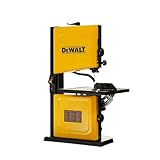
The limitations show up quickly with hardwood. Many compact saws use small wheels and modest motors, which restrict blade width and reduce the saw’s ability to maintain speed in 6/4 or 8/4 stock. Their small tables and short guide posts also make tall work awkward. Choose one with a real tension-release lever rather than a knob that must be backed off several turns.
For occasional hobby work, compare benchtop band saws with quick-release tension. Confirm the maximum blade width and resaw height before buying; advertised throat capacity does not tell you how thick a board the saw can cut.
Best for resawing: a heavy-duty 14- or 18-inch saw
If you routinely turn wide boards into book-matched panels, buy for resaw capacity and frame stiffness rather than for the release lever alone. A taller frame, 2-horsepower motor, wide upper and lower guides, and a fence that stays square under pressure are more important. A quick release is still valuable because resaw blades are often removed after a demanding session.
Plan on a 3/4-inch blade for straight resawing when the saw accepts it. The blade should have a low tooth count—roughly 2 to 3 teeth per inch—to clear chips from a deep kerf. Feed steadily, but do not push so hard that the motor slows noticeably. A slipping or wandering blade often indicates dull teeth, insufficient tension, poor tracking, or a fence that is not aligned with the blade’s actual drift.
Look at heavy-duty band saws with quick-release blade tension when cutting stock above 8 inches regularly. These machines can weigh several hundred pounds, so plan for delivery, floor space, and dust collection before ordering.
Features that matter more than the lever
Reliable tension indication: A scale is useful only if it is calibrated for the blade width and actually agrees with the blade manufacturer’s recommendation. Treat it as a starting point. Too little tension causes flutter and wandering; too much can break a blade or damage the machine.
Guide adjustment: Bearings or ceramic guides should adjust close to the blade without touching it during free running. Guides set too far away allow the blade to twist. Guides clamped too tightly create heat and premature wear.
Tracking adjustment: The upper wheel should tilt smoothly and hold its position. If the blade repeatedly walks toward the front or rear despite correct tension, inspect wheel alignment and tire condition instead of simply adding more tension.
Dust collection: A lower port near the blade is far more useful than a decorative port on the upper housing. Fine dust packed around the lower wheel can interfere with tracking and clog bearings.
How to use the quick release correctly
Unplug the saw before opening the doors. Release the lever, install the blade with the teeth pointing in the correct direction, and turn the wheels by hand while applying light tension. Engage the lever, then adjust the main knob to the blade’s working setting. Set tracking and guides with the blade moving only after the doors are closed.
Before cutting expensive stock, run the saw empty for 30 seconds. Stop immediately if the blade oscillates, scrapes a guide, or walks off the wheel. After the cut, release tension if the saw will not be used soon. That simple habit is the main reason to pay extra for the feature.