Best Table Saws for a Two-Car Garage Woodshop
What's inside
As an Amazon Associate I earn from qualifying purchases. This post may contain affiliate links at no extra cost to you.
Contents
Fit the saw to the garage
A table saw for a two-car garage has to do more than cut accurately. It has to leave room for a car, lumber storage, and safe movement around the blade. A full-size cabinet saw can be excellent for a permanent shop, but its weight and footprint are hard to justify if you need to roll everything aside after a project. For most garage shops, the practical choice is between a jobsite saw on a wheeled stand and a contractor-style saw with a larger table and more capable fence.
Measure the space with the saw fully set up, including the infeed and outfeed area. A 4-by-8-foot sheet needs support extending several feet beyond the blade in both directions; that does not mean you need a permanent 4-by-16-foot clear floor, but you do need a plan for roller stands, a helper, or breaking sheets down with a track saw. Leave room to stand beside the work and reach the switch without crossing behind a moving blade.
As an Amazon Associate we earn from qualifying purchases at no extra cost to you.


Which type makes sense?
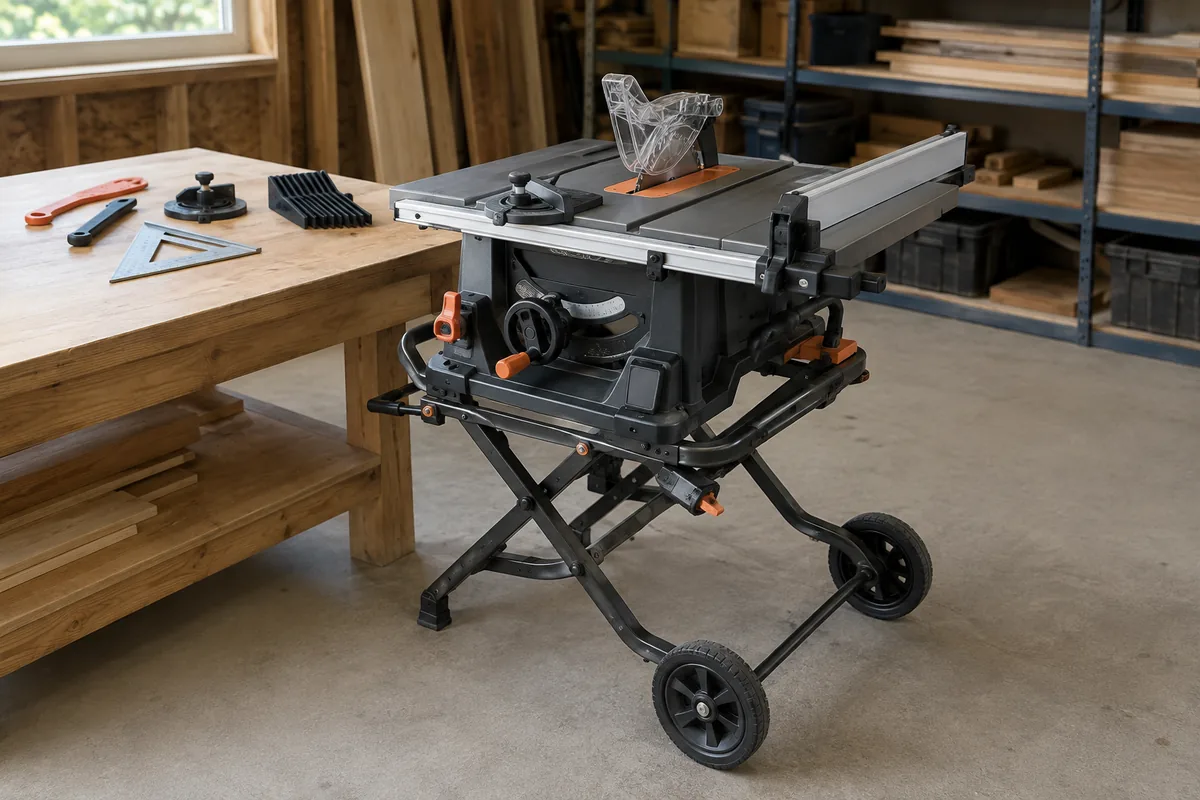
A jobsite saw is usually the best fit when portability and storage matter most. Its folding stand or wheeled base is easier to park, and its fence can handle ordinary ripping. The compromises are a smaller work surface, more vibration, and less convenient support for heavy panels. Check the rip capacity rather than judging by the size of the tabletop: a saw that reaches roughly 24 inches to the right of the blade can rip a 4-foot-wide sheet lengthwise with appropriate support, though handling that sheet alone is still awkward.
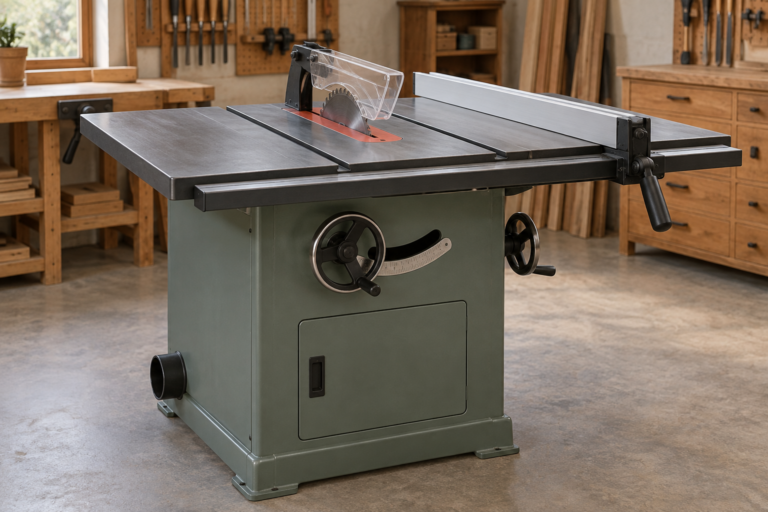
A contractor-style saw is a better choice for frequent furniture work, thicker hardwood, or long rip cuts. It has a heavier base and usually more table area, but it takes longer to move and may need a dedicated corner. A cabinet saw is worth considering only if the garage can spare a permanent footprint and its electrical service suits the motor. Don’t buy a large saw just for the promise of capacity you will rarely use.
Compare jobsite table saws with rolling stands if the saw needs to move between woodworking and parking. If it will stay put and see regular use, look at contractor-style table saws instead.
Quick comparison
| Type | Best for | Main trade-off | Check before buying |
|---|---|---|---|
| Jobsite | Shared or compact garages | Smaller table and less mass | Fence travel, stand stability, dust port |
| Contractor-style | Regular furniture and cabinet work | Harder to move and store | Footprint, motor requirements, fence quality |
| Cabinet | Permanent, high-use shop | Cost, weight, and space | Electrical supply and safe access around the saw |
These are broad categories, not guarantees: fence alignment, blade quality, and setup matter as much as the label. Read the manual for the actual rip capacity, motor rating, and electrical requirements. A household 120-volt circuit may run many jobsite saws, but a shared circuit can trip when the saw starts or when another tool is running. Larger saws may require 240 volts; confirm that before buying.
What to check before purchase
Prioritize a fence that locks securely at the front and stays parallel to the blade. A fence that shifts when pushed can turn a routine rip into a binding workpiece. In the store or after delivery, lock it at several positions and measure from the fence to the same tooth at the front and rear of the blade. Follow the manual’s alignment procedure rather than assuming the factory setup is perfect.
Also check blade tilt, riving-knife fit, guard removal and replacement, and access to the power switch. A riving knife helps prevent a kerf from closing and pinching the blade; keep it installed for through-cuts when the cut allows. A blade guard is not a substitute for careful feeding, but it helps contain contact and flying debris. If the included blade leaves rough edges, a suitable 40-tooth general-purpose blade can improve crosscuts and plywood, though a poor fence or dull blade will still spoil results.
Dust collection is another garage-specific issue. Many saws have a small port that works better with a shop vacuum than with a large dust collector, and some still leak dust around the blade. Expect cleanup, especially when cutting MDF. Use eye and hearing protection, and wear a properly fitted respirator when dust control is inadequate.
Support the work and use the saw safely
Long stock can lever against the table and steer into the blade. Use an outfeed table or roller support at the same height as the saw; a support set too high can lift the workpiece and cause a bad cut. For wide plywood, use stable infeed and outfeed support and get another person to help if you cannot control the sheet without twisting. Do not balance a panel on a narrow stand or reach across the blade to catch the offcut.
Use a push stick for narrow rips, keep hands out of the blade’s path, and stand slightly to one side rather than directly behind the work. Never freehand a cut or use the fence and miter gauge together for a crosscut that traps the offcut between them. That trapped piece can kick back. Unplug the saw before changing blades or clearing a jam, and wait for the blade to stop before reaching near it.
Buy for your actual work
For occasional shelving, trim, and small furniture in a garage that must remain usable, a jobsite saw is often the sensible purchase; spend the savings on a stable stand, a good blade, and material support. For weekly hardwood ripping and larger projects, the steadier table and fence of a contractor-style saw may save frustration. Choose a cabinet saw only when you have a permanent location, the right circuit, and enough clearance to use it safely.
Before ordering, confirm the folded dimensions, assembled footprint, rip capacity, and return policy. A saw that fits the budget but cannot be set up safely—or cannot be stored without blocking the garage—will see less use than a smaller, well-supported machine.