Best Table Saws for Hardwood Furniture Stock
What's inside
As an Amazon Associate I earn from qualifying purchases. This post may contain affiliate links at no extra cost to you.
Hardwood furniture stock exposes every weakness in a table saw. Dense boards increase cutting resistance, wide panels punish a short table, and a small amount of arbor or fence movement can turn an expensive cut into visible joinery trouble. The best table saw is not necessarily the one with the highest horsepower. For furniture work, reliable alignment, a solid fence, dust control, and a blade that stays square matter just as much.
As an Amazon Associate we earn from qualifying purchases at no extra cost to you.
Contents
What matters when cutting hardwood
Look for a saw with a 10-inch blade, a rigid cast-iron or heavy steel top, and enough rip capacity for the panels you actually build. A 1-1/2 to 2 horsepower cabinet saw is a comfortable choice for most small-shop furniture work. It will handle 8/4 maple, oak, ash, and walnut more confidently than a jobsite saw, especially when ripping several feet of stock.
A quality fence should lock parallel to the blade without needing a second hand to hold it down. The rails should not flex when you press against the fence. A practical test is to lock the fence, measure its distance from the miter slot at both ends, and repeat after applying moderate sideways pressure. Movement of more than a few thousandths of an inch is worth treating seriously.
Arbor runout and blade alignment are equally important. A saw that cuts slightly out of parallel can leave burn marks, force the board against the fence, or produce a tapered rip. For furniture parts, aim to align the blade to the miter slot within roughly 0.002 to 0.003 inch. The fence should be parallel at the front and either parallel or just a few thousandths farther away at the rear. Too much toe-out creates a wider, less controlled cut.
The best saw type for different shops
| Saw type | Best use | Main strengths | Main compromises |
|---|---|---|---|
| Cabinet saw | Regular furniture production | Power, stability, dust collection, accurate fence | High cost, weight, permanent floor space |
| Hybrid saw | Serious home shops | Good accuracy and value, enclosed base | Less reserve power and lighter components than a cabinet saw |
| Jobsite saw | Portable or occasional work | Low price, easy storage, useful mobility | Smaller table, louder operation, more limited ripping capacity |
| Sliding table saw | Repeatable panel and crosscut work | Excellent support and crosscut accuracy | Large footprint and higher purchase price |
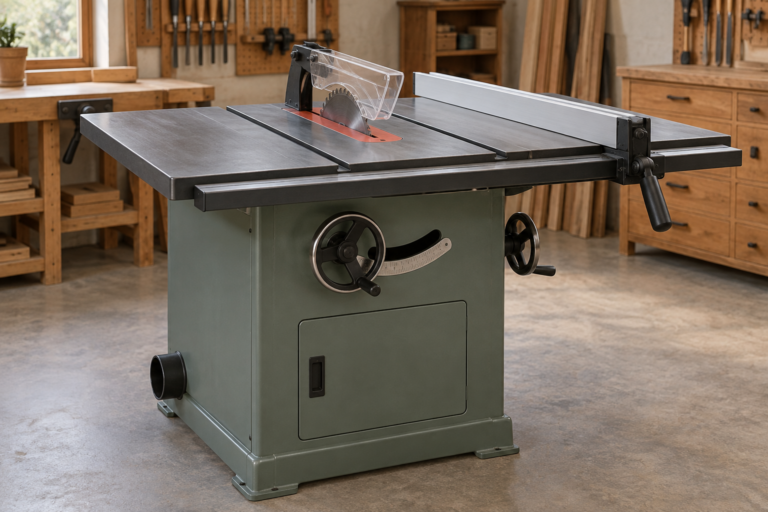
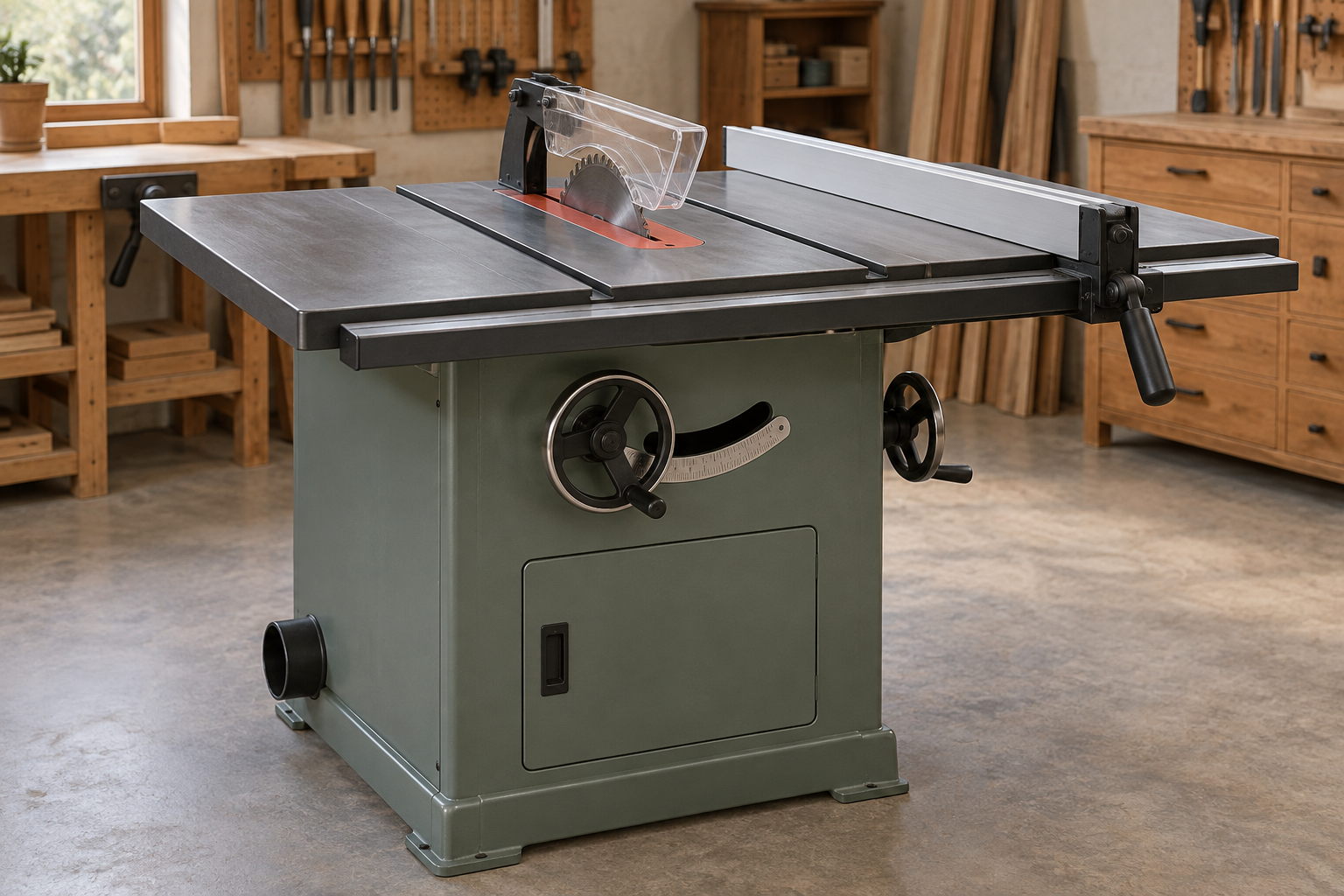
A cabinet saw is the strongest all-around choice if the machine will stay in one location. Its heavier trunnions and larger table reduce vibration, which helps when cutting tenons, thin strips, and long hardwood boards. A good cabinet saw also connects more effectively to a dust collector. Use a machine with a 4-inch dust port and a collector capable of moving roughly 600 to 1,000 CFM at the tool for useful chip pickup.
A hybrid saw is often the sensible middle ground. It is suitable for a hobbyist making cabinets, tables, and built-ins, provided the stock is milled flat and the cuts are not rushed. The cheaper choice is fine when you work mostly with boards under 6 inches wide, use a sharp blade, and can accept slower feed rates. It becomes frustrating when ripping long 8/4 boards or breaking down full sheets.
Features worth paying for
Prioritize a reliable rip fence over electronic features. A T-square-style fence with a long face is easier to trust than a short, flexible fence. A 30-inch rip capacity covers many furniture parts; 50 inches is useful for sheet goods but usually requires a larger shop and better outfeed support.
Use a riving knife that rises and falls with the blade. It reduces the chance of a kerf closing onto the blade and causing kickback, while still allowing many non-through cuts. A guard that removes without tools is more likely to be used. The saw should also have a positive, repeatable bevel mechanism. If the blade tilts and returns to 90 degrees inconsistently, every square cut becomes a setup problem.
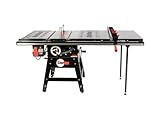
For a first serious stationary machine, compare 10-inch cabinet table saws when you have adequate electrical service and floor space. A 240-volt circuit is preferable for many cabinet saws because it reduces current draw and gives the motor more usable reserve. Check the saw’s actual electrical requirements before buying; not every motor can be converted between voltages.
Blade choice and setup are part of the saw
A factory blade is rarely the right blade for furniture stock. A 40-tooth combination blade is a useful general-purpose starting point. For clean crosscuts in hardwood, a 60- or 80-tooth crosscut blade leaves less tear-out. For ripping thick stock, use a 24-tooth or 30-tooth ripping blade with a flat or alternate-top bevel grind suited to the cut.
Burning does not always mean the motor is underpowered. A dull blade, misaligned fence, resin on the blade, or feeding too slowly can all create heat. If burn marks appear on one side of the cut, check alignment before buying a larger saw. Hardwood dust packed around the arbor or inside the cabinet can also restrict elevation and tilt mechanisms, so clean the machine regularly.
Support is another frequent failure point. A 6-foot board can lever against a short table and pull the cut away from the fence. Add an outfeed table and side support that are flush with, or no more than about 1/32 inch below, the saw table. For narrow rips, use a push block that keeps your hand well away from the blade while pressing the work down and against the fence.
What to buy for your workload
If you build furniture every week, choose a cabinet saw with a strong fence, enclosed dust collection, and a 30-inch or larger rip capacity. If you build occasionally and have a limited budget, a hybrid saw is a better long-term purchase than an inexpensive portable saw, assuming it can remain set up.
For a portable setup, a jobsite saw can still be effective. Choose one with a rack-and-pinion or otherwise precise fence, a usable riving knife, and a stand that does not wobble. Search portable jobsite table saws with folding stands if storage is the deciding factor. Expect to make fewer passes, support boards carefully, and verify the fence before important cuts.
Finally, budget for a quality blade, a straightedge, a dial indicator or alignment gauge, and dust collection. Those accessories can improve a modest saw more than cosmetic upgrades or extra digital controls. A well-aligned, adequately supported saw with a sharp blade will produce better furniture parts than a powerful machine that is poorly set up.