Best Router Bits for Cutting Circles
What's inside
- Best Router Bits for Cutting Circles
- Quick picks by situation
- Straight bits: the dependable choice for circle jigs
- Spiral bits: cleaner chip removal and specialized edges
- How bit diameter affects the cut
- Cut depth: the key to clean edges
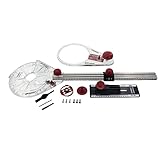
- Setting up a circle-cutting jig
- Matching the bit to the material
- Ownership costs and maintenance
- Final recommendation
- Related Guides
- Best Router Bits for Cutting Circles
- Quick picks by situation
- Straight bits: the dependable choice for circle jigs
- Spiral bits: cleaner chip removal and specialized edges
- How bit diameter affects the cut
- Cut depth: the key to clean edges
- Setting up a circle-cutting jig
- Matching the bit to the material
- Ownership costs and maintenance
- Final recommendation
- Related Guides
As an Amazon Associate I earn from qualifying purchases. This post may contain affiliate links at no extra cost to you.
Contents
- Best Router Bits for Cutting Circles
- Quick picks by situation
- Straight bits: the dependable choice for circle jigs
- Spiral bits: cleaner chip removal and specialized edges
- How bit diameter affects the cut
- Cut depth: the key to clean edges
- Setting up a circle-cutting jig
- Matching the bit to the material
- Ownership costs and maintenance
- Final recommendation
- Related Guides
Best Router Bits for Cutting Circles
The best router bit for cutting circles is usually a sharp, solid-carbide straight bit in a diameter that matches the thickness and finish you need: use a 1/4-inch bit for most circle-cutting jigs, a 1/2-inch bit for faster, more rigid cuts, and a spiral bit when clean edges in plywood, MDF, or laminates matter more than cost.
Quick picks by situation
| Situation | Best bit type | Recommended diameter | Why it fits |
|---|---|---|---|
| Occasional circles in solid wood | Two-flute straight bit | 1/4 inch | Affordable, easy to control, and suitable for shallow passes |
| Frequent work or thick stock | Two-flute straight bit | 3/8 to 1/2 inch | More rigid and efficient, with less tendency to deflect |
| Clean top edges in plywood or MDF | Up-cut spiral bit | 1/4 inch | Pulls chips upward and usually clears the cut effectively |
| Clean top face on veneered or laminated work | Down-cut spiral bit | 1/4 inch | Pushes fibers downward and reduces top-face breakout |
| Full-depth cuts in thick material | Compression spiral bit | 1/4 to 1/2 inch | Can protect both top and bottom faces when the cut setup is correct |
Straight bits: the dependable choice for circle jigs
A straight bit has cutting edges parallel to the shank. It is the conventional choice for a router circle-cutting jig because it cuts predictably while the router travels around a fixed pivot. A two-flute, carbide-tipped or solid-carbide bit is generally preferable to an unusually large bit: it gives the jig less resistance to turn and makes it easier to control the router.
As an Amazon Associate we earn from qualifying purchases at no extra cost to you.



A 1/4-inch straight bit is the most versatile starting size. It removes a moderate amount of material, fits many compact and full-size routers, and can make a narrow kerf that leaves more usable stock. It is particularly useful for cutting speaker openings, templates, table components, and plywood discs in several shallow passes.
A 3/8-inch or 1/2-inch straight bit is stiffer. That matters when cutting thick hardwood, where a small bit can flex if pushed too aggressively. The trade-off is greater cutting force, a wider kerf, and more waste. A large bit is not automatically better for a small circle; the jig, router, and workpiece must all have enough clearance.
When to choose a bottom-cleaning bit
Some circle jigs are used first to create a shallow recess and then to cut through the workpiece. A bottom-cleaning or spoilboard bit can be useful for leveling a wide flat area, but its broad cutting diameter is inefficient for a narrow circular cut. Use it for flattening or recessing rather than as the default bit for every circle.
Spiral bits: cleaner chip removal and specialized edges
Spiral bits use helical flutes rather than straight flutes. An up-cut spiral lifts chips out of the groove, which helps prevent packing when cutting MDF, plywood, and deeper solid-wood circles. It can leave a particularly clean lower edge, but the upward force may lift loose veneer or produce more breakout on the top face.
A down-cut spiral presses chips and fibers downward. This is often the better choice when the visible top surface is veneered plywood, melamine, or laminate. It can produce a cleaner top edge, but it evacuates chips less readily. Use shallow passes, clear dust frequently, and avoid burying the entire cutting length in a deep kerf.
A compression spiral combines opposing flute directions. It is designed to keep both faces cleaner when enough material is removed in the correct pass sequence. These bits cost more and are less forgiving of an unsuitable depth of cut. For a thin panel, a compression bit may not have enough material engaged in both flute zones to work as intended.
How bit diameter affects the cut
Bit diameter affects rigidity, cutting load, minimum practical circle radius, and the appearance of the finished edge. A larger diameter does not necessarily cut faster if the router lacks power or the circle is small.
- 1/4 inch: Best general-purpose size for circle jigs, smaller radii, templates, and controlled shallow passes.
- 3/8 inch: A useful compromise for thicker stock and repeated work where additional stiffness is valuable.
- 1/2 inch: Strong and efficient for large circles and thick material, but requires a rigid jig, a capable router, and adequate clearance.
- 1/8 inch and smaller: Better suited to detail work than structural circle cutting. These bits are more vulnerable to deflection and breakage.
Remember that the bit itself limits the smallest circle your jig can make. If the pivot point is offset from the router base, calculate the radius from the jig’s pivot center to the bit’s cutting center, not to the edge of the router base. For a hole cutout, the bit removes a kerf equal to its diameter, so the finished opening will not match the pivot radius unless the jig is laid out for the bit’s centerline.
Cut depth: the key to clean edges
For a through-cut, do not begin by plunging through the entire board. Set the bit to remove roughly 1/8 inch per pass in hardwood and about 1/8 to 1/4 inch per pass in softer sheet goods, depending on router power, bit sharpness, and diameter. Leave a thin skin at the bottom for the final pass or cut into a sacrificial backer.
For example, a 3/4-inch plywood panel can be cut in three passes of approximately 1/4 inch, followed by a final pass through the remaining material. A 1/2-inch bit may tolerate the deeper passes, but a 1/4-inch bit should usually be treated more conservatively. The final pass should be light; forcing a full-depth finishing pass increases burning, tear-out, and deflection.
For a recess rather than a through-cut, make the first pass shallow and check the floor. A 1/8-inch-deep recess followed by a second pass is often cleaner than trying to reach 1/4 inch in one trip. Keep the router moving continuously around the circle so one section does not receive excessive heat.
Setting up a circle-cutting jig
- Mark the center and radius. Measure from the intended finished edge to the bit’s cutting center. Account for the bit diameter when cutting an opening.
- Secure the workpiece. Clamps must stay outside the router’s path. For a through-cut, support the panel on a sacrificial board so the waste cannot drop and tear the final fibers.
- Mount the router firmly. The base should not rock on the jig. Check that the collet grips the shank above its minimum insertion mark, without bottoming out in the collet.
- Set the speed and depth. Follow the bit maker’s speed range. Larger bits require lower speeds than small ones; never exceed the bit’s rated maximum.
- Make shallow, continuous passes. Complete each revolution at a controlled feed rate before changing depth. Stop if the router labors, chatters, or produces smoke.
- Finish the last fibers carefully. A sacrificial backer, a light final pass, and support beneath the waste reduce breakout.
In a fixed-base router, feed direction matters. Viewed from above, feed the router counterclockwise around the outside of a circle so the bit cuts against its rotation and the router remains pressed toward the jig’s pivot. For an inside opening, the effective climb relationship changes; use a controlled conventional cut and take especially light passes near the final edge. A climb cut can pull the router suddenly and is best avoided unless you have a specific, well-controlled reason to use one.
Matching the bit to the material
Solid hardwood: A sharp straight bit or up-cut spiral works well. Use shallow passes, clear chips, and reduce the feed rate only enough to avoid chatter; feeding too slowly can burn the edge.
Plywood: An up-cut spiral usually clears chips effectively. If the top veneer is the visible face, a down-cut or compression bit may reduce splintering. Masking tape can help with fragile veneer, but it does not replace a sharp bit and proper support.
MDF: Either straight or up-cut spiral bits can work, although MDF dust is abrasive and quickly exposes dull edges. Use effective dust extraction and clean the router after the job.
Plastic laminate: A down-cut or compression spiral is often preferable for the finished face. Avoid excessive heat, since melted plastic can smear onto the flutes. Make a test cut in scrap before committing to the panel.
Ownership costs and maintenance
In general market terms, a quality 1/4-inch straight bit may cost about $10–$30, while specialized spiral or compression bits commonly fall around $25–$90 or more. The cheaper choice can be economical for occasional softwood work, but frequent MDF, plywood, or laminate cutting may justify a replaceable-insert or premium solid-carbide bit.
The cutting edges wear first, followed by resin and dust buildup in the flutes. Clean bits with a non-abrasive resin remover or the cleaner recommended by the manufacturer; do not scrape carbide with steel tools. Inspect for chipped carbide, blue discoloration from overheating, and a loose or damaged shank. A dull bit increases force and heat, so replacing or professionally sharpening it is safer than compensating with an extremely slow feed.
Final recommendation
Choose a 1/4-inch, two-flute straight bit if you want one affordable bit for a circle jig. Choose a 1/4-inch up-cut spiral for frequent plywood, MDF, or deeper cuts where chip evacuation is important. Choose a down-cut or compression spiral when the visible face needs the cleanest possible edge. Move up to 3/8 or 1/2 inch only when the material is thick, the circle is large enough, and your jig and router can handle the extra cutting load.