
Key takeaways
- Compare the best cutting board oils and board butters, from pure food-grade mineral oil to beeswax board cream, with sizes, ingredients, and care cycles.
As an Amazon Associate I earn from qualifying purchases. This post may contain affiliate links at no extra cost to you.
A wooden cutting board or butcher block that never gets oiled will dry out, fade, and eventually split along the grain. The fix is simple and cheap in effort: a food-safe oil that soaks into the fibers, followed when needed by a wax-rich cream that sits on the surface and slows water from soaking in during washing. Board makers call the first step oiling and the second step sealing, and most boards do best with both on a regular cycle.
This roundup covers five board-care products sold for food-contact wood: straight mineral oils, an oil-and-wax conditioner blend, a beeswax board cream, and a coconut-oil-based alternative. Every pick is a board-care product in its own right, not a pharmacy bottle and not a furniture finish, and every formula here is published by its maker as safe for surfaces that touch food.
As an Amazon Associate, we earn from qualifying purchases.
Quick answer
For most boards, the Howard Butcher Block Conditioner is the simplest one-bottle routine: food-grade mineral oil blended with beeswax and carnauba wax in a 12-ounce bottle. For a thicker sealing layer, the John Boos Board Cream is the board butter to add on top of plain oil. Thirteen Chefs Mineral Oil is the budget workhorse, Clark’s adds lemon and orange oils, and Walrus Oil is the coconut-oil-based pick.
Howard Butcher Block Conditioner, 12 fl oz

Howard’s conditioner is the one-step pick of this group, because it does the two jobs of board care in a single bottle. The formula blends food-grade mineral oil with beeswax and carnauba wax, so the oil portion sinks into dry fibers while the waxes stay near the surface and leave a water-shedding layer behind. That makes it a practical choice for a board that is already in service and needs reviving rather than a full first seasoning.
The maker directs it at butcher blocks, cutting boards, wooden bowls, and utensils, and the published guidance is to apply it after the board has been oiled or whenever the surface looks dry and pale. The mineral oil in the blend is published as exceeding United States FDA regulations for direct and indirect food contact. Because the waxes are already in the bottle, a single product covers the routine that otherwise takes a separate oil and a separate cream.
Specs
- Form: Liquid conditioner blend
- Size: 12 fl oz
- Base: Food-grade mineral oil
- Waxes: Beeswax and carnauba wax
- Food-contact basis: Mineral oil published as exceeding FDA regulations for direct and indirect food contact
- Use: Butcher blocks, cutting boards, wooden bowls, utensils
- Model: BBC012
- Item weight: Not stated
John Boos Board Cream, 5 oz
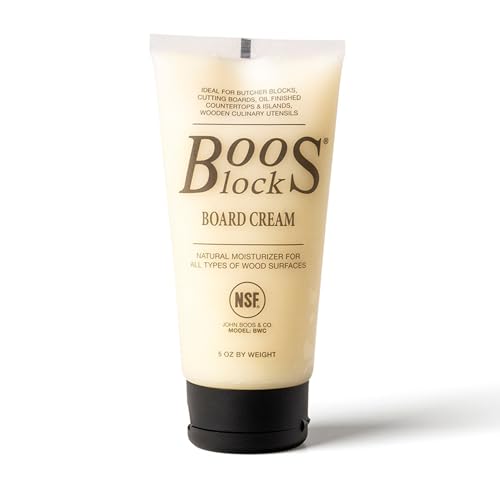
Board butter is the thick half of board care, and the Boos Block Board Cream is the reference example. It is a dense cream of food-grade mineral oil and natural unbleached beeswax, sold in a 5-ounce tube, and it is meant to be spread over a board that has already been oiled. Where a straight oil soaks in and disappears, this cream stays on top and leaves what the maker calls a silky wax barrier that locks moisture in.
John Boos publishes a clear routine for it: apply an even coat, let it penetrate overnight, and repeat every three to four weeks, in between applications of the brand’s Mystery Oil. That rhythm suits end-grain blocks and heavy butcher blocks that see daily washing. The cream also works on countertops and wooden utensils. A tube goes a long way, since each coat is thin, and the 5-ounce size is the standard single tube the brand sells for home kitchens.
Specs
- Form: Cream (board butter)
- Size: 5 oz tube
- Base: Food-grade mineral oil
- Wax: Natural unbleached beeswax
- Maker’s cycle: Every 3 to 4 weeks, between oil applications
- Use: Butcher blocks, cutting boards, countertops, utensils
- Model: BWCB
- Item weight: 5.6 oz
Thirteen Chefs Mineral Oil, 12 fl oz

Thirteen Chefs is the plain, workhorse oil of the group: a 12-ounce bottle of food-grade mineral oil with no wax and no scent, built for the soaking step of board care. The maker publishes a simple method — apply generously, let the oil sit for four hours or overnight, then wipe away the excess — and a light maintenance dose of about one ounce every three months for boards up to 18 inches long.
The detail that sets this bottle apart is its certification. Thirteen Chefs states the oil is NSF certified food grade, a credential aimed at commercial kitchens as much as home ones, and the formula is published as colorless, odorless, tasteless, and gluten-free. The listing also notes the oil doubles as a lubricant for knives and meat grinders, and the same formula is sold in larger sizes for shops that oil many boards. For a first seasoning of a new board, this is the budget pick to reach for.
Specs
- Form: Liquid oil
- Size: 12 fl oz
- Base: Food-grade mineral oil
- Certification: NSF certified food grade (maker statement)
- Scent: None; published as colorless, odorless, and tasteless
- Maker’s cycle: About 1 oz every 3 months for boards up to 18 inches
- Model: CB01
- Item weight: 11 oz
Clark’s Cutting Board Oil, 12 fl oz
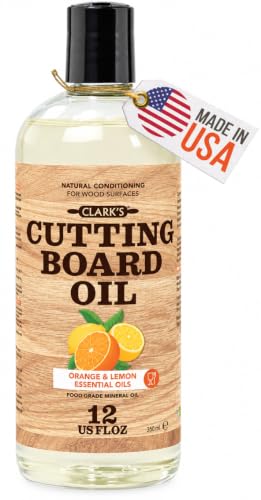
Clark’s takes the same food-grade mineral oil base as the plain oils and enriches it with lemon and orange oils, which gives the bottle a light citrus character the unscented picks do not have. It is a mid-range choice for owners who oil often and prefer a scented product, and the brand positions it for cutting boards and butcher blocks that need both restoring and protecting in one pass.
The formula is mineral oil first, so it behaves like the other soaking oils in this roundup: flood the surface, let it drink in, and wipe off what remains. The citrus oils are an addition to that base rather than a replacement for it, so the board still gets the deep fiber saturation plain mineral oil provides. Clark’s is a United States brand, and this 12-ounce bottle is its standard board oil size.
Specs
- Form: Liquid oil
- Size: 12 fl oz
- Base: Food-grade mineral oil
- Added oils: Lemon oil and orange oil
- Food-contact basis: Published as food grade for cutting boards and butcher blocks
- Use: Cutting boards, butcher blocks, wood countertops
- Applicator: Not stated
- Item weight: Not stated
Walrus Oil Cutting Board Oil, 8 oz

Walrus Oil is the alternative for buyers who want to keep petroleum-based mineral oil off their boards. Its cutting board oil is built on coconut oil rather than mineral oil, in an 8-ounce bottle, and the listing presents it as 100 percent food-contact safe with an FDA food-contact basis. The maker directs it at cutting boards, butcher blocks, wooden spoons, and bowls, and also sells a companion wood wax for the sealing step.
A coconut-oil base behaves a little differently from mineral oil: it is a plant-derived oil the maker formulates for wood care, and the brand built its name on food-safe finishes for board makers. The 8-ounce bottle is smaller than the 12-ounce picks here, which fits a single-board household better than a busy prep kitchen.
Specs
- Form: Liquid oil
- Size: 8 fl oz
- Base: Coconut oil
- Food-contact basis: Published as FDA food-contact safe, 100 percent food-contact safe
- Use: Cutting boards, butcher blocks, wooden spoons, bowls
- Companion product: Wood wax sold by the same maker
- Item weight: Not stated
- Full ingredient list: Not stated
How to choose
Begin with the two-step logic every maker in this roundup shares. Oil is the step that feeds the wood: a thin liquid soaks into the fibers, replaces moisture lost to washing, and keeps the board from drying and cracking. Cream, butter, or wax is the step that protects the surface: it sits on top, slows water entry, and stretches the time between oilings. A conditioner blend like the Howard bottle combines both steps in one pass, which is convenient, while separate products let you control each layer.
Match the product to the board’s condition. A brand-new or very dry board needs straight oil first, applied in repeated coats until the wood stops absorbing it; the Thirteen Chefs and Clark’s bottles suit that soaking stage. A board already in service usually needs maintenance, which is where the Howard blend or a coat of Boos Board Cream over an earlier oiling does the work. End-grain blocks drink the most oil and benefit most from the cream layer, since their open fibers face up.
Then weigh the formula differences that actually matter. Plain mineral oil never goes rancid and has no scent, which is why most makers build on it. Scented oil, like the Clark’s bottle, is a preference call. A coconut-oil base, like the Walrus Oil pick, suits buyers avoiding mineral oil entirely.
Who should skip
Skip this whole category if your board is plastic, glass, or stone; these products are for wood and bamboo only. Skip board cream as a first step on a new board, because wax on dry wood slows the oil soak the board needs most; oil first, then seal. Skip scented oil if you prep delicate foods and notice flavors easily, and choose an unscented bottle instead. And skip any product here as a substitute for a film finish on a countertop that must resist standing water all day; board oils and butters are renewable maintenance coatings, not permanent barriers, and they need reapplication to keep working.
FAQ
How often should a cutting board be oiled?
Makers publish cycles rather than one fixed rule. John Boos advises renewing its board cream every three to four weeks between oil applications, and Thirteen Chefs suggests about one ounce of oil every three months for a board up to 18 inches. A board that looks pale or feels rough is due sooner.
What is the difference between board oil and board butter?
Board oil is a thin liquid that soaks into the wood fibers and restores moisture. Board butter, also sold as board cream, is a thicker blend of oil and beeswax that stays on the surface and forms a water-shedding layer. The two are used together: oil first for depth, butter on top for protection.
Can board oil be used on bamboo boards and wooden utensils?
Yes, within the makers’ published directions. Howard lists wooden bowls and utensils among the uses for its conditioner, Walrus Oil names wooden spoons and bowls, and the oils here are all published for food-contact wood generally, which includes bamboo boards. Apply thin coats and wipe off the excess.
Does mineral oil go rancid on a cutting board?
No. The makers of the mineral oil picks state that food-grade mineral oil is tasteless, odorless, and colorless and will not go rancid, which is the main reason it is the standard base for board care. That stability is also why it is preferred over kitchen cooking oils for this job.
Final verdict
For a single bottle that handles routine care, the Howard Butcher Block Conditioner earns the main pick: oil and two waxes in one 12-ounce bottle, with a published FDA food-contact basis. Pair it with the John Boos Board Cream when a block needs a real sealing layer, since that cream is the board butter benchmark with a clear published cycle. Thirteen Chefs is the budget workhorse for seasoning and upkeep, Clark’s is the scented mid-range option, and Walrus Oil serves buyers who want a coconut-oil base. Any of the five will keep a board fed; the right choice is the one whose routine you will actually repeat.
Product and ASIN Reference
| Product | ASIN |
|---|---|
| Howard Butcher Block Conditioner, 12 fl oz | B001ESTA30 |
| John Boos Board Cream, 5 oz | B002HDT9FK |
| Thirteen Chefs Mineral Oil, 12 fl oz | B01B5ECU3O |
| Clark’s Cutting Board Oil, 12 fl oz | B00FE72UQ6 |
| Walrus Oil Cutting Board Oil, 8 oz | B074QVDKYC |
Related guides
More from Amazon
Programs that pair well with the guide above. Offers and eligibility are set by Amazon and may change.
A free business account with business pricing and bulk-buying tools for work, shop or home office.
Create a business accountFree shipping on eligible items, Prime Video and more. Eligible new members can start with a free trial.
Start a Prime free trialAudiobooks and podcasts to listen to on the go. Eligible new members can start with a free trial.
Try Audible freeAd-free music streaming. Eligible new subscribers can start with a free trial.
Try Music Unlimited freeAs an Amazon Associate we earn from qualifying purchases.


Write Your Review
No reviews yet. Be the first to share your experience!