Best Router Bits for Laminate: Clean Cuts Without Chipping
What's inside
As an Amazon Associate I earn from qualifying purchases. This post may contain affiliate links at no extra cost to you.
Contents
Best Router Bits for Laminate: Clean Cuts Without Chipping
The best router bit for laminate is a sharp, carbide-tipped flush-trim bit sized to the material you need to remove: use a short cutting length for thin edge overhangs, and a longer bit only when trimming a thicker countertop build-up. For most countertop work, choose a top-bearing bit when the router rides on the countertop surface, or a bottom-bearing bit when it rides on the cabinet or a template below the laminate.
Choose by the job, not just the bearing
Laminate is thin and brittle at its edges, so the goal is controlled shearing—not maximum cutting capacity. A small bearing follows a template or reference surface; the carbide cutters trim the overhang flush to it. Match the bearing position to the surface your router can safely ride on, then select the shortest cutting length that covers the material.
As an Amazon Associate we earn from qualifying purchases at no extra cost to you.


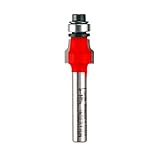
- Countertop overhang above a substrate: A top-bearing flush-trim bit can follow the top face while its cutters trim the edge. Confirm that the bearing can contact a flat, finished area and won’t ride over a seam or uneven surface.
- Template beneath the work: A bottom-bearing bit follows the template underneath while cutting the laminate and any projecting substrate. This is useful when the top surface should not be the bearing reference.
- Thin laminate edge: A short cutter reduces the amount of exposed carbide and makes it easier to control the cut. Don’t use a long bit just because it is available.
- Thick countertop edge or multiple layers: Select a cutting length that spans the full material thickness, or make the cut in stages if the bit and setup allow it. Avoid letting the bearing lose contact with its reference.
Bit features compared
Common sizes below are representative options, not a guarantee that every manufacturer offers the exact same dimensions. Check the bit’s stated cutting length, bearing position, shank, and router compatibility before buying.
| Bit configuration | Typical cutter diameter | Typical cutting length | Best fit | Main trade-off |
|---|---|---|---|---|
| Short flush-trim, top bearing | 1/2 in. (12.7 mm) | 1/2 in. (12.7 mm) | Trimming a thin overhang while referencing the top face | Limited reach through thick edges |
| Long flush-trim, top bearing | 1/2 in. (12.7 mm) | 1 in. (25.4 mm) | Thicker countertop edges where the top is the reference | More cutter exposure; requires a steady, well-supported setup |
| Short flush-trim, bottom bearing | 1/2 in. (12.7 mm) | 1/2 in. (12.7 mm) | Following a template or reference surface below the work | Template must be secure and accurately positioned |
| Spiral flush-trim, bearing-guided | 3/8–1/2 in. (9.5–12.7 mm) | 1/2–1 in. (12.7–25.4 mm) | Controlled trimming where cutter geometry suits the work and machine | Costs more; confirm the bit is designed for the intended laminate and router |
These are practical comparison dimensions, not universal specifications. A 1/2-inch shank generally offers a more rigid option than a 1/4-inch shank when the router accepts it, but the shank must match the collet exactly. Never force a mismatched shank into a collet.
Carbide geometry: straight, shear, or spiral?
For routine edge trimming, a sharp two-flute straight carbide bit is a sensible, widely available choice. Its simplicity makes it easy to inspect and replace, and the bearing gives a clear reference. Carbide quality and edge sharpness matter more than a complicated profile: dull or chipped edges can crush the laminate instead of cutting it cleanly.
Shear-angle and spiral designs can produce a slicing action that may help reduce edge breakout in suitable setups. However, performance depends on the bit’s specific geometry, rotation, feed direction, and material. A spiral bit may also pull the work or router in a direction that calls for extra control. Follow the manufacturer’s feed and operating guidance rather than assuming one geometry is automatically chip-free.
For delicate decorative laminate, the best router bit for laminate trimming is usually the sharpest suitable bearing-guided cutter with the shortest adequate cutting length—not necessarily the most expensive or longest bit. If the bit is intended for a particular cutting direction or material, follow that specification.
Best choice by situation
| Your situation | Practical choice | Why |
|---|---|---|
| Occasional DIY edge trimming; already own a compatible router | Short, bearing-guided carbide flush-trim bit | Usually enough for a thin laminate overhang and keeps the cutter engagement limited |
| Countertop with a thick edge build-up | Longer flush-trim bit, or staged trimming with a suitable short bit | Matches the edge thickness while preserving bearing contact and control |
| Reference is a template under the work | Bottom-bearing bit with cutter length matched to the stack | Lets the bearing follow the template rather than the top surface |
| Frequent work or a fragile visible edge | Quality carbide bit with appropriate shear or spiral geometry, tested on scrap | A sharper, suitable cutting action may improve the finish, but setup still determines results |
Setup for a clean countertop trim
- Check the stack before choosing the cutter. Measure the laminate overhang and the thickness the cutter must span. The bearing needs a continuous reference surface throughout the pass.
- Secure the work and support the waste. Clamp the countertop or workpiece so it cannot shift. Support projecting laminate where practical, but keep clamps clear of the router’s path.
- Inspect the bit and bearing. With the router unplugged, check for chipped carbide, resin buildup, and a bearing that turns freely. Install the bit to the depth specified by its manufacturer and tighten the collet correctly.
- Test on a matching offcut. Confirm the bearing follows the intended surface and the cutter trims flush without gouging it. This also reveals whether the cut direction is pushing the router away from its reference.
- Make a controlled pass. Keep the router’s base stable, maintain bearing contact, and feed at a steady rate. Follow the router and bit manufacturers’ instructions for feed direction and speed; don’t force the cut or linger in one spot.
- Check the edge before cleanup. If a tiny lip remains, adjust the setup rather than leaning harder on the router. A fine file or suitable hand tool can remove small remnants, working carefully to avoid lifting the laminate.
Wear eye and hearing protection, and use dust extraction where possible. Keep hands away from the cutter, disconnect power before adjustments, and don’t rout unsupported work or stand where a kickback could pull the router toward you.
Ownership: what wears and what goes wrong
Carbide edges gradually dull, while resin and laminate dust can collect on the cutter and bearing. Clean buildup with a cleaner approved for the bit’s materials; avoid soaking a bearing or using a solvent the manufacturer warns against. Replace a bit if the carbide is chipped, the bearing is rough or loose, or cleaning does not restore smooth rotation. Don’t attempt to sharpen brazed carbide at home unless you have the proper service and equipment.
Common causes of chipping include a dull cutter, poor support, a loose template, excessive feed pressure, and a bearing that rides over a gap. A cutter that is too long for the job can increase vibration and make control harder. For countertops, make bearing position and cutting length your first decisions; then choose sound carbide and geometry suited to the material.
In short, the best router bit for laminate countertop work is a sharp, bearing-guided carbide flush-trim bit that matches the edge thickness and reference surface. For delicate edges, favor a short, controlled cut and verify the setup on scrap before routing the finished piece.