Best Raised Panel Router Bits for Clean Cabinet Door Results
What's inside
As an Amazon Associate I earn from qualifying purchases. This post may contain affiliate links at no extra cost to you.
Contents
Best Raised Panel Router Bits for Clean Cabinet Door Results
For most cabinet doors, the best raised panel router bits are carbide-tipped, matched to your door-rail-and-stile system, sized for your router table and spindle, and used with a back cutter when the panel needs to fit a standard-thickness frame. A vertical-profile bit is the practical choice for a smaller router or limited shop space; a horizontal-profile bit is usually steadier for repeat work, but needs a powerful router, a large table opening, and careful workholding.
Choose by door style and shop setup
“Best” depends less on a dramatic-looking profile than on whether the cutter matches your rails, stiles, panel thickness, and machine. A raised panel door router bit is not interchangeable with a rail-and-stile bit: the panel cutter shapes the panel’s outside edge, while the rail-and-stile cutters make the frame’s joining profile. If you are building a complete door, confirm that all profiles are compatible before buying.
As an Amazon Associate we earn from qualifying purchases at no extra cost to you.

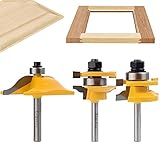


- Occasional doors or a compact router table: Choose a vertical-profile router bit for raised panel work, with a 1/2-inch shank if your router accepts it. It puts less leverage on the router than a broad horizontal cutter, though it still calls for a stable table and controlled feed.
- Frequent cabinet-door production: A horizontal-profile cutter can offer smoother, more consistent handling on large panels when used in a suitably powerful router table. Check the bit’s required speed, table opening, fence clearance, and workpiece support.
- Existing rail-and-stile set: Match the panel bit’s profile and the door system’s intended panel thickness. A visually similar cutter may leave a mismatch at the frame or an incorrect tongue.
- Mostly plywood panels: Prefer a profile and setup that leave a supported, clean edge, and use a back cutter if the panel’s rear needs to sit flush. Plywood veneer can chip, so make test cuts and use a sharp, suitable carbide bit.
Comparison: what the specifications mean in practice
These are common format and sizing ranges, not specifications for a single product. Actual capacities, maximum speeds, and included cutters vary by manufacturer; use the bit maker’s instructions as the authority. Shank size alone does not establish that a router has adequate power or safe capacity.
| Bit format | Common shank | Typical panel stock range | Router-table needs | Best fit |
|---|---|---|---|---|
| Vertical-profile panel bit | 1/2 in.; some models 1/4 in. | About 3/4–1 in. before final thicknessing | Rigid table, insert opening that clears the cutter, fence or guard suited to the bit | Small shops, occasional doors, manageable cutter size |
| Horizontal-profile panel bit | Usually 1/2 in. | Often about 3/4–1 1/4 in.; check the specific cutter | Large, stable table; adequate router power; ample clearance and panel support | Repeated work and larger panels with controlled feed |
| Back cutter paired with panel bit | Often 1/2 in. | Selected to match the panel’s required rear rabbet or tongue | Same stability and clearance checks; setup must match the front profile | Panels that must sit flush in the frame or fit a defined groove |
| Matched rail-and-stile set | Commonly 1/2 in. | Set-dependent; often designed around nominal 3/4-in. door stock | Accurate fence setup, test pieces, and support for long frame parts | Building the whole door rather than shaping panels alone |
Nominal lumber dimensions are not finished dimensions: “3/4-inch” stock may be thinner after milling. Measure the actual panel and frame, then compare them with the cutter’s stated capacity and the groove depth. Do not assume a bit can safely cut every panel within a broad thickness range in one pass.
Profile, material, and edge quality
Profile choice
Ogee and cove profiles are common traditional choices; simpler bevel or contemporary profiles suit cleaner, less ornate doors. A deeper profile removes more material and can look heavy on a narrow panel. Compare the cutter drawing with the actual door proportions, not just its name. For a consistent door series, use the same matched profile family and preserve the same setup between parts.
Carbide and durability
Carbide-tipped cutters are the practical standard for cabinet work. Carbide grade, brazing, grind quality, and cutter geometry all affect service life and finish; “carbide” by itself is not a guarantee of equal performance. In normal use, the cutting edge dulls before the body wears out. Resin and pitch buildup can make a sound bit cut poorly, so clean it with a product intended for router bits and inspect for chipped edges or loose carbide. A damaged bit should be taken out of service, not tested on a door blank.
Hardwood versus plywood
Sharp cutters can produce a clean profile in hardwood, but dense or figured grain may tear out at the panel’s end grain. Plywood is less predictable: veneer thickness, glue lines, and voids can cause edge chipping or expose an unattractive core. A raised panel router bit does not turn plywood into solid wood; use quality, appropriately thick plywood, test the profile on offcuts, and consider solid-wood edging or a different panel design when the exposed edge matters.
Setup steps that prevent costly mistakes
- Verify fit before cutting: Confirm shank diameter, router collet compatibility, cutter diameter, maximum RPM, and table-insert clearance. The shank must be fully seated as directed by the router maker, with no contact between the cutter and insert.
- Mill and measure the panel: Make the panel flat, square, and consistently thick. Check the intended groove and panel allowance against the frame cutters; a panel that is too thin can rattle, while one that is too thick may bind.
- Make a full test setup: Use scrap of the same species and thickness. Adjust height and fence in small increments until the profile and back edge fit the actual door groove. A test joint is cheaper than remaking a panel.
- Use multiple passes where appropriate: Follow the bit manufacturer’s limits and take lighter cuts rather than forcing a heavy cut. Feed steadily, keep hands clear with suitable push blocks, and use featherboards or other workholding that keeps the panel controlled without binding.
- Check the result before production: Inspect the edge for burn marks, fuzz, tear-out, and an even tongue. Burning can indicate a dull or dirty cutter, a feed that is too slow, or an unsuitable speed; tear-out may call for a sharper bit, better support, or a revised cutting sequence.
Which raised panel router bit set is worth buying?
A raised panel router bit set makes sense when you need matching panel, rail, and stile profiles and will build more than one door. Before purchasing, confirm the set’s intended stock thickness, profile drawing, shank size, and whether it includes a back cutter. Sets are not automatically universal: mixing a panel cutter with unrelated frame cutters can produce a poor fit.
If you only need to shape panels for an existing cabinet system, buy the specific panel cutter that matches the frame and panel dimensions rather than paying for an entire set. For occasional work, a quality carbide-tipped bit in a manageable format is usually a better value than a large production cutter your router table cannot safely accommodate. In either case, budget for test stock and routine cleaning; those small costs help preserve edge quality and prevent avoidable damage to expensive door blanks.