Best Router Table Insert Plates: Fit, Flatness & Leveling
What's inside
- What matters most when choosing a router table insert
- Phenolic versus aluminum: which plate stays flatter?
- Leveling systems: four screws versus three points
- Pre-drilled or blank mounting pattern?
- Router table insert rings: the small parts that affect accuracy
- Decision matrix: choose by router, table, and workload
- Installation: a flatness check that prevents most problems
- Ownership realities: what wears first
- Final buying recommendation
- Related Guides
- What matters most when choosing a router table insert
- Phenolic versus aluminum: which plate stays flatter?
- Leveling systems: four screws versus three points
- Pre-drilled or blank mounting pattern?
- Router table insert rings: the small parts that affect accuracy
- Decision matrix: choose by router, table, and workload
- Installation: a flatness check that prevents most problems
- Ownership realities: what wears first
- Final buying recommendation
- Related Guides
As an Amazon Associate I earn from qualifying purchases. This post may contain affiliate links at no extra cost to you.
The best router table insert is a rigid, accurately machined plate with three-point leveling, a mounting pattern that suits your router, and enough thickness to resist sag under the motor’s weight; for most woodworkers, a 9¼-by-11¾-inch phenolic or aluminum plate with replaceable router table insert rings is the best balance of price and performance.
As an Amazon Associate we earn from qualifying purchases at no extra cost to you.


Contents
- What matters most when choosing a router table insert
- Phenolic versus aluminum: which plate stays flatter?
- Leveling systems: four screws versus three points
- Pre-drilled or blank mounting pattern?
- Router table insert rings: the small parts that affect accuracy
- Decision matrix: choose by router, table, and workload
- Installation: a flatness check that prevents most problems
- Ownership realities: what wears first
- Final buying recommendation
- Related Guides
What matters most when choosing a router table insert
A router table insert plate does three jobs: it supports the router, closes the opening around the bit, and provides a flat reference surface for workpieces. A plate can look substantial yet perform poorly if it flexes, sits below the tabletop, or relies on inaccurate leveling screws.
- Flatness: The plate should remain flush with the tabletop. A dip of even 0.5 mm can catch a panel edge during a pass.
- Rigidity: Thick aluminum resists sag particularly well, while good phenolic is lighter, electrically nonconductive, and often less expensive.
- Leveling: Four-corner leveling screws are common, but three-point systems are easier to adjust without rocking.
- Mounting pattern: Pre-drilled plates install faster, but blank plates accommodate more router brands and unusual base patterns.
- Opening and rings: A replaceable ring system lets you match the opening to the cutter, reducing unsupported workpiece edges and dust leakage.
- Insert size: The plate must fit the table opening and leave enough surrounding material to support heavy routers.
Phenolic versus aluminum: which plate stays flatter?
| Plate type | Typical thickness | Typical weight | Leveling behavior | Best use | Typical market range |
|---|---|---|---|---|---|
| Phenolic | 6–9 mm | 1.2–2.2 kg | Stable when fully supported; can flex with large unsupported spans | General routing and portable tables | About $40–$100 |
| Cast or machined aluminum | 8–12 mm | 2.5–4.5 kg | Excellent resistance to sag; threads tolerate repeated adjustment | Heavy routers and frequent production use | About $100–$250 |
| Steel | 3–6 mm | 3–6 kg | Very rigid, but corrosion and surface flatness depend on finish | Specialty or shop-built installations | About $80–$200 |
For a router weighing approximately 4 kg, a well-supported 9 mm phenolic plate is usually adequate. The same plate may show measurable deflection if the opening is oversized, the mounting ledge is narrow, or the router is left attached permanently. Aluminum becomes more attractive when using a 3-horsepower-class router, a lift, or large-diameter cutters that create greater vibration and downward load.
Material alone does not guarantee flatness. A thick plate with a warped mounting surface is worse than a thinner plate that is accurately machined and fully supported. Look for a stated flatness tolerance, a broad perimeter flange, and a table opening that supports the plate continuously rather than at only four small corners.
Leveling systems: four screws versus three points
Most router table insert plates use four leveling screws, one near each corner. This arrangement is familiar and works well when the plate and table opening are accurately made. The drawback is that four independent screws can create a twist: raising one corner may cause the opposite corner to lose contact.
A three-point leveling system establishes a plane without over-constraining it. Two adjusters can sit along one edge and a third can sit opposite them, or the plate can use three broad support points with separate retaining screws. This makes initial setup faster, especially on a homemade table whose opening is not perfectly square.
How much adjustment is enough?
A useful plate should provide roughly 1.5–3 mm of vertical adjustment. More travel is not always better: excessive adjustment can leave too little thread engaged or allow the plate to move under load. Fine-pitch screws are preferable because they make small corrections easier. Locknuts, jam screws, or clamping screws prevent vibration from changing the height during use.
Do not use the leveling screws to compensate for a badly cut table opening. If the plate rocks before adjustment, inspect the ledge for dust, splinters, or inconsistent depth. A thin shim beneath the mounting flange can correct a localized low spot, but a severely uneven opening should be recut or replaced.
Pre-drilled or blank mounting pattern?
A pre-drilled router table plate is the quickest choice when its hole pattern matches your router base. Brands such as JessEm and Woodpeckers sell plates and lift systems with specific mounting solutions, while many generic plates use a selection of common patterns. Confirm the pattern from the actual router base rather than assuming that two routers from the same manufacturer share identical hole spacing.
Pre-drilled plates are especially useful when:
- you want to install the plate without removing the router’s baseplate;
- the manufacturer publishes a precise compatibility list;
- you value repeatable installation and do not own a drill press;
- the plate will be used with a dedicated router lift.
A blank router table insert plate is the safer universal router table insert plate when you change routers, use an older model, or need to mount a router with an unusual base. The trade-off is additional layout work. The holes must be countersunk or counterbored so screw heads sit below the plate, and they must not weaken the perimeter or interfere with leveling hardware.
When drilling a blank plate, use the router’s factory base as a template, not the removable plastic sub-base unless the manufacturer specifies that it is the intended mounting surface. Mark the bit center, verify that the router’s handles and switches remain accessible, and test the screw length with the router removed. Screws that protrude into the motor housing can cause serious damage.
Router table insert rings: the small parts that affect accuracy
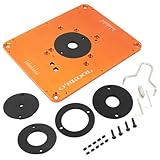
Router table insert rings reduce the opening around the bit. A smaller opening supports the workpiece closer to the cutter, which is valuable when routing narrow stock or using a bearing-guided profile. Rings also reduce the amount of debris that falls into the table opening.
Choose a system with positive retention, such as threaded rings, a locking bayonet, or magnets backed by a mechanical shoulder. A loose magnetic ring can shift if sawdust prevents it from sitting fully down. Rings should be flush with the plate; if a ring sits proud by 0.2–0.3 mm, it can affect a long straight cut.
Keep the opening large enough for the cutter body and any bearing, but not so large that a workpiece corner can drop into it. Never use an insert ring whose opening is smaller than the rotating cutter. Disconnect power before changing rings, and rotate the spindle by hand after installation to confirm clearance.
Decision matrix: choose by router, table, and workload
| Your situation | Recommended choice | Why | What to avoid |
|---|---|---|---|
| Occasional hobby use, compact table | 6–9 mm phenolic plate, pre-drilled pattern | Lower cost and weight; adequate when well supported | Oversized opening or thin unsupported plate |
| One router used frequently | Machined aluminum plate with fine leveling screws | Better thread durability and long-term flatness | Plastic leveling hardware |
| Several routers or an unusual model | Blank aluminum or thick phenolic plate | Allows a custom mounting pattern | Drilling close to the plate edge |
| Heavy 2¼–3¼ horsepower router or lift | 8–12 mm aluminum with broad perimeter support | Improves sag resistance under continuous load | Thin plate supported only at four corners |
| Small-shop table moved often | Phenolic plate with three-point leveling | Lower weight and simpler alignment | Heavy steel plate without a rigid table frame |
Installation: a flatness check that prevents most problems
- Measure the opening. Check length, width, corner radius, and ledge depth. Allow at least 2–3 mm of bearing surface around the plate, preferably more on the sides carrying the router’s weight.
- Clean the ledge. Remove dust, glue, and finish buildup. A single chip under one corner can make the entire plate rock.
- Set the plate loosely. Install the retaining screws and levelers without fully tightening them.
- Establish the reference plane. Lay a reliable straightedge across the tabletop and plate in several directions. Adjust until no edge catches on the plate.
- Lock the adjustment. Tighten retaining screws gradually in a diagonal sequence, checking the straightedge after each round.
- Check the router mounting. Confirm that the router is centered, the bit clears the opening, and the motor does not contact the table beneath.
For a more quantitative check, place a 300 mm straightedge across the joint and use feeler gauges. A gap of 0.1 mm is normally acceptable for general routing; a visible gap or a joint that catches a card indicates that leveling or table support needs attention.
Ownership realities: what wears first
Leveling screw threads and retaining screws usually wear before the plate itself. Repeated overtightening can strip soft aluminum, so use only enough torque to prevent movement. Replace damaged screws rather than forcing them through gritty threads.
Phenolic plates can chip at the central opening if rings are removed with a screwdriver. Use the intended removal holes or a plastic tool. Aluminum plates can develop burrs around mounting holes; remove them with a fine file while keeping the plate surface protected.
Clean the underside periodically. Packed dust can prevent a ring from seating, obstruct router ventilation, and hold the plate above its ledge. Avoid flooding the plate with solvent, particularly around printed scales, plastic rings, and magnetic components. A vacuum, soft brush, and dry cloth are usually sufficient.
Final buying recommendation
Choose a pre-drilled phenolic plate for an occasional-use table and a matching router. Choose a blank plate when compatibility matters more than installation speed. For a heavy router, frequent work, or a lift, spend more on a thick aluminum plate with a broad supported perimeter, fine-pitch leveling screws, and securely retained router table insert rings. Whichever material you select, accurate support and a reliable leveling system matter more than the label on the plate.