Best Table Saws for Cutting Accurate Bevels in Cabinet Parts
What's inside
As an Amazon Associate I earn from qualifying purchases. This post may contain affiliate links at no extra cost to you.
Accurate bevels on cabinet parts depend on more than a saw’s maximum cutting depth. The important factors are a rigid bevel mechanism, a fence that stays square to the table, a flat tabletop, and controls that let you make small adjustments without disturbing the setting. A saw that cuts a 2-by-4 easily can still produce inconsistent cabinet stiles, toe-kick parts, and angled face-frame pieces.
For most cabinet work, a high-quality jobsite saw is the minimum sensible choice, while a contractor or hybrid saw is easier to tune and more stable over long parts. A cabinet saw is the best option if you regularly process sheet goods and hardwoods, but its extra cost and weight are difficult to justify for occasional bevel cuts.
As an Amazon Associate we earn from qualifying purchases at no extra cost to you.


Contents
What Makes a Table Saw Good at Bevels
The blade must tilt smoothly and hold its angle under load. Look for a bevel range of at least 0 to 45 degrees, positive stops at 0 and 45 degrees, and a handwheel or control with little backlash. Some saws provide stops only at those two angles; that is acceptable, but intermediate angles should still be easy to set with a digital angle gauge.
Bevel accuracy is also affected by arbor and trunnion stiffness. If the arbor or blade flange has runout, the cut may vary from tooth to tooth. A practical target is less than 0.005 inch of blade runout. You can check this with a dial indicator or by slowly rotating the blade and watching the gap against a fixed reference.
The table and extension surfaces should be coplanar. A dip or raised edge can lift a cabinet panel as it passes the blade, changing the bevel and creating a tapered cut. On a saw with a small table, support the work with an outfeed table or roller support, but keep the support level with the saw table—not higher.
Best Saw Types for Cabinet Bevels
| Saw type | Best use | Strengths | Limitations |
|---|---|---|---|
| Cabinet saw | Frequent cabinet and furniture work | Rigid trunnions, powerful motor, large table, stable bevel settings | Expensive, heavy, usually requires dedicated space |
| Hybrid saw | Serious home workshops | Good stability and dust collection without the full cost of a cabinet saw | Less portable; fence and table quality vary by model |
| Contractor saw | General shop use and moderate cabinet work | Reasonable capacity, serviceable accuracy, easier to move | More vibration and less rigid bevel hardware than heavier saws |
| Jobsite saw | Small shops, remodeling, occasional parts | Portable, affordable, quick to store | Small table, shorter fence, more sensitive to workpiece support |
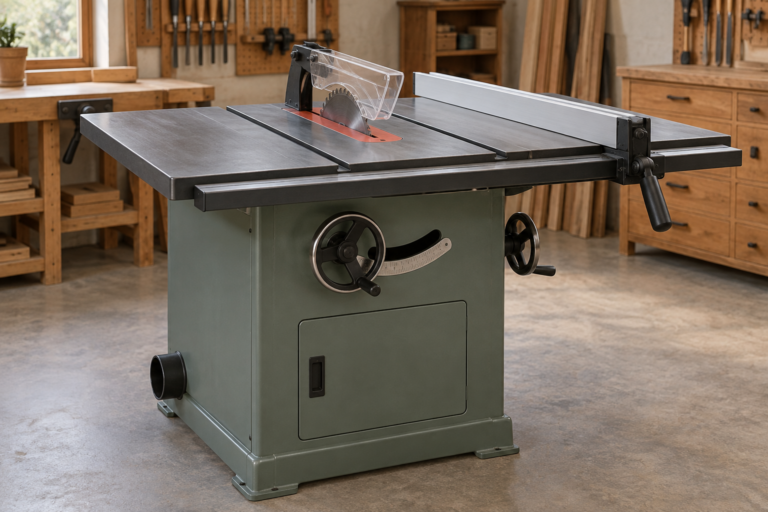
A cabinet table saw is the strongest choice when bevel accuracy matters across many parts. Its heavier cast-iron table and enclosed base reduce vibration, and the trunnions generally hold an angle better when cutting thick hardwood. The trade-off is that moving one can require several people or lifting equipment.
A hybrid table saw is often the sensible middle ground. It can produce cabinet-quality bevels after careful setup, especially when paired with a reliable fence and a good blade. The cheaper option is fine if you build only a few cabinets a year and are willing to check alignment before a critical batch.
A contractor table saw can work well, but inspect the trunnion adjustment and fence before buying. Some lighter designs allow the blade angle to drift when the saw is moved or when a heavy panel presses against the fence. A portable saw is suitable for occasional bevels if you add a flat auxiliary table and support the panel on both sides of the cut.
Fence and Blade Requirements
The fence should lock parallel to the miter slot and remain square to the table. A fence that pivots slightly at the rear can pinch the workpiece against the blade, while one that opens too far can allow the cut to wander. Check parallelism at the front and rear with a steel rule or dial indicator. A difference of roughly 0.003 to 0.005 inch over the fence length is a useful practical target.
Use a sharp, flat-top or alternate-top-bevel combination blade intended for plywood and hardwood. For cabinet panels, a 40- to 60-tooth blade usually gives a cleaner edge than a coarse ripping blade. A dull blade increases feed pressure and can push the workpiece sideways, producing a bevel that is technically set correctly but visibly inconsistent.
For veneered plywood, use a high-quality plywood or combination blade and keep the good face upward when the blade exits on the underside. If tear-out appears on the visible face, test the opposite orientation and use a sacrificial scoring setup or a shallow first pass. Do not solve tear-out by forcing the panel faster through the blade.
Setup Procedure for Accurate Bevels
Before cutting cabinet parts, unplug the saw and check that the blade is parallel to the miter slot. Set the blade about 1/8 to 1/4 inch above the workpiece. Excessive blade height increases tear-out and exposes more carbide without improving accuracy.
Set the bevel with a digital angle gauge referenced against the blade, then verify the setting with a test cut. For a 10-degree bevel, cut a scrap of the same thickness and measure the resulting angle with a bevel gauge. Do not rely solely on the saw’s pointer; a pointer can be off by one or two degrees even when the mechanism is sound.
Mark the test piece so you know which face was against the table and which edge was against the fence. If the angle is wrong, adjust the bevel stop or handwheel and repeat. Once correct, cut two parts and place their beveled faces together. A visible gap at one end indicates either an angle error, a bowed part, or inconsistent feeding.
Common Failure Modes
A bevel that changes from one part to the next usually points to poor support, a loose fence, or a blade that is not fully seated on the arbor. A bevel that is consistent but not the intended angle usually means the stop or pointer needs calibration. A tapered edge often comes from a warped panel or from pushing the workpiece into a fence that is not parallel.
For narrow cabinet parts, use a push block or a properly designed push stick rather than placing your hand near the blade. A featherboard can help maintain contact with the fence, but position it before the blade so it does not press the cut-off against the teeth. Never trap a loose offcut between the blade and fence; use the fence only for the section of the workpiece that remains supported.
If your work is mostly small cabinet components, buy the best-fenced hybrid saw you can fit and spend time calibrating it. If you cut full sheets, thick hardwood, or repeated angled parts every week, the stability of a cabinet saw will save setup time and reduce rejected pieces. For occasional repairs or a compact shop, a jobsite saw is adequate—but only with careful support, test cuts, and frequent checks.