Best Table Saws for Small-Scale Production Woodworking
What's inside
As an Amazon Associate I earn from qualifying purchases. This post may contain affiliate links at no extra cost to you.
Small-scale production woodworking needs more than a saw that can make one accurate cut. The machine must hold alignment through repeated work, accept a reliable fence setup, manage dust, and survive long sessions without becoming difficult to adjust. That usually points toward a stationary contractor, hybrid, or cabinet table saw rather than a lightweight jobsite saw.
The right choice depends on the material, available power, and how often you will repeat the same operation. A hobbyist making ten cabinet parts a month may be well served by a contractor saw. A one-person shop producing furniture components every week will usually benefit from the mass and dust control of a cabinet saw.
As an Amazon Associate we earn from qualifying purchases at no extra cost to you.

Contents
What matters in production use
Fence repeatability is the first priority. A fence that moves 1/32 inch between setups can create visible gaps in cabinet parts and inconsistent joinery. Look for a rigid fence that locks at both ends and can be adjusted without excessive force. The fence should remain parallel to the miter slot and blade after locking.
Table size matters when cutting sheet goods and long boards, but a huge table is not a substitute for outfeed support. For most small shops, a 27- to 30-inch rip capacity is enough for furniture parts and narrow cabinet components. Full 4-by-8-foot sheets are awkward on nearly any table saw; break them down with a track saw or circular saw first.
Power is less important than many buyers assume. A properly aligned 1-3/4 to 2 horsepower saw can rip ordinary hardwood efficiently with a sharp, appropriate blade. A 3-horsepower cabinet saw is a better choice for thick hardwood, wide rips, and repeated production, but it commonly requires 240-volt service. A 120-volt saw is simpler to install, yet may trip a 15-amp circuit during deep cuts or when the blade is dull.
Best table saw categories for a small shop
| Category | Typical strength | Main drawback | Best fit |
|---|---|---|---|
| Contractor saw | Good accuracy, moderate price, often 120-volt | More exposed dust and less mass | Part-time production and small furniture work |
| Hybrid saw | Enclosed base, better dust collection, solid table | Usually heavier and less portable | Dedicated home or small professional shop |
| Cabinet saw | Maximum stability, power, and dust control | Higher price and often 240-volt wiring | Frequent hardwood and cabinet production |
| Jobsite saw | Low cost and easy storage | Smaller table and less refined fence system | Occasional work or mobile installation jobs |
A contractor table saw is often the sensible starting point. The cheaper option is fine when production means a few dozen parts at a time, the stock is mostly under 1-1/2 inches thick, and you can provide a sturdy outfeed table. Do not confuse a contractor saw with a compact jobsite saw: the larger cast-iron or steel working surface and better fence are valuable when dimensions must repeat.
A hybrid table saw sits between the two major options. Its enclosed cabinet improves dust collection and reduces noise compared with an open contractor design. It is generally heavy enough to stay put while ripping, but it may still use a 120-volt motor. For a garage shop that produces boxes, doors, shelving, or furniture parts every week, this is often the best balance.
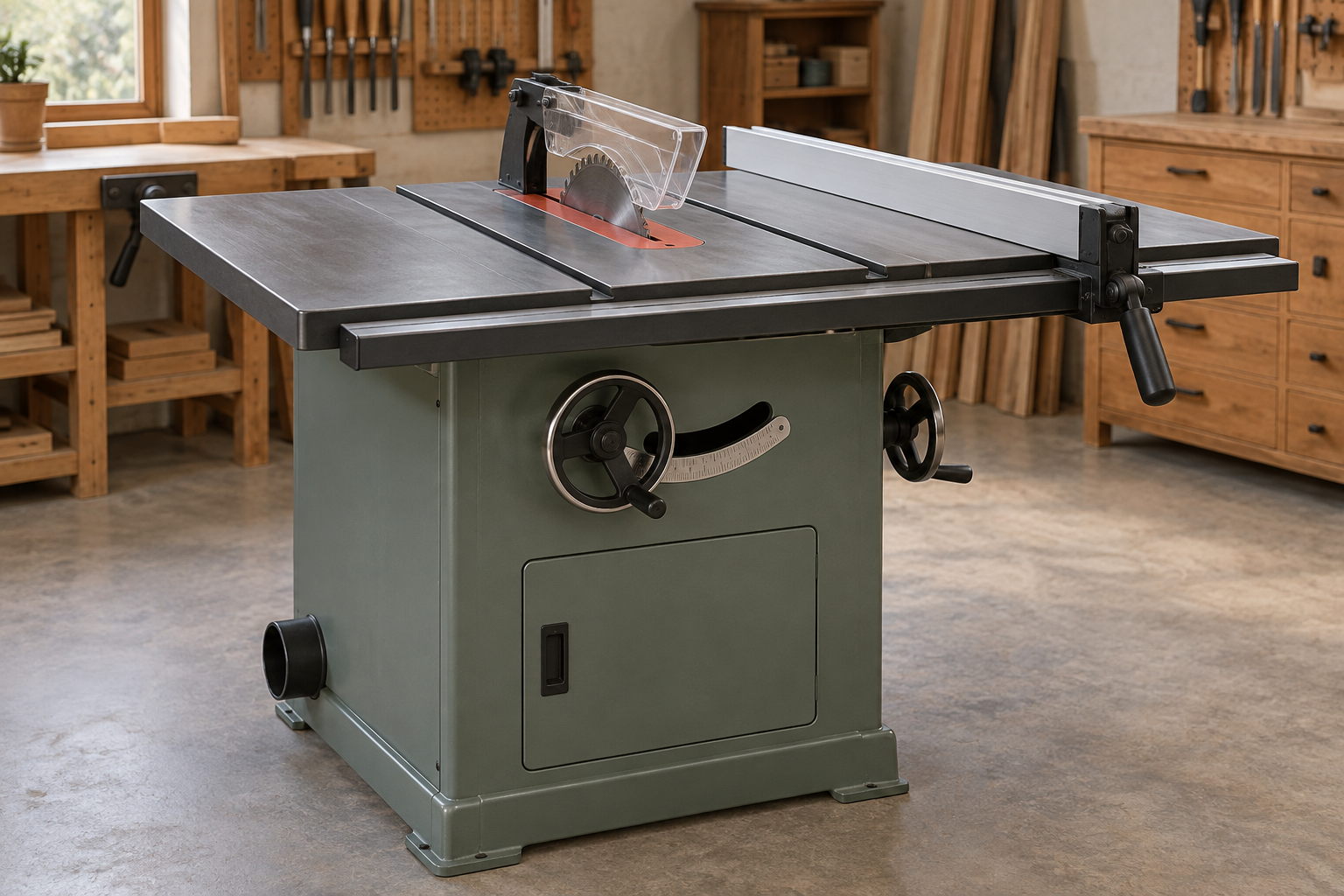
Choose a cabinet table saw when the saw will run for hours, the material is frequently hard maple, oak, or walnut, or the cost of a ruined batch is significant. The extra mass reduces vibration, and the enclosed cabinet works better with a suitable dust collector. The trade-off is not just purchase price: budget for 240-volt wiring, a 4-inch dust hose, and enough floor space to safely feed and receive stock.
Blade, fence, and dust collection
Plan to own more than one blade. A 40-tooth combination blade handles general crosscuts and rips, while a dedicated 24-tooth ripping blade feeds faster through thick solid wood. Use a high-tooth-count blade for clean plywood and veneered panels. A dull blade increases burning, motor load, and kickback risk; dark burn marks on a normally easy cut are a maintenance warning, not a reason to push harder.
A riving knife is essential for production work because it follows blade height changes and helps prevent the kerf from closing onto the blade. Keep the knife aligned with the blade and use a proper push stick or push block once your hands approach the danger zone. The most common failure is removing the riving knife or guard for convenience, then allowing a twisted board to pinch the blade.
Dust collection is another dividing line between cheap and useful machines. A small shop vacuum may capture dust from a compact saw, but an enclosed hybrid or cabinet saw works best with a 1-1/2 to 2 horsepower dust collector and a 4-inch hose. Poor collection leaves fine dust in the cabinet, on the motor, and in the air. A dust port alone does not guarantee good extraction; leaks around the blade opening and cabinet seams can dominate the result.
Setup and buying checklist
Before judging a saw, place it on a level floor and verify the blade is parallel to the miter slot. Check the fence at the front and rear of the blade; a slight intentional toe-out at the back is safer than a fence that pinches the work against the blade. Confirm that the blade reaches at least 3-1/8 inches at 90 degrees if you expect to cut standard 2-by lumber, though most furniture work does not require that depth.
Leave at least 8 feet of clear feed and outfeed space when possible. If the shop is shorter, use folding supports, but make sure they are level with the saw table. A low outfeed stand can lift a board into the blade; a high one can stop it halfway through a cut.
Finally, prioritize a straight table, dependable fence, riving knife, and serviceable parts over electronic features. A cheaper stationary saw is a good buy when it can be aligned, supported, and connected to dust collection properly. Spend more when the machine will run daily, when downtime costs money, or when you need thick hardwood cuts to remain consistent from the first part to the last.