Best Planers for Producing Uniform Drawer Box Parts
What's inside
As an Amazon Associate I earn from qualifying purchases. This post may contain affiliate links at no extra cost to you.
Uniform drawer box parts come from controlled thickness, consistent width, and repeatable setup—not from buying the biggest planer in the store. A thickness planer is the right machine for bringing drawer sides, fronts, backs, and bottoms to a common thickness after the boards have been jointed flat on one face. It does not replace a jointer, and it cannot correct a board that rocks or bows unless one face is stabilized first.
Contents
What Makes a Planer Suitable for Drawer Parts
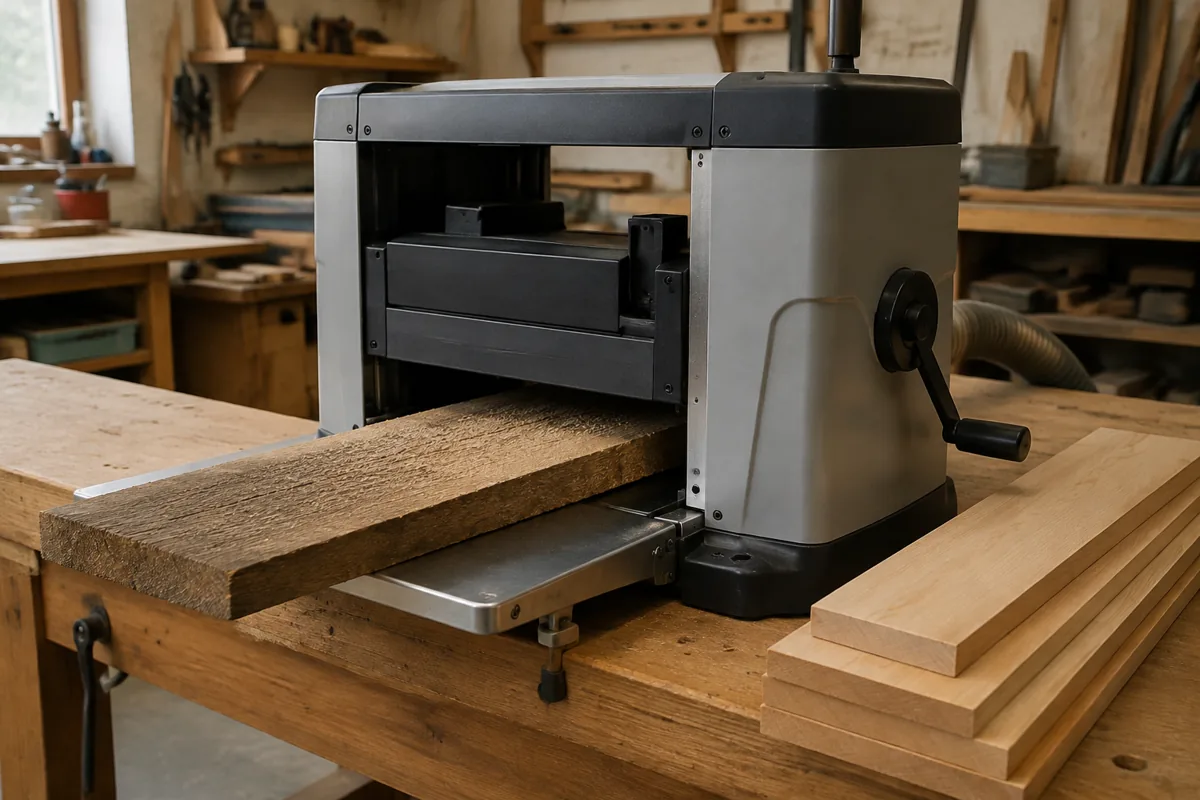
For most cabinet shops and serious home workshops, a 12-1/2-inch or 13-inch portable planer is the practical starting point. It can handle typical drawer-side stock and is small enough to store under a bench. A 15-inch stationary planer is a better choice when you regularly process wide hardwood panels, run many drawers at once, or want a heavier feed system.
Look for four characteristics. First, the cutterhead must leave a clean surface at the feed rate you intend to use. Second, the infeed and outfeed tables need to support short parts without excessive snipe. Third, the depth adjustment should be repeatable. Finally, the machine should have enough power to maintain feed speed in dense hardwood without stalling or leaving washboard marks.
A 12.5-inch thickness planer is usually the best value for a one-person shop. You can spend more on a heavier machine, but a cheaper planer is perfectly adequate if you are making a few drawer sets at a time and are willing to make lighter cuts.
Planer Types Compared
| Planer type | Best use | Main advantages | Main drawbacks |
|---|---|---|---|
| Portable 12-1/2 to 13 inch | Occasional and small-batch drawer work | Low cost, compact, widely available knives | More snipe, louder operation, lighter feed mechanism |
| Benchtop helical-head planer | Frequent hardwood processing | Quieter cuts, better finish, replaceable inserts | Higher purchase price; inserts still need adjustment |
| 15-inch stationary planer | Production cabinet work and wide stock | Rigid tables, stronger feed rollers, better consistency | Cost, floor space, dust collection requirements |
| Handheld electric planer | Bevels, edge work, and rough correction | Portable and useful for localized removal | Not suitable for uniform drawer-part thickness |
Straight-Knife or Helical Cutterhead
Straight knives are the economical choice. They cut quickly and produce a good surface when sharp and correctly aligned. Replacement knives are inexpensive, but a nick from a nail or a patch of mineral streak can leave a visible line across every subsequent part until the knife is replaced or repositioned.
Helical or spiral cutterheads use many small carbide inserts. They generally run quieter, handle abrasive woods better, and make small damaged areas less noticeable because only a few inserts are affected. They are attractive for drawer production, where repeated sanding can erase crisp edges. However, they cost more initially, and a helical head does not cure poor technique, excessive depth of cut, or badly supported stock.
If you already own a straight-knife planer, upgrading the cutterhead can make sense. If you are buying new, compare the complete cost: machine, replacement knives or inserts, dust collection, and mobile base. A benchtop helical-cutterhead planer is worth considering when you process a lot of oak, maple, or figured stock. For occasional pine, poplar, or plywood parts, the cheaper straight-knife version is often enough.
How to Plane Drawer Box Parts
Start with rough boards longer and wider than the finished parts. Joint one face flat, then plane the opposite face parallel. If you do not have a jointer, use a planer sled to support cupped or twisted boards; feeding a rocking board directly through the planer only copies the problem from one face to the other.
Plane all matching parts in the same setup. For example, if the drawer sides must finish at 1/2 inch, plane several boards to about 9/16 inch, then make light finishing passes until they reach the final dimension. Measure with calipers at both ends and in the middle. A difference of 0.010 inch may not matter on one drawer, but it becomes obvious when several drawers are installed beside each other.
Remove no more than 1/16 inch per pass in ordinary hardwood, and use 1/32 inch or less for the final pass. Feed long stock whenever possible. Short drawer parts are more likely to show snipe because the rollers lose full control near the beginning and end of the cut. Leave parts 2 to 4 inches long, then cut them to final length after planing.
Common Planer Problems
Snipe: The first or last few inches are thinner than the rest. Support the board level with the planer tables, keep the cutterhead locked if the machine provides a lock, and feed the next board immediately behind the first. Cutting parts oversized and trimming afterward is the most reliable solution.
Uneven thickness: Check that the knives or inserts are seated correctly, the bed is clean, and the feed rollers are not packed with dust. Also verify that the board is not twisting as it enters.
Tear-out: Reduce the depth of cut and feed the board with the grain when possible. Figured hardwood may still require a light final pass, scraping, or sanding.
Washboard surface: This usually indicates vibration, dull knives, dirty rollers, or a feed-rate problem. Tighten the machine to a stable stand and connect adequate dust collection. Chips trapped between the board and bed can change the cut by several thousandths of an inch.
Which Planer Should You Buy?
Choose a portable 12-1/2-inch planer if you make drawers for personal projects, have limited space, and can accept a little trimming and sanding. Choose a helical-head machine if surface quality, noise, and reduced knife maintenance matter more than the lowest price. Move to a 15-inch stationary planer when production volume, wide material, and repeatability justify the space and electrical requirements.
For the cleanest drawer parts, spend as much attention on stock preparation, measuring, and support as on the machine itself. A modest planer making 1/32-inch finishing passes will outperform an expensive planer fed warped boards or unsupported short pieces.