Thickness Planer Buying Guide
Key takeaways
- A criteria-led look at what separates a good thickness planer from a frustrating one, from bed flatness and cutterhead locks to feed rollers, dust extraction and long-term knife costs.
What's inside
As an Amazon Associate I earn from qualifying purchases. This post may contain affiliate links at no extra cost to you.
Most thickness planer purchases go wrong at the spec sheet. Width and amp draw are the easiest numbers to compare, so those are the numbers buyers compare, and then the machine arrives and puts a shallow trench across the last two inches of every board. This thickness planer buying guide is built around the parts that actually decide surface quality: bed flatness, table alignment, how firmly the cutterhead is restrained, how the feed rollers grip, and how much of the chip load ends up on the floor.
The second point worth making early is that a planer has a consumable. Knives dull, they get nicked by grit hiding in reclaimed stock, and eventually they need replacing or resharpening. Over five years that recurring cost can outweigh the price gap between two machines that looked interchangeable on the shelf, so we weight it heavily.
As an Amazon Associate we earn from qualifying purchases at no extra cost to you. Product prices and availability are accurate as of the date shown and are subject to change.




| Class | Typical width | Suits | Main compromise |
|---|---|---|---|
| Compact benchtop | 12 in to 12-1/2 in | Occasional hardwood, tight shops | Lighter build, single feed speed |
| Two-speed benchtop | 13 in | Most furniture work | Noise and chip volume indoors |
| Benchtop, segmented head | 13 in | Figured stock, shared walls | Higher entry cost |
| Floor-standing | 15 in | Cabinet shops, wide glue-ups | Footprint, often 220V |
| Wide industrial | 20 in and up | Production, thick slabs | Price, power, moving it |
What This Thickness Planer Buying Guide Judges
We judge planers the way we judge a table saw: by the systems that hold parts in position under load.
Bed and table flatness
Lay a straightedge diagonally across the main bed, then along both long edges. A hollow in the middle or a twist between opposite corners transfers into your stock as thickness variation that sanding will not fix. Cast iron holds its shape better than formed steel over a decade. Extension tables should be adjustable, and they belong a hair proud of the bed rather than level with it.
Cutterhead restraint
Snipe is mostly a story about a cutterhead that moves. Four-post carriages with a positive head lock, meaning a cam or lever that clamps the assembly before you feed a board, hold position far better than two-post columns relying on gib pressure alone. If a machine has no lock and no way to retrofit one, plan on fighting snipe with technique forever.
Feed rollers and drive
Rubber rollers grip well and mark less. Serrated steel bites harder into rough sawn lumber but can leave impressions that force another pass. Either way, look for spring-loaded rollers with enough travel to swallow a board that changes thickness end to end, plus a chain or gear drive rather than one narrow belt doing all the work.
Feed speeds and the depth limiter
Two speeds earn their keep: fast for dimensioning rough lumber, slow for the final pass, where cuts per inch decide how much sanding you owe later. A mechanical depth-of-cut limiter that blocks an overly greedy bite protects the motor, the knives, and any figured board.
Dust port and vibration
A planer makes more waste per minute than anything else in a small shop. A 4-inch port with a short, straight path off the cutterhead is the baseline, and a hood that throws chips along the rotation instead of into a dead corner is better. For vibration, watch whether the machine walks at idle. Mass, rubber feet, and a balanced head matter more than extra horsepower.
13-inch two-speed benchtop planers
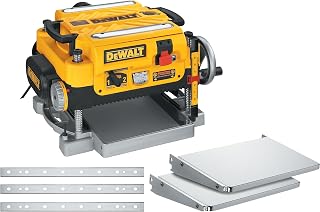
This is the class most furniture makers should shop first: enough width for typical glue-ups, a second feed speed for finish passes, and a four-post carriage. Confirm a head lock and a 4-inch port before comparing anything else, and add a spare knife set to the cart.
Benchtop or Floor-Standing?
A 13-inch benchtop machine covers most furniture and cabinet work, since anything wider is usually a panel you can surface in pieces before glue-up. Universal motors in this class are shrill, but they are light enough to lift onto a stand and happy on a 15-amp circuit. DeWalt, Makita, and Ridgid all field credible benchtop planers, and the real differences are head lock design, table adjustment, and how painless a knife change is.
A 15-inch floor-standing planer buys an induction motor, belt drive, cast iron where it counts, sealed bearings, a proper dust hood, and a sound closer to a fan than a scream. It also wants a 220-volt circuit, a mobile base, and room to feed 8-foot boards. Plane hardwood most weekends and that trade makes sense. Plane a few boards a month and the benchtop is the honest answer.
Straight Knives or a Segmented Helical Head?
Straight knife heads use two or three disposable double-edged blades spanning the full width. Sharp, they cut cleanly, cost little, and swap in about fifteen minutes. Their weakness is exposure: one nick from grit or a hidden staple leaves a raised line down every board you run afterward.
Segmented helical heads carry rows of small square carbide inserts set in a spiral. The cut is quieter and closer to a shear than a chop, which is much kinder to curly and quartersawn material. When an insert dulls you loosen one screw and rotate it ninety degrees. Many machines can be retrofitted, so price that before replacing an otherwise sound planer.
- ✔ Quieter shear-style cut with far less tearout in figured stock
- ✔ Rotate single inserts instead of buying full knife sets
- ✔ A nicked insert marks one narrow strip, not the whole width
- ✘ Higher cost up front, bought new or retrofitted
- ✘ Prefers shallower passes and slower feed on wide hardwood
- ✘ Insert screws need a torque driver and patience
Segmented helical cutterhead planers
Worth the premium if you work figured hardwood, share a wall with neighbors, or dislike knife changes. Check insert count and replacement insert availability for that head pattern, because odd sizes get expensive later.
Snipe, Dust, and the Support You Have to Build
No planer arrives snipe-free. Set the extension tables slightly high, support long stock with roller stands at bed height or a touch above, lift gently on the trailing end as a board enters and the leading end as it exits, and save a light final pass. Feeding boards nose to tail so the rollers are never empty is the oldest fix and still the best.
Remember that a planer flattens nothing. It makes the second face parallel to the first, so a twisted board comes out thinner and still twisted. Joint one face first or build a shimmed planer sled, a Saturday project that postpones the jointer purchase.
On dust, a shop vacuum is the wrong tool. Planer chips are bulky and light, so they want volume rather than suction: a dust collector moving several hundred CFM through a short, straight 4-inch line. Skip it and chips pack around the cutterhead, get pressed into the board by the outfeed roller, and dimple the surface you just cut.
4-inch dust collection hose and fitting kits
Order hose, clamps, and a blast gate with the machine. Most complaints we read about dimpled surfaces and clogged hoods trace back to an undersized or overly long duct run rather than the planer.
Frequently Asked Questions
Do I still need a jointer? Eventually, if you buy rough lumber often. Until then a planer sled plus a table saw or track saw will flatten one face and straighten one edge well enough for furniture. Few shops regret buying the planer first.
How short a board can I plane? Check the manual, but 12 inches is a common minimum, because the workpiece must reach the outfeed roller before it leaves the infeed roller. Plane short parts as one long blank, then cut to length.
Is a wider machine always better? No. Unused width costs money, floor space, and knives or inserts across the full span. A 13-inch planer with a solid head lock, flat bed, and real extraction gives better surfaces than a wide machine with sloppy carriage tolerances.
The Verdict
Rank the criteria in this order and the shortlist writes itself: positive cutterhead lock, flat and stable bed, genuine 4-inch extraction, two feed speeds, then head type, then width. For most readers that means a 13-inch two-speed benchtop machine, ideally one with a helical head available now or as a retrofit later. Buy spare knives or inserts up front, build the stands and the sled the same weekend, and the planer stops being the tool that ruins boards late in a project.
Check prices on Amazon →