Table Saw vs Miter Saw for Cutting Long Furniture Components
What's inside
As an Amazon Associate I earn from qualifying purchases. This post may contain affiliate links at no extra cost to you.
For long furniture components, the choice between a table saw and a miter saw depends less on the length of the board than on the cut you need. A table saw excels at ripping: cutting lengthwise with the grain, producing straight, repeatable widths. A miter saw excels at crosscutting: cutting boards to length, usually with square, mitered, or beveled ends.
That distinction matters when working with table legs, rails, stiles, aprons, shelves, stretchers, and long molding. A long board can be cut on either machine, but one may be much safer and more accurate for the job. The wrong setup can produce wandering cuts, damaged edges, or a board that twists unexpectedly during the cut.
As an Amazon Associate we earn from qualifying purchases at no extra cost to you.


Contents
What Each Saw Does Best
A table saw is the better choice when the finished component needs a precise width. For example, ripping a 6-foot board into 3-inch-wide rails is straightforward, provided the board is supported before and after the blade. The fence controls the width, and the blade leaves a continuous cut along the entire length.
A miter saw is faster for cutting a group of components to identical lengths. It is particularly useful for crosscutting 2-by-4-sized stock, cabinet stiles, furniture rails, and long trim. A stop block lets you cut multiple pieces without measuring each one individually.
The limitation is that a standard miter saw only cuts across the board’s width. Its maximum capacity is commonly around 6 to 12 inches at 90 degrees, depending on the blade size and saw design. A sliding model can crosscut wider stock, but its capacity decreases for steep miters and bevels.
| Task | Better machine | Why | Main limitation |
|---|---|---|---|
| Ripping a long board to width | Table saw | Fence provides continuous width control | Long stock needs infeed and outfeed support |
| Cutting many rails to equal length | Miter saw | Stop block makes repeated cuts fast | Cannot rip the component narrower |
| Cutting long, wide panels | Track-guided circular saw or panel saw | Panel is supported while the saw travels through it | Not the main strength of either machine |
| Compound angles on long trim | Sliding compound miter saw | Handles bevels and miters with a fixed workpiece | Capacity and accuracy vary with setup |
Using a Table Saw on Long Components
For long furniture parts, table-saw support is not optional. If the board drops off the back of the saw, its weight can lift the stock against the blade or pull it away from the fence. Both conditions can cause burning, a crooked cut, or kickback.
The support surface should be close to the height of the saw table. A roller stand set too high can push the board into the fence; one set too low lets the board sag. For a 6- to 8-foot board, use support at the infeed and outfeed ends, and add side support if the piece is wide or difficult to balance.
Use the table saw’s rip fence for ripping, but do not use the fence as a length stop for crosscutting. A trapped offcut can bind between the blade and fence. For crosscuts, use a crosscut sled, miter gauge, or a dedicated stop system that keeps the offcut from being captured.
A table saw outfeed roller stand is a reasonable low-cost purchase for occasional long stock. It is not as stable as a full outfeed table, but it is better than trying to catch a falling board by hand. Keep both hands controlling the workpiece and use a push stick once your hand approaches the blade.
Using a Miter Saw on Long Components
A miter saw is usually safer and more convenient when the component is already close to its final width. Support the stock on both sides of the saw with a flat bench, auxiliary table, or properly adjusted stands. The support must be level with the saw bed; even a small height difference can tip a long board as the blade exits.
For repeated furniture parts, install a stop block on the support side rather than clamping a stop directly beside the blade. On a sliding miter saw, an enclosed stop or a stop that ends before the blade path helps prevent the cutoff from becoming trapped between the fence and blade.
Cut the longest parts first when possible. This preserves options if a measurement is wrong or the board contains a defect. Mark the waste side of every cut, and place the better-looking face consistently against the fence or table. A miter saw can produce a clean cut while still allowing a board to shift slightly, so a sharp blade and firm clamping are useful for narrow or warped pieces.
If you regularly cut long molding or wide trim, a 12-inch sliding compound miter saw offers more crosscut capacity than a compact saw. It also costs more, takes more bench space, and may require a longer support system. Do not buy the larger saw solely because the workpieces are long; length is handled by supports, not by a larger blade.
When the Cheaper Option Is Enough
If your furniture parts are already dimensioned and you mainly need square cuts to length, a basic 10-inch miter saw can be enough. A sturdy pair of stands, a straight auxiliary fence, and a stop block often matter more than extra motor power. For occasional shelves or rails, paying for a large sliding saw may not improve the result.
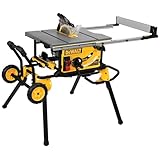
Conversely, a table saw is the cheaper and more versatile choice if you need to rip boards, trim solid-wood edges, cut tapers with a jig, and make repeatable strips. A compact jobsite table saw can handle long components, but its small table makes support and alignment more important. A full-size cabinet saw is more stable, quieter, and more powerful, but it needs a permanent location and appropriate dust collection.
Long Panels and Awkward Stock
Neither saw is ideal for cutting a full sheet of plywood or a long, flexible panel on the machine table. A large panel can sag, catch, or shift before the cut is complete. For this work, a track-guided circular saw kit is often the better first purchase. Support the sheet on rigid foam or a cutting platform, clamp the guide, and let the saw travel through the material.
For rough, bowed, or highly twisted boards, straighten one edge before relying on a table-saw fence. A jointer, planer sled, or straightedge-guided first cut may be necessary. Never force a warped board against the fence and assume the blade will correct it. The board can spring back as soon as the pressure is released.
A Practical Buying Decision
Choose a table saw first if your projects involve ripping furniture stock to width or making many narrow, parallel parts. Choose a miter saw first if your work consists mostly of cutting purchased boards to length, building frames, or making repeated angled cuts. If you build cabinets or furniture from sheet goods, consider support equipment or a track-guided saw before choosing either machine solely for length.
Whichever saw you buy, budget for support, dust collection, sharp blades, and a safe work area. Those accessories determine whether a long component stays controlled through the cut. The machine makes the cut; the setup determines whether the cut is accurate and safe.