Best Planers for Processing Wide Solid-Wood Shelves
What's inside
As an Amazon Associate I earn from qualifying purchases. This post may contain affiliate links at no extra cost to you.
Wide solid-wood shelves are a demanding job for a thickness planer. A shelf that is 12 to 16 inches wide and 6 feet long puts more load on the cutterhead, feed rollers, and bed than ordinary cabinet parts. The right planer will do the work accurately, but only if its capacity matches the stock and you control moisture, grain direction, support, and cut depth.
As an Amazon Associate we earn from qualifying purchases at no extra cost to you.


Contents
What to Look For in a Planer
Start with width capacity. A 12-1/2-inch planer can process boards up to roughly 12 inches wide, but that is a maximum, not a comfortable working size. If your shelves are 11-3/4 inches wide, the machine may work well. If they are 12 inches exactly, any slight bow, irregular edge, or misalignment can cause trouble. For regular work on wide shelves, a 15-inch planer gives useful clearance.
Thickness capacity matters less than width for this project, but it still affects usability. Most portable planers accept stock from about 1/8 inch to 6 inches thick. A stationary 15-inch machine commonly handles thicker material, though the exact range varies. Check the specifications before buying, especially if you are processing thick slab-like shelves.
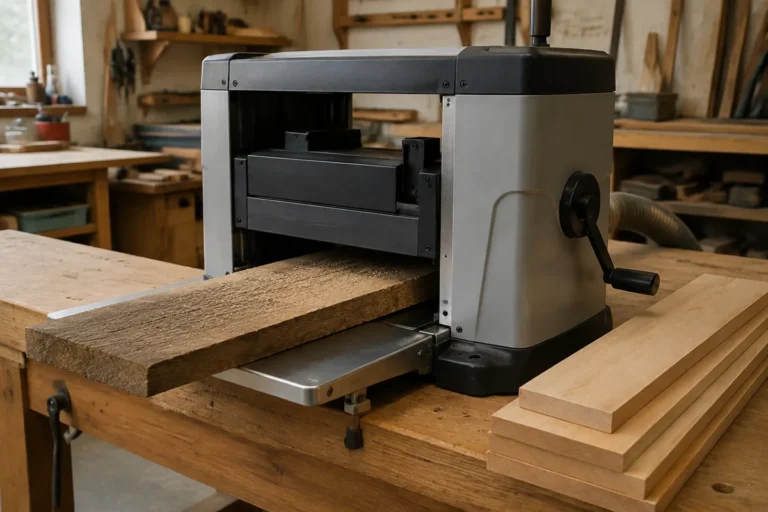
Look for a cast-iron bed or a rigid steel bed with reliable extensions. Long shelves need support on both sides of the machine. Without it, the board can tip as it enters or exits, causing a tapered cut, torn corners, or severe snipe. A planer with a short bed can still work, but you will need sturdy infeed and outfeed tables positioned at the same height as the planer bed.
For a practical starting point, compare 15-inch woodworking planers if you routinely make shelves wider than 12 inches. A 12-1/2-inch thickness planer is the cheaper and more portable choice when your finished shelves remain below its actual capacity.
Which Planer Type Makes Sense?
| Planer type | Typical capacity | Best use | Main drawback |
|---|---|---|---|
| Portable benchtop | 12 to 13 inches wide | Occasional shelves and small shops | More noise, vibration, and snipe |
| Portable 15-inch | 15 inches wide | Frequent wide-board work with limited space | Still needs careful support and dust collection |
| Stationary floor planer | 15 to 20 inches or more | Regular production and heavy hardwood | Higher price, weight, and electrical demands |
| Spiral or helical cutterhead | Available in several sizes | figured grain and quieter cutting | Higher initial cost and insert maintenance |
A portable benchtop planer is fine for a few pine, poplar, or soft maple shelves. It becomes less attractive with dense hardwood, wide glue-ups, or long production runs. The lighter frame can move under load, and many models have feed rollers that struggle when the board is heavy or slightly cupped.
A stationary 15-inch planer is usually the best balance for a serious home shop. It has more stable tables, stronger feed rollers, and better chip removal. It also takes up substantially more room. Measure the machine with its tables and dust hose attached, not just the footprint listed in the catalog.
A spiral or helical cutterhead is particularly useful when shelves contain reversing grain, curly maple, oak with interlocked grain, or other difficult areas. It reduces tear-out and usually produces a less harsh cutting sound. It does not eliminate the need for a sharp cutter or sensible feed direction, and it costs more than a straight-knife head.
How to Process Wide Shelves
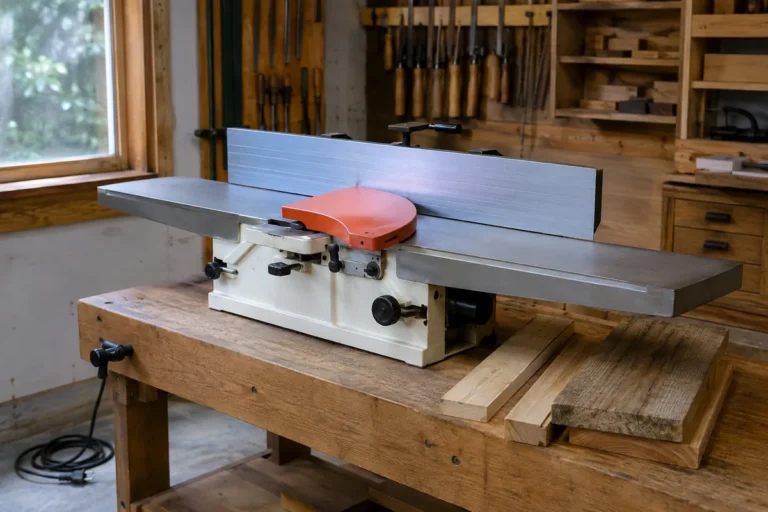
A thickness planer makes both faces parallel; it does not reliably flatten a badly twisted board. Flatten one face first with a jointer, router sled, or other controlled method. Then run that face against the planer bed. If you send a twisted board directly through the machine, the rollers can press it flat temporarily, and the planer will reproduce the twist when it exits.
For glued-up shelves, flatten the panel after glue cures fully. Scrape or sand away dried squeeze-out before planing. Glue ridges can damage knives, and a raised ridge can make the panel rock on the bed. If the panel is wider than the planer, do not try to force it through at an angle. That produces uneven thickness and can be unsafe.
Take light cuts. Removing 1/32 inch per pass is a sensible starting point for wide hardwood shelves. On a portable planer, 1/64 inch may produce a better finish and reduce motor strain. Reserve deeper cuts—around 1/16 inch—for softwood or rough stock when the machine’s manual permits it. Feed slowly enough to avoid bogging, but do not stop the board beneath the cutterhead.
Plane both sides in alternating passes rather than removing all the material from one face. This keeps stresses more balanced and reduces the chance that the panel will cup after processing. Leave approximately 1/16 inch for final sanding if the shelf must meet a precise thickness.
Snipe, Tear-Out, and Dust Control
Snipe is a deeper cut at the first or last few inches of a board. Long infeed and outfeed supports help, as does lifting the free end slightly until the board is fully engaged. On the exit, support the board without pushing it upward. Many machines also benefit from sacrificing a short piece of scrap before and after the shelf, though this wastes material.
Reduce tear-out by identifying the grain direction and feeding the shelf so the cutterhead cuts with the grain where possible. On a board with changing grain, use shallow passes and a sharp knife or insert. A final pass of only 1/64 inch can improve the surface, but plan to sand rather than expecting planer marks to disappear on their own.
Dust collection is not optional for wide shelves. A planer can produce a large volume of chips in seconds. Use a collector with adequate airflow, keep the hose as short and straight as practical, and stop immediately if the chip chute plugs. Packed chips can lift the board, mark the surface, and overheat the machine.
A Practical Buying Decision
Choose a 12-1/2-inch portable planer if your shelves are narrower than 12 inches, your workload is occasional, and storage space matters more than speed. Pay for a 15-inch stationary machine if you regularly process 12- to 15-inch shelves, use dense hardwood, or need repeatable thickness over many panels. If your material routinely exceeds 15 inches, buy a wider planer or change the workflow; trying to make a narrow machine handle oversized stock is not a reliable shortcut.
Before purchasing, confirm the machine’s actual maximum width, minimum and maximum thickness, motor requirements, dust-port size, replacement knife or insert cost, and availability of service parts. A cheaper planer is perfectly adequate when the stock is within capacity and you only build a few shelves a year. For frequent wide solid-wood work, rigidity, support, cutterhead quality, and dust handling are worth more than a low purchase price.