
Key takeaways
- Compare the best marking gauges for mortise and tenon layout: a self-centering center gauge, micro-adjust wheel gauges and budget sets, with full specs.
What's inside
As an Amazon Associate I earn from qualifying purchases. This post may contain affiliate links at no extra cost to you.
- Top Pick: Woodpeckers MT Center Gauge Deluxe Set
- Runner-up: Taytools 464763 Solid Brass Wheel Marking Gauge
- Also consider: Taytools 465494 Wheel Marking Gauge
The best marking gauge for mortise and tenon work is the one that scribes both sides of a joint from the same reference face, every time, without measuring twice. For centered joints, the Woodpeckers MT Center Gauge Deluxe Set removes the math entirely with self-centering arms and quick-change marking bars. For shoulder lines and tenon cheeks, a brass wheel gauge such as the Taytools 464763 gives a knife-clean line that a saw or chisel can follow exactly.
A mortise and tenon joint fails at the layout stage more often than at the cutting stage. If the mortise walls and tenon cheeks are scribed from the same setting and the same face side, the parts register against each other even when the nominal dimension drifts slightly. The five gauges below cover that job at premium, mid-range, and budget tiers: one dedicated centering gauge, three wheel gauges for shoulder and cheek lines, and one dual-purpose scriber for shops that also mark arcs and curves.
As an Amazon Associate, we earn from qualifying purchases.
Contents
Table of Contents
- 1. Woodpeckers MT Center Gauge Deluxe Set
- 2. Taytools 464763 Solid Brass Wheel Marking Gauge
- 3. Taytools 465494 Wheel Marking Gauge
- 4. VISLONE Wheel Marking Gauge 180mm
- 5. Red Oak Tools Wheel Marking Gauge Set
- How to Choose a Marking Gauge for Mortise and Tenon Work
- FAQ
- Conclusion
1. Woodpeckers MT Center Gauge Deluxe Set
Most mortise layout errors are centering errors: the mortise ends up slightly off the middle of the stock, so the tenon shoulders sit unevenly. The MT Center Gauge attacks that problem directly. Its parallelogram arms ride both faces of the workpiece and keep the marking bar centered on the stock automatically, so the scribed lines land in the middle of the edge without any measuring, splitting differences, or test marks. Swap the bar, and the same setting marks the matching tenon piece.
The Deluxe Set is the complete version of the system. It includes the four fractional inch bars used for common furniture stock sizes and adds five metric bars, which matters if a project mixes dimensioned lumber with metric-sized loose tenons or hardware. Bars change quickly, so one gauge covers a full run of rails, stiles, and legs in a single setup session. This is the premium pick of the group, and the right one for woodworkers who cut mortise and tenon joints regularly and want the layout step to be nearly automatic.
Specs:
- Part number MTCGSS-DEL-24
- Self-centering parallelogram arms keep the marking bar centered on the stock
- Arms accommodate stock up to 2 inches thick
- Quick-change stainless steel marking bars
- Inch bars: 1/4, 3/8, 7/16, and 1/2 inch
- Metric bars: 4, 5, 6, 8, and 10 mm
- Made in the USA in Strongsville, Ohio
2. Taytools 464763 Solid Brass Wheel Marking Gauge
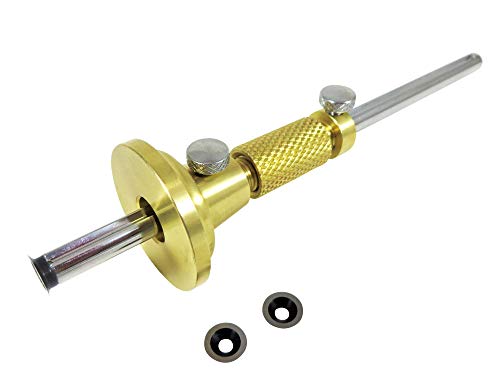
Where the Woodpeckers gauge centers a joint, the Taytools 464763 is built for dialing in a single line with unusual precision. Its solid brass head carries a lockable micro-adjust mechanism: set the fence close, lock the tension, then creep the cutter to the exact shoulder line with the knurled knob. That fine control is what tenon shoulders and dovetail baselines demand, where a line a hair too deep shows up as a visible gap after glue-up.
The beam is grooved along its length so the head cannot rotate while it is being adjusted, which removes a common source of drift on smooth-beam gauges. The hardened round cutter retracts into a countersink in the head when the tool is put away, protecting the edge, and two spare cutters come in the box. One trade-off to plan around: the beam has no graduations, so settings are transferred from the workpiece itself or a rule rather than read off the tool. For mortise and tenon work that is often a virtue, since the sound practice is to set the gauge from the actual chisel or tenon, not from a number.
Specs:
- Model 464763
- Solid brass micro-adjust head, 1.625 inches in diameter
- Lockable micro-adjust with knurled adjustment knob and tail
- Independent tension screws for fine adjustment
- Hardened round cutter, 3/8 inch diameter
- 2 extra cutters included
- Hardened steel beam, 7 inches long and 5/16 inch in diameter, grooved to prevent head rotation
- Cutter retracts into a countersink in the head for storage
- Beam has no graduations; settings are transferred from the workpiece or a rule
3. Taytools 465494 Wheel Marking Gauge

The 465494 is the straightforward, read-it-off-the-beam option in the Taytools line. The head is machined from solid brass rather than plated, and the black chrome beam carries engraved SAE and metric graduations, so a setting can be noted, written on the project notes, and returned to later with confidence. For batch work, where the same tenon is marked across a whole set of chair or table parts, that repeatability is the feature that matters most.
The beam reaches a full 7 inches of marking depth, which covers wide rails and apron stock that shorter gauges cannot register against. The cutting wheel is hardened high-speed steel at 7/16 inch in diameter, large enough to track steadily across grain without skating. A knurled thumb screw locks the head, and the fence face is a practical size for general furniture work. This is the mid-range pick for woodworkers who want graduations and reach without paying for a micro-adjust mechanism they will rarely use.
Specs:
- Model 465494
- Solid brass head, machined rather than plated, 1-9/16 inches in diameter by 1-3/16 inches tall
- Hardened steel beam, .310 inch in diameter, with a black chrome finish
- Marking depth up to 7 inches
- Hardened high-speed steel cutting wheel, 7/16 inch in diameter
- Engraved SAE and metric graduations on the beam
- Knurled thumb screw locks the head setting
4. VISLONE Wheel Marking Gauge 180mm

The VISLONE is the flexible budget option: a sliding scriber that marks straight parallel lines for tenon cheeks and shoulders, then converts to arc and circle work for the curved parts of a project, such as arched aprons or rounded table edges. Its 180 mm beam covers the marking distances furniture joinery needs, and the aluminum and stainless steel construction keeps the tool light enough to control with one hand on narrow stock.
Because it handles both linear and arc layout, this is a sensible first gauge for a shop that has not yet committed to a full set of dedicated layout tools. The trade-off is refinement: it lacks the heavy brass fence and micro-adjust hardware of the premium picks, so settings are made by sliding and locking rather than by fine screw adjustment. For occasional mortise and tenon work alongside general project layout, that balance of range and simplicity is easy to justify.
Specs:
- Model VISLONE-E5190
- 180 mm sliding beam
- Dual-purpose scriber for parallel lines and for arcs and circles
- Aluminum and stainless steel construction
- Adjustable sliding head locks at the set distance from the edge
5. Red Oak Tools Wheel Marking Gauge Set

The Red Oak Tools set is the starter pick: a 6 inch wheel gauge that covers the layout distances used on most furniture-scale mortises and tenons, bundled with two spare steel cutters so a dulled or chipped wheel never stops a project mid-run. Wheel cutters wear gradually and are easy to forget about until a line starts tearing instead of slicing, so having spares in the drawer is a genuinely practical inclusion at the budget tier.
At 150 mm of reach, this gauge suits table legs, chair rails, frame-and-panel parts, and similar stock. It does not offer micro-adjustment or an engraved premium beam, and its fence is sized for everyday work rather than wide production parts. As a first wheel gauge, or as a second gauge that stays set to a common tenon thickness while the primary gauge moves between jobs, it fills the role well.
Specs:
- Model ROT-105
- 6 inch / 150 mm marking reach
- Includes 2 spare steel cutters
- Wheel cutter design for lines with and across the grain
How to Choose a Marking Gauge for Mortise and Tenon Work
Start with the joint, not the tool catalog. A mortise and tenon needs two kinds of lines: the pair of lines that define the mortise walls and tenon cheeks, and the shoulder lines that set the tenon length. A centering gauge such as the Woodpeckers MT handles the first job by geometry, guaranteeing the mortise sits in the middle of the stock. Wheel gauges handle both jobs one line at a time and are set directly from the mortising chisel or from the mating part, which is the traditional and still most reliable method.
Beam reach is the next filter. Most furniture parts need no more than 6 inches of marking distance, but wide aprons and thick legs can push past that; the 7 inch reach of the Taytools 465494 covers those cases. Graduations are a convenience, not a requirement: they speed up repeatable batch settings, while an ungraduated beam like the 464763 encourages setting from the work itself, which eliminates conversion errors entirely.
Finally, consider the cutter. A wheel severs fibers cleanly across the grain, leaving a line a chisel can register in, and it tracks straight along the grain without the wandering a pin can show. Spare cutters, a retracting cutter guard, and a fence heavy enough to stay registered against the reference face are the details that separate a gauge that gets used daily from one that stays in the box. Whichever tier you choose, mark every part of a joint from the same face side, and the gauge will repay the discipline with joints that close without force.
FAQ
Why use a marking gauge instead of a pencil for mortise and tenon joints?
A scribed line is a shallow cut in the fibers, not a mark on top of them. A chisel or saw can register in that cut, so the tool starts exactly on the line instead of next to a graphite smear of uncertain width. A gauge also repeats the same setting on every part of a joint, while pencil marks are re-measured, and re-introduce error, each time.
What is the difference between a wheel gauge and a mortise gauge?
A traditional mortise gauge carries two pins, one fixed and one adjustable, and scribes both walls of a mortise in a single pass. A wheel gauge carries one circular cutter and scribes one line at a time, but that line is a clean cut that works across grain and end grain as well as along it. Many woodworkers use a wheel gauge for both mortise walls by marking one line, then resetting, or use a centering gauge for the pair.
How do you set a wheel marking gauge for a tenon?
Set it from the work, not from a ruler. Register the cutter against the mortising chisel that will cut the mortise, or against the finished mortise itself, lock the fence, and scribe the tenon cheeks from the same face side used for the mortise. Because both parts come from one setting, small deviations from the nominal size cancel out and the joint fits.
Can one gauge mark both the mortise and the tenon?
Yes, and it should. Marking both parts with the same gauge at the same setting is the core technique of fitted joinery: the mortise walls and tenon cheeks are scribed from the same reference face, so the parts match each other even if the setting is slightly off the planned dimension. A centering gauge does this automatically; a wheel gauge does it with one setting used for both parts.
Conclusion
For mortise and tenon layout, accuracy comes from referencing, not measuring. The Woodpeckers MT Center Gauge Deluxe Set is the premium choice for centered joints with zero layout math. The Taytools 464763 adds micro-adjust control for shoulder lines that must land exactly, while the 465494 offers graduations and 7 inch reach for batch work. The VISLONE and the Red Oak Tools set cover the budget tier honestly, one with dual-purpose arc marking and the other with spare cutters in the box. Pick the gauge that matches how often you cut the joint, set it from the work itself, and mark everything from the same face.
Related guides
More from Amazon
Programs that pair well with the guide above. Offers and eligibility are set by Amazon and may change.
A free business account with business pricing and bulk-buying tools for work, shop or home office.
Create a business accountFree shipping on eligible items, Prime Video and more. Eligible new members can start with a free trial.
Start a Prime free trialAudiobooks and podcasts to listen to on the go. Eligible new members can start with a free trial.
Try Audible freeAd-free music streaming. Eligible new subscribers can start with a free trial.
Try Music Unlimited freeAs an Amazon Associate we earn from qualifying purchases.




Write Your Review
No reviews yet. Be the first to share your experience!