Best Jointers for Squaring Large Hardwood Panels
What's inside
As an Amazon Associate I earn from qualifying purchases. This post may contain affiliate links at no extra cost to you.
Contents
Why Large Panels Challenge a Jointer
Squaring a large hardwood panel – say a 30″ wide glue-up for a dining table or a 6-foot long face frame – exposes every limitation of a small jointer. The job requires two separate operations: face-jointing one side flat, then edge-jointing one edge square to that face. If either reference surface is off by even 0.005″ over a foot, the error compounds when you glue up, run it through the planer, or try to get a gap-free joint.
The two most common failure modes with an undersized jointer are table drop and fence flex. When a heavy panel overhangs a short infeed or outfeed table, its weight levers the leading or trailing end off the cutterhead. You get a tapered cut, or worse, a bow that you keep chasing. A weak stamped-steel fence that deflects 1/32″ under pressure will give you an edge that looks square until you put two panels together and see light through the seam.
As an Amazon Associate we earn from qualifying purchases at no extra cost to you.



What Size Jointer Do You Actually Need?
For small stock, a 6-inch jointer is adequate. For large hardwood panels, it is almost always the wrong tool. You cannot face-joint any board wider than the cutterhead in a single pass, and you cannot safely edge-joint a 5-foot panel on a 45-inch bed without support.
Here is the practical breakdown:
A 6-inch jointer with a 46″ to 55″ bed and a 1 HP motor handles boards up to about 4″ wide and 3-4 feet long. It will stall or leave scallops if you try to take more than a 1/16″ cut in hard maple or white oak. You can use sleds and workarounds, but you will not get a reliable flat reference for a 12″ wide slab.
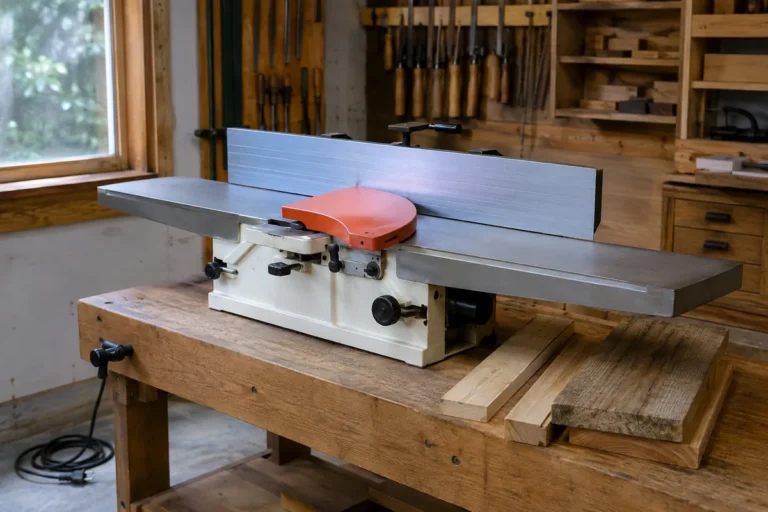
An 8-inch jointer is the minimum serious option for furniture-scale panels. Look for a bed length of 72″ to 76″, a 2 HP motor running on 220V, and a fence at least 38″ long. That length supports a 5- to 6-foot board without roller stands, and 8″ of width lets you face-joint most 4/4 and 8/4 stock in one or two passes.
If you regularly build doors, large tops, or slabs over 10″ wide, a 12-inch or larger jointer is the correct machine. These are 3 HP and up, weigh 600+ pounds, and have 80″+ beds. The mass alone helps – vibration is lower and the tables stay coplanar longer. For most small shops, the cost and floor space put them out of reach, which is why many woodworkers pair an 8 inch helical head jointer with a planer sled for the occasional wide board.
Cutterhead: Helical vs. Straight Knives
For large hardwood panels, the cutterhead matters more than the brand. Traditional straight-knife cutterheads with two or three knives work, but they are louder, they dull faster in abrasive woods like hickory, and they tear out badly on figured grain. Changing and setting knives to within 0.001″ takes time and a good dial indicator. If the knives are not perfectly level with the outfeed table, you will get snipe or a slight lip at the end of the cut.
A helical head with four-sided carbide inserts is more forgiving and far more practical for wide panels. The shear cutting action reduces tearout on curly maple and interlocked white oak by a noticeable margin, and you can rotate a single chipped insert in two minutes instead of pulling all the knives. Noise drops from about 105 dB to the low 90s, which matters when you are taking multiple 6-foot passes.
The trade-off is price – expect to pay $200 to $400 more for the helical version of the same machine – and slightly higher power demand. For squaring panels where you might take light 1/32″ to 1/16″ finishing passes to sneak up on square, the finish from a helical head often needs no sanding before glue-up. If you only joint softwoods or straight-grained poplar, straight knives are fine and cheaper to replace.
Bed Length and Fence Quality Matter Most
When comparing jointers for large panels, ignore marketing and check three numbers: overall bed length, fence size and mechanism, and table flatness tolerance.
Bed length should be at least 1.5 times the length of the longest board you want to joint. A 72″ bed will handle a 48″ panel comfortably. Anything shorter forces you to use infeed/outfeed supports, which introduce their own alignment errors if they are even slightly high or low.
The fence is where budget jointers fail. You want a cast-iron fence, not aluminum, at least 4″ tall, that locks firmly at 90 degrees without deflection. Rack-and-pinion or worm-gear fences hold square better than a simple lever lock. Test it by locking at 90 degrees, pushing hard at the far end, and checking with a square – if it moves, it will not hold square on a heavy 30 lb panel.
Tables should be ground cast iron, not aluminum. Check coplanarity with a 4-foot straightedge. If the infeed and outfeed are not in the same plane, every board you joint will have a taper or a bow. Parallelogram bed adjustment holds alignment better long-term than wedge-bed designs, especially on machines that will see heavy hardwood.
Comparison: Which Class Fits Large Panels?
| Category | Typical Bed Length | Jointing Width | Motor / Power | Best For | Limitation for Large Panels |
|---|---|---|---|---|---|
| 6-Inch Benchtop / Open Stand | 46″ – 56″ | 6″ | 1 HP, 120V | Small boxes, short rails | Tables too short, fence flex, cannot face-joint wide boards |
| 8-Inch Floor Standing (Parallelogram) | 72″ – 76″ | 8″ | 2 HP, 220V | Furniture panels up to 6 ft | Still requires two passes or sled for boards over 8″ wide |
| 12-Inch Professional | 80″ – 84″ | 12″ | 3-5 HP, 220V | Wide slabs, door panels, large tops | Heavy, expensive, needs 220V and 8+ sq ft of floor space |
| 16-Inch Industrial (Jointer-Planer Combo) | 90″+ | 16″ | 5+ HP, 220V 3-phase | Full-width slab flattening | Overkill for most shops, complex setup |
For most home shops squaring hardwood panels up to 36″ wide and 6 feet long, the 8-inch floor-standing jointer is the sweet spot. If you look at 12 inch floor standing jointer options, you gain width but you pay for it in weight, power requirements, and the need to move the machine with a pallet jack.
When to Skip the Jointer and Use Another Method
A jointer is not the only way to square a large panel, and sometimes it is the wrong way. If your panels are wider than your jointer by more than an inch, you will not get a flat face without a planer sled or a wide drum sander.
For panels over 12″ wide, a common workflow is to flatten one face with a planer sled – a flat MDF board with shims and hot glue to hold the twisted slab – then run it through the thickness planer to make the second face parallel. You then straight-line one edge on the table saw with a straight-line jig or a track saw. This method is slower but it works on a 42″ wide top with no 16-inch jointer required.
Edge-jointing long panels can also be done on the table saw if the jointer bed is too short. A good table saw with a sharp rip blade and a straight-line jig will produce a glue-ready edge on an 8-foot board more accurately than wrestling it over a 56″ jointer bed. Do not force a large panel over a small jointer just because you own one; you are more likely to create a safety issue and a bad edge.
Whatever method you use, invest in proper hold-down and push blocks. Large panels have more momentum and less room for your hands near the cutterhead. A pair of magnetic jointer push blocks with good grip gives you control without putting fingers over the head.
What to Buy Based on Shop Size and Budget
If you have a two-car garage shop and work mostly with 4/4 to 8/4 hardwoods under 8″ wide, buy an 8-inch parallelogram jointer with a helical head. It runs on 220V single-phase, fits against a wall, and will handle 90% of panel work if you support the wood correctly. Keep the tables waxed, check fence squareness every time you move it, and take light cuts – 1/32″ for the final pass.
If you are on a tight budget or only square panels a few times a year, a used 6-inch jointer with straight knives is not useless – it is just limited. Use it for edges on shorter stock, and build a planer sled for wide face-jointing. Put the money you save into a better planer or a track saw, which will actually widen your panel capacity.
If you build large tables, slab doors, or batch out kitchen cabinets, do not waste time with workarounds. Budget for a 12-inch machine or a jointer-planer combo with at least an 80″ bed. The flatness and squareness you get in one pass will save hours of sanding and re-gluing, and the machine will hold its settings under heavy use where a lighter jointer drifts.
Final check before you buy: measure your longest typical panel, add 24″, and make sure the bed you are considering is that long. Check that the fence locks dead at 90 degrees under load, and that the outfeed table is exactly level with the cutterhead at top dead center. Those three details determine whether your large panels come out square or just look square until assembly.