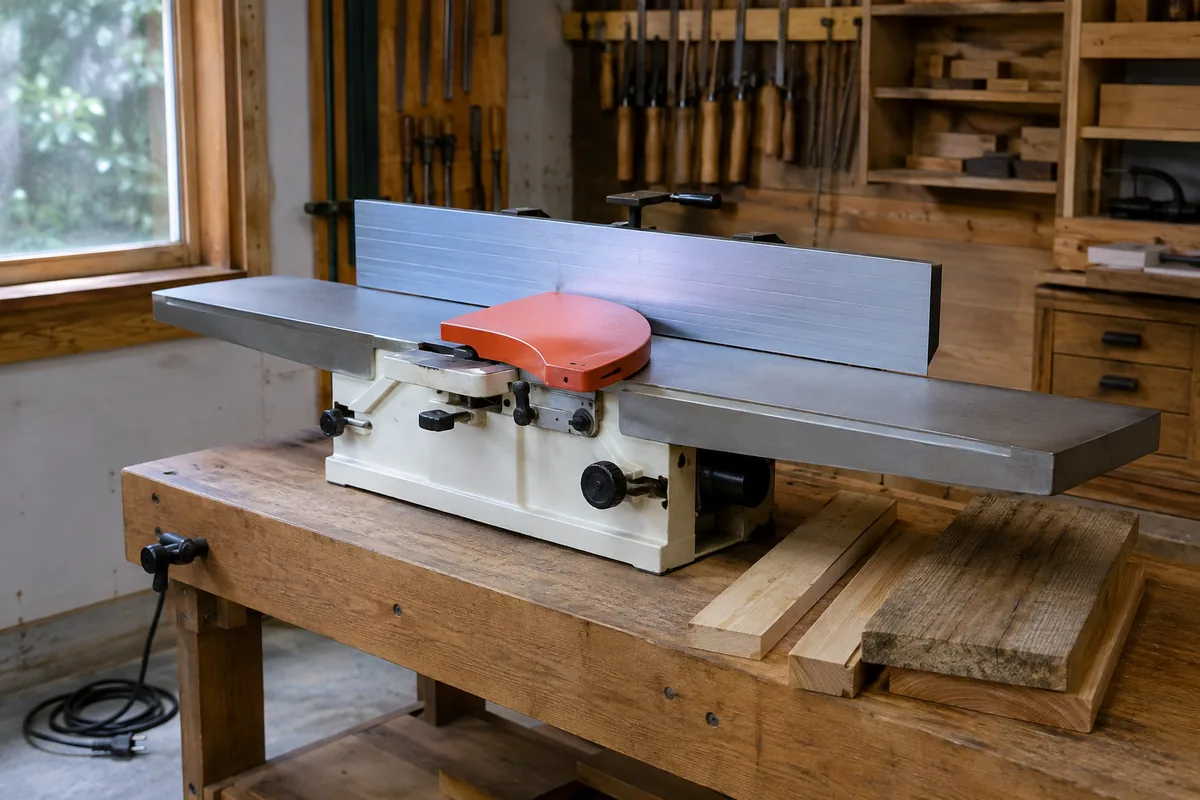
How to Choose Jointer Cutterhead Speed for Hardwood
What's inside
As an Amazon Associate I earn from qualifying purchases. This post may contain affiliate links at no extra cost to you.
Jointer cutterhead speed isn’t something you adjust on most jointers — it’s fixed by the motor, pulleys, and cutterhead diameter. But when you’re buying a jointer or deciding whether to upgrade a cutterhead for hardwood, that speed determines surface quality, noise, and how fast your knives dull. Get it wrong for hard maple, white oak, or hickory and you’ll see tearout, chatter, or burn marks that no amount of sanding will fix cleanly.
Contents
Why speed matters more in hardwood
On softwoods, almost any jointer will leave an acceptable edge. Hardwood is less forgiving because the grain is denser and often interlocked. The cutterhead needs to make enough cuts per inch to sever fibers cleanly instead of lifting and tearing them.
What matters is not just RPM, but cuts per minute. The formula is simple: Cuts Per Minute = RPM x Number of Knives (or rows of inserts). Feed rate then determines Cuts Per Inch: Cuts Per Minute / Feed Rate (in inches per minute) = Cuts Per Inch. For hardwood, you want 50 to 80 cuts per inch for a glue-ready edge. Below 40, you get visible scallops that telegraph through a joint.
Hardwoods also dull steel faster. A 2-knife cutterhead at 4,500 RPM that works fine in pine will dull quickly in hard maple, and as the edge dulls, it needs more cutting speed to compensate or it starts to crush rather than cut, which causes burning.
Typical jointer speeds and what they mean
Most 6-inch and 8-inch stationary jointers with an induction motor run between 4,800 and 6,000 RPM at the cutterhead. This is achieved with a 3,450 RPM motor and a pulley ratio. Older or benchtop universal-motor jointers may run faster, around 8,000 to 10,000 RPM, but with a smaller cutterhead diameter.
Cutterhead diameter matters because surface speed at the knife tip is what actually cuts. A 2.5-inch diameter head at 5,500 RPM has a tip speed of about 3,590 surface feet per minute (SFPM). A 2-inch head needs about 6,875 RPM to reach the same SFPM. That’s why you can’t compare RPM alone between different machines.
For hardwood, you want a tip speed of at least 3,500 SFPM and ideally 4,000 to 5,500 SFPM. Below that, knives tend to hammer the wood, especially on figured grain. Above 6,500 SFPM, you gain little in quality but increase noise and bearing wear.
If you are buying new, don’t chase the highest RPM number. A helical cutterhead jointer with 6 rows of inserts at 5,500 RPM will outperform a 2-knife straight-knife machine at 10,000 RPM in hardwood, because the effective cuts per minute is much higher.
Straight-knife vs. helical for hardwood
This is where the real choice is for hardwood users. Straight knives (2 or 3 knives) cut the full width at once. Helical or spiral cutterheads use small four-sided carbide inserts set at a shear angle, so each insert takes a small, slicing cut.
For interlocked or highly figured hardwood like curly maple, figured white oak, or wenge, a shear-cutting helical head reduces tearout dramatically even at the same RPM. It also stays sharp 20 to 30 times longer than HSS knives, which matters because a dull HSS edge in hickory or hard maple will burn within a few passes.
The trade-off is cost and cut quality on straight-grained stock. A sharp set of straight HSS or carbide knives at correct speed can leave a slightly smoother, more polished surface on straight-grained cherry or walnut than a helical head, which leaves a very fine washboard pattern that usually sands out in one pass with 150-grit. If you mostly joint straight-grained domestic hardwoods and you don’t mind sharpening or replacing knives, straight knives are fine and cheaper to run.
For mixed hardwoods, reclaimed wood, or anything with knots and direction changes, helical is worth the premium. You can rotate or replace individual inserts when you nick one on a hidden staple, instead of pulling and regrinding the whole set of knives.
| Cutterhead Type | Typical RPM | Effective Cuts/Min | Cuts Per Inch at 15 FPM Feed | Best Use in Hardwood |
|---|---|---|---|---|
| 2-Knife Straight (HSS) | 5,000 | 10,000 | 55 | Budget option for straight-grained soft to medium hardwoods. Requires frequent sharpening. |
| 3-Knife Straight (HSS/Carbide) | 5,500 | 16,500 | 92 | Good all-around for hardwoods if knives are kept razor sharp. Smoother finish than 2-knife. |
| Helical, 6 rows x 8 inserts | 5,500 | 33,000* | 183* | Best for figured, interlocked, and very hard species. Lowest tearout, longest edge life. |
| Helical, 4 rows x 6 inserts (Benchtop) | 10,000 | 40,000* | 222* | Compensates for small head diameter. Good performance if inserts have true shear angle. |
* Helical heads don’t cut the full width at once; effective cuts per inch depends on insert spacing and shear angle. Numbers shown are total insert strikes per minute. Actual surface shows more, smaller scallops that sand out easier than straight-knife scallops.
How to match feed rate to speed
Cutterhead speed is only half the equation. Your feed rate determines whether that speed actually helps. With hardwood, slow down. For that glue-ready edge, aim for about 12 to 20 feet per minute on an 8-inch jointer. Pushing a board through at 30 FPM halves your cuts per inch and will leave chatter in birdseye maple or quartersawn oak, even with a fast head.
Listen and look. If you hear a high-pitched whine with a thumping rhythm, you’re feeding too fast for the RPM. If you smell burning and see dark streaks on hard maple or cherry, you’re feeding too slowly, dwelling too long, or your knives are dull. In that case more RPM won’t help — you need sharper edges.
Depth of cut also interacts with speed. On hardwood, take 1/32 to 1/16 inch per pass for face jointing. A deep 1/8-inch cut in hard maple at any speed will increase tearout and strain a 1 HP motor. Multiple shallow passes at the right speed leave a flatter board and less snipe from cutterhead deflection.
What to buy if hardwood is your focus
If you are choosing a stationary jointer primarily for hardwoods, prioritize cuts per minute and knife type over peak RPM.
For a shop that runs a lot of 4/4 to 8/4 hard maple, white oak, or ash, an 8-inch jointer with a 3-knife head or true helical head running 5,500 to 6,000 RPM on a 2.5-inch head is the sweet spot. You get enough tip speed without excessive noise, and the 1.5 to 2 HP induction motor won’t bog down in a 1/16-inch cut.
Benchtop jointers can work for hardwood, but check the cutterhead type. Many low-cost benchtop models advertise 10,000 RPM but use a small 2-knife head with straight knives. In hardwood they vibrate more and scallop more. If you must go benchtop, a benchtop jointer with helical cutterhead will give you far better results on figured stock and spare you constant knife changes.
Don’t pay extra for variable-speed jointers marketed for hardwood vs. softwood. Unlike a drill press or shaper, you don’t want to slow a jointer down for hardwood. Slower RPM in dense wood just increases tearout and the chance of kickback as the knives take a bigger bite. The only time a slower speed makes sense is when using a large-diameter cutterhead where tip speed is already very high.
Common failure modes and fixes
Tearout on one side of the board but not the other: Grain direction issue, not speed. Flip the board end-for-end. If tearout persists in figured wood, your straight knives are too dull or your cuts per inch is too low. Switch to a helical head or reduce feed rate by 30%.
Burn marks on edges: Dull knives, feed rate too slow, or taking too light a cut that just rubs. Resharpen or rotate inserts, then increase depth slightly to 1/32 inch minimum so the edge bites. Clean resin buildup off carbide inserts with pitch remover — buildup effectively dulls the edge and causes heat.
Visible scallops or washboard: Too few cuts per inch. Either feed slower or upgrade from 2 to 3 knives or to helical. On a straight knife jointer replacement set, switching from HSS to carbide-tipped knives lets you hold an edge longer at the same RPM and keeps the scallops consistent over time.
Chatter and ridges that repeat every few inches: Usually vibration from an unbalanced cutterhead, loose gibs, or a nicked knife hitting at high RPM. Check knife height with a dial indicator — all knives should be within 0.001 inch. A single low knife at 6,000 RPM will leave a raised line on every rotation.
Practical rule for choosing
If you joint hardwood occasionally and mostly straight-grained stock, a standard 5,000 to 6,000 RPM jointer with 3 sharp straight knives is plenty. Keep spare knives sharp and feed at 15 FPM.
If you joint figured hardwoods weekly, sell lumber, or want to skip knife sharpening, buy the helical head. The higher effective cuts per minute covers variations in feed rate and grain, and the carbide inserts handle abrasive species like white oak and exotic woods that kill HSS edges in an afternoon. Speed alone won’t save a dull or poorly designed cutterhead in hardwood — effective cutting frequency and edge retention will.