Best Floor-Standing Drill Presses for Deep Hardwood Boring
What's inside
As an Amazon Associate I earn from qualifying purchases. This post may contain affiliate links at no extra cost to you.
Deep boring in hardwood is where a handheld drill and a benchtop press both show their limits. When you need a clean, straight 3-inch deep hole in maple, white oak, or walnut with a 1-1/2″ Forstner bit, you need long, controlled quill travel, low RPM with real torque, and zero quill deflection. That combination only comes from a floor-standing drill press with enough mass and spindle stroke to do the work in one pass.
As an Amazon Associate we earn from qualifying purchases at no extra cost to you.


Contents
What actually matters for deep hardwood boring
For deep holes, forget the advertised horsepower and look at three specs first: spindle travel, lowest speed, and quill/stroke rigidity. Most 12-inch benchtop presses offer 2-1/2″ to 3-1/8″ of travel. That forces you to stop, raise the table, and re-bore to go deeper — which introduces misalignment and burning. A good floor-standing press gives you 4″ to 6″ of travel, so you can bore a 3-1/2″ deep mortise or lamp base blank without moving the workpiece.
The second spec is low-end speed. Hardwood wants slow speeds with large-diameter bits. A 2″ Forstner in hard maple should run around 250-400 RPM, not 700. If your press bottoms out at 500 RPM, the bit will overheat, scorch the wall, and dull in minutes. Look for a mechanical variable-speed or stepped pulley system that gets down to 150-300 RPM and still holds torque. Belt-drive models with a 12 or 16-speed pulley stack do this better than most electronic variable-speed units under $600, which lose torque at low RPM.
The third is runout and quill play. Chuck a 6″ long piece of 3/8″ drill rod, indicate it, and push sideways on the quill. If you can feel clunk or see more than 0.003″ deflection, deep holes will wander and Forstner bits will squeal. Mass helps here. A 180-250 lb cast-iron head and column damps vibration far better than a 90 lb benchtop, even if the motor rating is the same.
Power and speed tradeoffs
Most floor-standing presses in this category are 3/4 HP to 1-1/2 HP, induction motor, 120V. For hardwood boring up to 1-1/4″ with Forstner or auger bits, 3/4 HP is enough if you have the right low speed. Above 1-1/2″ diameter and deeper than 2″, 1 HP or more makes a clear difference — not for speed, but to prevent the motor from stalling when chips pack.
Failure modes to watch for: The most common is chip packing. Deep Forstner holes don’t clear themselves. If you try to plunge 3″ continuously, the bit overheats, wood dust welds to the rim, and the bit seizes on withdrawal. You need to peck: bore 1/2″ to 3/4″, retract fully to clear chips, then continue. A press with a smooth, balanced quill return spring and a reliable depth stop makes this repeatable. Cheap rack-and-pinion depth stops slip under vibration; look for a threaded rod with lock nuts or a micro-adjust collar.
Second failure mode is table flex. At 60-80 lbs of feed pressure on a 2″ bit, a thin stamped-steel table will deflect 0.010″ – 0.020″. That turns a perpendicular hole into an oval. Cast-iron tables 10″ x 14″ or larger with a full rack-and-pinion elevation crank stay flat and stay put. If you bore chair legs or end-grain blanks often, add a drill press vise for woodworking bolted through the table slots — holding by hand is not safe at these diameters.
Comparison: floor-standing options by class
There are really three classes that make sense for this work. Don’t pay for industrial features if you only bore a few deep holes a month.
| Class | Typical Specs | Best For | Limitation |
|---|---|---|---|
| Budget 15″ Floor (3/4 HP, 12-speed) | 3-1/8″ to 4″ travel, 200-3,630 RPM, MT2 taper, ~150-180 lbs | Hobby use, Forstner to 1-1/2″, auger to 1″ | Belt changes for speed, more quill play, shorter travel |
| Mid-Range 17″ Floor (1 HP, 16-speed) | 4-3/4″ to 5-1/8″ travel, 150-3,000 RPM, MT2 or MT3, ~200-250 lbs | Deep 2″-3″ boring in oak/maple, drum sanding, mortising attachment | Heavier, takes floor space, still needs pecking technique |
| Heavy 17″-20″ Floor (1-1/2 HP, Low-Speed Pulley) | 5″ to 6″ travel, 150-2,500 RPM, MT3, ~270-350 lbs | Production leg/blank work, 2″+ Forstner, large hole saws | 220V on some models, overkill for light work |
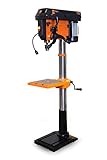
For most home shops boring hardwood deeper than 2″, the mid-range 17″ floor press is the sweet spot. You get the extra travel and lower minimum speed without needing 220V or a forklift to set it up. When shopping, compare actual spindle travel and lowest RPM, not just swing. A 15″ press with only 3-1/8″ of stroke is less useful than a 17″ with 4-3/4″, even if both say floor-standing.
If you are choosing between a premium benchtop and a budget floor model at the same price, pick the floor model for this task. The longer column gives you the working height to use Forstner bits for hardwood deep boring with a tall jig or cross-slide vise and still have full quill travel. Benchtops are fine for 1″ deep shelf-pin holes, but you will hit their limits quickly on deep work.
Features worth paying for (and ones to skip)
Worth it: Morse Taper spindle (MT2 minimum, MT3 preferred). It lets you run taper-shank bits and reduces runout versus a Jacobs chuck alone. A 5/8″ chuck capacity is also non-negotiable if you run 1/2″ shank Forstners or 1″ augers. Look for at least 1/2″ to 5/8″ chuck included. Another worthwhile feature is a true mechanical depth stop with scale and lock — you will set depth to within 1/64″ repeatedly for mortises.
Often overhyped: laser guides and built-in work lights. Lasers are rarely calibrated to the actual bit center under load and drift. A better investment is a quality fence and a sharp bit. Also be skeptical of digital RPM readouts on belt-drive machines without feedback; they are estimates. Count your pulley positions instead.
For safety and accuracy, bolt the press to the floor or to a wide plywood base with ballast. Top-heavy floor presses will walk when you lean into a 2″ cut, especially on smooth concrete. Check belt tension after the first 10 hours — loose belts slip and squeal at low speed under load, which people mistake for motor weakness.
Bits and technique matter more than the press
Even the best floor standing drill press 1HP will burn hardwood if the bit is dull or the technique is wrong. Use sharp, rim-guided Forstner bits for flat-bottom holes and ship-auger bits with a screw tip for deep through-holes where entry tear-out is not critical. Clear chips every 1/2″, wax the bit with paste wax to reduce friction, and back the feed pressure off as you approach the bottom to avoid blowout. Place sacrificial scrap underneath and clamp the workpiece so grain direction cannot lift it.
If you need holes deeper than 4″, consider drilling from both sides. Mark centers with an awl, bore halfway from each face, and meet in the middle. It is more accurate than trying to force a 6″ long bit straight through dense stock in one pass, even with 6″ of travel. For holes over 2-1/2″ diameter, step up in sizes: pilot with 1″, then finish with your final diameter. It cuts feed pressure in half and extends bit life dramatically.
When the cheaper option is fine
You do not need a 1-1/2 HP industrial press to bore a handful of 1″ dog holes in hard maple. A well-tuned 3/4 HP 15″ floor press with a 200 RPM low speed, a sharp bit, and proper pecking will do it cleanly. Save the money and spend it on premium bits and a solid vise. Where the extra cost pays off is volume and diameter: if you routinely bore 1-3/4″ to 2-1/2″ holes 3″ deep for furniture or turning blanks, the extra travel, mass, and low-speed torque of a 1 HP 17″ machine will save time and burned stock.