Best Floor-Standing Drill Presses for Large Furniture Components
What's inside
As an Amazon Associate I earn from qualifying purchases. This post may contain affiliate links at no extra cost to you.
Contents
Why choose a floor-standing drill press?
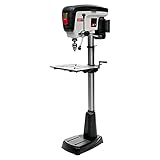
Large furniture parts make a small benchtop drill press feel cramped fast. A long table leg can foul the column or base, and a wide panel may be impossible to position without hitting the machine. Floor-standing presses generally offer more throat depth, a larger worktable, and enough height for tall workpieces. They also put the spindle at a more useful working height, though the machine still needs a stable, level floor.
For furniture work, capacity and control matter more than headline horsepower. The key measurements are spindle travel, throat depth, table size, and the distance from the table to the spindle. Check these against the largest part you expect to drill, including clamps and any angled jig. A press that can reach the center of a 24-inch-wide panel, for example, needs roughly 12 inches of throat depth—plus room to position the work safely.
As an Amazon Associate we earn from qualifying purchases at no extra cost to you.



What to look for
Spindle travel: Around 3 inches is common and adequate for many through-holes and mortises drilled in stages. Short travel means raising or lowering the table more often for thick stock. For deep holes, verify travel rather than assuming a tall machine can drill them in one stroke.
Speed range: Woodworking benefits from a wide range. Large Forstner bits and hole saws need slower speeds than small twist bits. A press with several pulley settings is simple and dependable, but changing speed takes time. Variable-speed controls make adjustment quicker; inspect their low-speed torque and the machine’s stated range before paying extra. As a starting point, use about 250–500 rpm for a 2-inch Forstner bit, then follow the bit maker’s guidance and reduce speed if the cutter chatters or burns.
Table and support: A tilting table helps with angled holes but can be less convenient to square and lock than a fixed table. In either case, a sacrificial plywood spoilboard protects the iron table and gives you a flat surface to clamp to. Large components need support beyond the press table: use roller stands or a level auxiliary table, and keep the work from tipping as the bit breaks through.
Rigidity and runout: A heavy cast-iron machine usually resists vibration better than a light press, but weight alone does not guarantee accuracy. Check that the quill moves smoothly, the table locks without shifting, and the chuck has little visible wobble. Excessive runout enlarges holes and can make a Forstner bit wander. If possible, test with a dial indicator; otherwise, inspect the machine in person and return it if the chuck or spindle visibly wobbles.
Which type fits the work?
| Type | Best for | Main trade-off |
|---|---|---|
| Basic floor-standing press | Occasional joinery, hardware holes, and general furniture work | Lower cost, but often a modest table and slower pulley changes |
| Heavy-duty floor-standing press | Frequent use, larger cutters, and parts that need steadier support | More weight and cost; still requires careful setup and workholding |
| Variable-speed floor-standing press | Shops switching often between small bits and large cutters | Faster adjustments, but controls and low-speed performance vary |
A practical buying shortlist
For a first stationary press in a furniture shop, compare a general-purpose floor-standing drill press with at least about 3 inches of spindle travel, a broad speed range, and a table that accepts clamps. This is the sensible choice if most work is smaller than a cabinet door and you do not routinely use cutters larger than 2 inches.
If you drill large panels or make repeated deep holes, look at a heavy-duty floor-standing drill press. Its extra mass and larger work area can improve stability and setup, but it will not compensate for a poorly supported panel or a dull cutter. Measure the machine’s throat and table-to-spindle clearance against your actual parts before buying.
A variable-speed floor-standing drill press is worth considering if speed changes are frequent, especially when moving between small bits and large Forstner bits. For occasional work, a pulley-driven model is often the better value. Changing belts is a nuisance, not a meaningful limitation, when it happens only a few times a week.
Setting up large components safely
Do not try to balance a long leg or wide panel on the table by hand. Support the piece on the same plane as the table, clamp it against a fence or stop, and clamp the work itself whenever the shape allows. A spinning Forstner bit can catch at breakthrough and rotate the stock violently. A simple plywood fence with a stop block makes repeated holes easier to locate and reduces the temptation to hold a part close to the cutter.
For deep holes, use a sharp bit and clear chips regularly. A Forstner bit can pack with chips, overheat, and burn the hole; feed pressure should ease as the cutter warms. For a through-hole, place a sacrificial board under the work to reduce tear-out. If a hole must land precisely on a long component, mark from a consistent reference face and verify the setup on scrap first. A small error in the fence position can repeat across every part.
When a cheaper press is enough
A basic floor model is adequate for a hobbyist drilling shelf-pin holes, chair parts, or occasional hardware holes, provided its table reaches the work and the spindle runs true. You do not need a premium machine just because the parts are large; careful support and a well-made jig often matter more. Spend extra when the cheaper press lacks the throat depth, travel, table stability, or low-speed control your work actually requires.
Before purchase, check the machine’s footprint and weight, the chuck capacity, and whether the table can be rotated or removed for tall work. Plan for a dedicated circuit if the motor’s electrical requirements call for one, and bolt the base down if the press rocks or will see heavy use. The right press is the one that fits your largest repeatable setup—not simply the tallest or most powerful machine on the floor.

