
Key takeaways
- The best combination squares for layout and machine setup compared: 4R graduations, cast iron and cast zinc heads, and 6, 12 and 16 inch rules.
What's inside
As an Amazon Associate I earn from qualifying purchases. This post may contain affiliate links at no extra cost to you.
- Top Pick: iGaging Combination Square Premium 2-Piece 12-Inch 4R
- Runner-up: iGaging Combination Square Premium 2-Piece 6-Inch 4R
- Also consider: IRWIN Combination Square 12-Inch (1794469)
A combination square earns its place on the bench because one tool does the work of several: it marks 90-degree and 45-degree layout lines, works as a depth gauge for dadoes and mortises, transfers measurements from board to board, and checks whether a table saw blade or jointer fence is truly square. For machine setup it is often the first tool out of the apron, because a fence a fraction off telegraphs that error into every cut.
As an Amazon Associate, we earn from qualifying purchases.
What separates a square you can trust from one that quietly misleads you is rarely the brand name. It comes down to the head material, how the graduations are cut into the blade, how firmly the lock bolt holds the rule, and whether the individual unit in the box is actually square. Squareness varies from unit to unit even within one model line, so the five picks below were chosen for consistent construction: ground head faces, etched rather than printed scales, and blades stiff enough to stay straight under pressure.
This article contains affiliate links, and fdwoodworking.com may earn a commission when you buy through them at no extra cost to you.
Contents
Quick Answer
For most woodworkers, a 12-inch square with a cast iron head and etched 4R graduations is the right first buy: it covers board layout, depth checks and machine setup in one tool. Choose the iGaging Premium 12-inch for precision work, the IRWIN 12-inch for everyday value, and add a 6-inch or 16-inch rule for small parts or wide panels.
iGaging Combination Square Premium 2-Piece 12-Inch 4R

The iGaging Premium 12-inch is the precision pick of this group. Its blade is hardened steel with a satin chrome finish, and the graduations are etched and machine divided rather than printed, so the marks stay legible under bright shop lights without glare and will not rub away with use. The cast iron square and miter head has precision-ground faces for 90-degree and 45-degree work, which matters when the head becomes the reference for a saw fence.
A spirit level vial and a hardened scriber are built into the head, and the listing notes blade straightness and parallelism figures most carpentry-grade squares never publish. It ships in a storage case, suiting a tool whose accuracy depends on not being knocked around in a drawer. Woodworkers who set up machines often or mark fine work in 64ths will get the most from it.
Specs:
– Blade length: 12 inches
– Blade material: hardened steel, satin chrome finish
– Graduations: 4R (8ths, 16ths, 32nds, 64ths), etched and machine divided
– Head: cast iron square/miter head, ground 90-degree and 45-degree faces
– Inclusions: spirit level vial, hardened scriber, storage case
– Model: 34-212-2
iGaging Combination Square Premium 2-Piece 6-Inch 4R

The 6-inch iGaging Premium follows the same recipe in a size that lives in an apron pocket. The fully hardened and tempered steel blade carries etched, machine-divided 4R graduations, with 8ths and 16ths on one side and 32nds and 64ths on the other, and the cast iron head has precision-ground faces.
Short rules shine where a 12-inch blade does not fit: checking a miter saw or table saw blade for square against a short fence, gauging router bit or dado stack depth, and marking dovetails, hinge mortises and other small parts. The shorter blade is also stiffer and easier to control one-handed. It will not span a wide panel, so treat it as a companion to a 12-inch square rather than a replacement.
Specs:
– Blade length: 6 inches
– Blade material: fully hardened and tempered steel, satin chrome finish
– Graduations: 4R (8ths, 16ths, 32nds, 64ths), etched and machine divided
– Head: cast iron square/miter head, precision-ground faces
– Spirit level: not stated
– Scriber: not stated
IRWIN Combination Square 12-Inch (1794469)

The IRWIN 1794469 is the everyday workhorse option. It pairs a rust-proof stainless steel blade with a cast zinc body, keeping the tool light and shrugging off the humidity and grime that can spot a plain steel rule. The head gives the standard 90-degree and 45-degree references for marking cut lines, checking board ends, and setting depths.
Cast zinc is the honest trade here: it is die-cast rather than machined from iron, so the faces are less finely finished and unit-to-unit squareness varies more than on the cast iron picks above. That makes the flip check described later in this guide especially important with this model. For general carpentry, site work, and a first square for a home shop, it covers the core jobs at the accessible end of the range.
Specs:
– Blade length: 12 inches
– Blade material: stainless steel, rust proof
– Head: cast zinc body
– Graduations: not stated
– Spirit level: not stated
– Scriber: not stated
– Model: 1794469
IRWIN Combination Square 16-Inch (1794471)
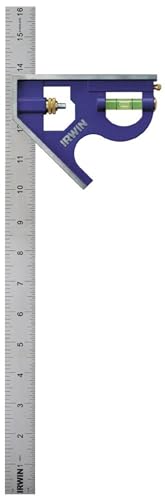
A 16-inch rule solves a specific problem: layout lines that run past the reach of a 12-inch blade. Cabinet sides, wide panels, sheet-goods crosscuts and stair stringers all benefit from the extra length, because scribing one continuous line beats marking, moving the square, and hoping the segments meet. The IRWIN 1794471 stretches the same formula as its 12-inch sibling to that longer format.
The trade-offs of length are real. A longer blade puts more leverage on the lock bolt, so the head must be snugged firmly and re-checked after repositioning, and the tool is clumsier on small parts and inside cabinets. Most shops will use it as a second square for panel work rather than an only square.
Specs:
– Blade length: 16 inches
– Blade material: stainless steel
– Head: metal body (cast zinc)
– Graduations: not stated
– Spirit level: not stated
– Scriber: not stated
– Model: 1794471
iGaging Combination Square Set 6-Inch and 12-Inch 4R

If the size debate has no single answer in your shop, this set removes it by including both a 6-inch and a 12-inch square. Both blades are hardened, precision-ground steel with a satin chrome finish and 4R graduations, so readings transfer between sizes without switching scale habits. The set arrives in a foam-lined storage case that keeps the pair protected and stored together.
Buying the pair together suits woodworkers who split their time between furniture-scale layout and small-part or machine-setup work, and it avoids the common pattern of owning one good square and one bargain square of unknown accuracy. The flip check is still worth doing on each one, but the construction standard is consistent across the set.
Specs:
– Blade lengths: 6 inches and 12 inches
– Blade material: hardened, precision-ground steel, satin chrome finish
– Graduations: 4R (8ths, 16ths, 32nds, 64ths)
– Inclusions: storage case with foam insert
– Heads included: not stated
– Model: 34-212-26
How to Choose
Start with size. A 12-inch rule is the correct first purchase: it spans most furniture boards, reaches across a table saw top for setup checks, and still handles drawer parts. A 6-inch rule is the setup specialist, small enough to check a blade against a short fence and to live in a pocket. A 16-inch rule is for wide panels, cabinet sides and stairs, where a shorter blade forces you to move the square mid-line.
Then weigh the head material. Cast iron heads are heavier, and their reference faces are machined or ground, so they register flat and hold their squareness well over years of use. Cast zinc heads are die-cast: lighter, cheaper, and serviceable for carpentry, but the faces are less finely finished and individual units vary more, so verification matters more. Plastic heads sit below both and are best avoided for machine setup.
Look closely at the graduations. Etched or machine-divided marks are cut into the blade and stay readable for the life of the tool. Photo-printed marks on budget blades can fade or rub off exactly where your thumb slides. A satin chrome finish cuts glare under shop lighting. The 4R pattern found on the precision picks here puts four scales on one blade: 8ths and 16ths for general layout, and quick-reading 32nds and 64ths for fine joinery and machine adjustment. If you work mostly in millimeters, look for an inch/metric graduation instead.
Check the extras. A scribe awl stored in the head draws a finer line than a pencil, especially across grain and on metal. A spirit level vial handles quick level and plumb checks without fetching a separate level. Neither is essential, but both get used constantly once present.
Finally, verify squareness yourself. Rest the head against the straight edge of a board and scribe a line along the blade. Flip the square over, register it against the same edge at the same spot, and scribe a second line. If the lines coincide, the square is true. If they form a narrow V, the square is out by half the gap you see, and it should be exchanged rather than trusted.
Who Should Skip
Skip a combination square entirely if your layout work is almost all framing and rafter cuts: a speed square is faster for marking studs and rafters, rides in a tool belt better, and doubles as a saw guide. Also skip these inch-graduated 4R models if your shop works purely in metric; choose a metric or inch/metric blade instead of converting every reading. And if you only need to check the occasional corner on a picture frame, a fixed try square does that job without a sliding head to verify. Everyone else, especially anyone setting up saws, jointers or router tables, will use one weekly.
FAQ
How do I check a combination square for true 90 degrees?
Use the flip method: scribe a line along the blade with the head registered on a known straight edge, flip the square over, and scribe again from the same point. Coinciding lines mean the square is true; a V shape shows the error at twice its actual size, making small errors easy to spot.
What does 4R mean on a combination square blade?
4R means the blade carries four inch scales: 8ths and 16ths on one side, and quick-reading 32nds and 64ths on the other. It is the standard pattern for fine woodworking and machine setup, covering rough layout and fine adjustment without changing tools.
Is a cast iron head worth it over cast zinc?
For machine setup and fine joinery, yes: ground cast iron faces register more consistently and hold squareness longer. For general carpentry and site work, cast zinc is lighter and entirely adequate, provided you verify the individual square with the flip method when it arrives.
Which size should I buy first?
Buy the 12-inch first. It covers the widest range of layout, depth-gauging and machine-setup tasks. Add a 6-inch later for small parts and tight setup work, or a 16-inch if wide panels become your regular work.
Final Verdict
For a single square that will handle layout and machine setup for years, the iGaging Premium 12-inch is the strongest pick here, with its ground cast iron head and etched 4R blade. The IRWIN 12-inch covers everyday carpentry at the accessible end, the 16-inch IRWIN handles wide panel layout, and the iGaging 6-inch or the two-size set rounds out a shop splitting time between big boards and small parts. Whichever you choose, run the flip check the day it arrives: a combination square is only as good as the 90 degrees it actually draws.
Related guides
More from Amazon
Programs that pair well with the guide above. Offers and eligibility are set by Amazon and may change.
A free business account with business pricing and bulk-buying tools for work, shop or home office.
Create a business accountFree shipping on eligible items, Prime Video and more. Eligible new members can start with a free trial.
Start a Prime free trialAudiobooks and podcasts to listen to on the go. Eligible new members can start with a free trial.
Try Audible freeAd-free music streaming. Eligible new subscribers can start with a free trial.
Try Music Unlimited freeAs an Amazon Associate we earn from qualifying purchases.





Write Your Review
No reviews yet. Be the first to share your experience!