
What's inside
- Contents
- Why a jointer matters in a small shop
- Types of benchtop jointers
- Cutterheads: straight knives, inserts and helical
- How to choose for your space and work
- Features that separate good from frustrating
- Power, noise and dust
- Setup and tuning
- Technique on a short-bed machine
- Safety
- Maintenance
- Common mistakes
- Who should choose what
- Checklist
- Frequently asked questions
- Conclusion
As an Amazon Associate I earn from qualifying purchases. This post may contain affiliate links at no extra cost to you.
The short answer: a benchtop jointer is the right choice for a small shop when you mostly work with boards up to about six inches wide and a few feet long, and when floor space or budget rules out a full-size stand-mounted machine. The best one for you will have the longest, flattest beds you can afford, a rigid and square fence, a cutterhead you can maintain easily, and a motor that suits your electrical supply. Expect to work in light passes, support longer boards with extra stands, and accept that a benchtop machine is a compromise, not a replacement for a heavy cast-iron jointer.
Contents
- Contents
- Why a jointer matters in a small shop
- Types of benchtop jointers
- Cutterheads: straight knives, inserts and helical
- How to choose for your space and work
- Features that separate good from frustrating
- Power, noise and dust
- Setup and tuning
- Technique on a short-bed machine
- Safety
- Maintenance
- Common mistakes
- Who should choose what
- Checklist
- Frequently asked questions
- Conclusion
Our Top Picks


Contents
- Why a jointer matters in a small shop
- Types of benchtop jointers
- Cutterheads: straight knives, inserts and helical
- How to choose for your space and work
- Features that separate good from frustrating
- Power, noise and dust
- Setup and tuning
- Technique on a short-bed machine
- Safety
- Maintenance
- Common mistakes
- Who should choose what
- Checklist
- FAQ
- Conclusion
Why a jointer matters in a small shop
Lumber moves as it dries and as humidity changes, so a board can arrive cupped, bowed, twisted or all three. Gluing such boards together produces gaps and stressed joints.
The jointer fixes this by removing material from one face until it is flat, then from one edge until it is square to that face. Those two surfaces become the references for everything that follows: planing the second face to thickness, ripping the second edge parallel on a table saw, and cutting accurate joinery. Without a jointer you can still flatten a board with hand planes, a router sled, or a planer sled, and many people do. But a jointer is the fastest and most repeatable way to prepare reference surfaces, which is why even small shops often want one.
A benchtop machine makes that possible where a full-size jointer would not fit. It sits on a sturdy bench or a dedicated stand, can often be put away between sessions, and uses less power. The price is shorter beds, lighter construction and narrower capacity, which means you need to understand what the machine can and cannot do.
Types of benchtop jointers
Benchtop jointers share a basic layout, an infeed table, an outfeed table, a cutterhead between them and a fence, but they differ in how they are built and what they ask of you.
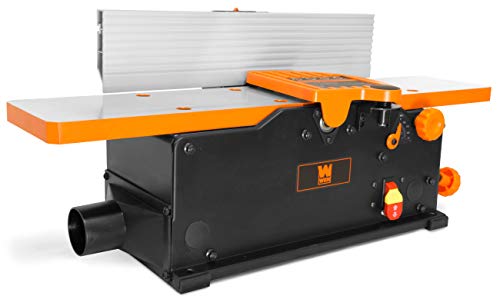
Compact lightweight models
Thin tables, a small motor and easy carrying. They suit narrow stock such as small box parts and drawer sides, but short tables make a bowed board ride its curve.
Heavier benchtop models with longer beds
Added mass and longer tables noticeably improve flattening and stability. These machines suit table legs, frame rails and the occasional longer board.
Stand-mounted compact jointers
Many small-shop owners place a benchtop jointer on a shop-built or purchased stand, which brings the tables to a comfortable working height and adds mass. This is technically still a compact machine, but it behaves differently in use because you can stand over the work properly.
| Type | Weight and portability | Bed length | Best for | Main limitation |
|---|---|---|---|---|
| Compact lightweight | Easy to carry and store | Short | Small parts, narrow stock, occasional use | Struggles to flatten long or bowed boards |
| Heavier benchtop with longer beds | Portable by two people | Moderate | Furniture parts, regular edge jointing | Needs a strong bench and more room |
| Compact on a dedicated stand | Semi-permanent | Short to moderate | Small shops that want comfortable height and stability | Takes floor space and must be moved to store |
Cutterheads: straight knives, inserts and helical
The cutterhead determines surface quality, noise, and how much maintenance you will do.
Straight knives are the traditional choice. They are inexpensive and can be resharpened, and on straight-grained wood they cut well. The downsides are that they must be set precisely level with the outfeed table, they nick when they meet a hard spot, and a nick leaves a continuous ridge on every board until you address it.
Indexable inserts are small carbide cutters held by screws. When one dulls or is damaged, you rotate it to a fresh edge instead of removing and resetting a long knife. They are generally easier to maintain, and a single damaged insert affects only a small part of the cut.
Helical or spiral heads arrange many small inserts in a staggered spiral so the cutting edges shear the wood at an angle. This typically leaves a smoother surface on figured or interlocked grain, reduces tearout, and runs quieter than straight knives. The trade-off is a higher purchase price and the work of rotating many individual inserts when they wear. For a small shop where noise matters and tricky grain is common, many woodworkers find a helical-style head worth the extra cost.
How to choose for your space and work
Start by defining the work, not the machine. Write down the typical width and length of your stock. A six-inch cutting width handles the majority of narrow furniture parts, and wider panels can be glued up from narrower boards. If you regularly need to flatten wide single boards for tabletops, a benchtop jointer will frustrate you, and you should consider a different approach such as a planer sled or a larger machine.
Next, look at bed length. Table length matters more than any other specification for flattening: the longer the tables relative to your board, the straighter the result. Support any overhang with roller stands set exactly to table height.
Then consider where the machine will live. A benchtop jointer needs a strong, stable surface. A flimsy bench flexes under pushing force, vibrates, and walks. You also need space at each end for the board, so measure the length of your longest stock and make sure you can feed it through without hitting a wall. If you will store the machine under a bench between uses, check the weight so you can actually lift it safely.
Finally, think about what else you own. If you already have a thickness planer, the jointer’s job is clear: make the first face flat and the first edge square. If you do not have a planer, you will still need some way to bring the second face to thickness, whether by planer, hand plane or buying lumber surfaced on four sides.
Features that separate good from frustrating
Table flatness and coplanarity
The tables must be flat and must be parallel to each other when set at the same height. Check with a straightedge. Lightweight tables can warp slightly or flex, and cheaper machines may arrive with imperfect alignment. Look for adjustment points that let you correct the outfeed table height relative to the cutterhead.
Fence rigidity and squareness
The fence is what makes the edge square. It should be tall enough to support the board, lock firmly, stay at ninety degrees under hand pressure, and offer positive stops at ninety and typical bevel angles. A fence that flexes or drifts is a common weakness on small machines.
Guard design
A good guard covers the cutterhead behind the fence and moves out of the way as the board passes, springing back afterward. Check that it works smoothly and reliably, because a sticky guard tempts people to remove it.
Dust port
Jointers eject a surprising volume of chips. A well-placed port that connects to a dust collector or a capable shop vacuum helps keep the cutter and tables clear. Poor chip evacuation causes marks on the surface and can clog the throat.
Power, noise and dust
Most benchtop jointers run on standard household 120-volt power, which is a big reason they suit small shops. Even so, motors draw a heavy current when starting and when cutting dense wood. Check the nameplate rating and confirm that your circuit and breaker can handle it, particularly if a dust collector, lights or a compressor share the circuit. If breakers trip, do not simply fit a larger breaker; have a licensed electrician assess the wiring. Avoid long or light-gauge extension cords, which can overheat and starve the motor.
Noise is substantial, so wear hearing protection; helical heads and induction motors tend to be quieter.
Dust deserves a plan. Jointers produce coarse chips that are easy to collect and fine dust that is a health hazard. Use dust collection at the port, wear a respirator or dust mask rated for fine particles, and sweep or vacuum regularly. Accumulated dust and shavings near a running motor are also a fire concern.
Setup and tuning
- Mount it securely. Bolt or clamp the machine to a strong bench so it cannot walk. Make sure the bench itself does not rack.
- Clean and wax the tables. Remove shipping grease and apply paste wax so boards slide easily.
- Check the cutterhead. With the machine unplugged, confirm the knives or inserts are secure and at the correct height according to the manual.
- Align the outfeed table. Lay a straightedge on the outfeed table so it extends over the cutterhead. The cutting edge at its highest point should just touch the straightedge. If the table is too low, the board’s trailing end will be cut deeper and you will get a taper. If it is too high, the board will bump up and leave a step.
- Square the fence. Use a reliable engineer’s square against the table and fence, adjusting the stop until they meet at ninety degrees.
- Make test cuts. Joint a scrap face and edge, then check flatness with a straightedge and squareness with a square. Adjust and repeat.
Technique on a short-bed machine
Short beds demand careful technique. Place the concave face down so the board does not rock, with the cutter shearing downhill. Press on the infeed table at first, then shift pressure to the outfeed table once the board passes the cutterhead; that transfer is what makes the cut flat.
For longer boards, support the overhang with a roller stand set to bed height, and cut a badly bowed board into shorter pieces first. For edge jointing, press the flat face firmly against the fence and use push blocks; if the edge will not come out square, check the fence before blaming the board.
Safety
The jointer is one of the most hazardous machines in a woodworking shop because the cutterhead is exposed on the table surface during the cut. Treat it with respect.
- Wear eye and hearing protection, and a respirator or dust mask suited to fine wood dust.
- Use push blocks or push pads so your hands never pass directly over the cutterhead. Keep fingers well clear of the cutting area.
- Keep the guard in place and make sure it returns smoothly after each pass.
- Do not joint very short, very thin or very narrow stock. Check the manual for minimum dimensions, and use another method for small parts.
- Take light passes. A heavy cut increases kickback risk and tearout.
- Inspect wood for nails, staples, grit and loose knots before it touches the cutter.
- Unplug the machine before adjusting knives, clearing chips from the throat or making any internal adjustment.
- Do not wear gloves, loose sleeves or jewelry, and tie back long hair.
Maintenance
Jointers are simple machines. Clean and wax the tables and fence, clear chips from the throat after each session, and inspect knives or inserts for nicks. Keep cutterhead fasteners tight per the manual, wipe off excess lubricant, check the cord and switch, and re-verify outfeed height and fence angle periodically.
Common mistakes
- Expecting full-size performance. A short-bed machine cannot flatten a long bowed board as well as a long-bed jointer.
- Mounting it on a weak bench. The machine will vibrate, walk and give inconsistent results.
- Setting the outfeed table incorrectly. This causes tapers, steps and snipe-like defects that no technique can fix.
- Pressing on the infeed side throughout the cut. Shift pressure to the outfeed table.
- Taking deep cuts to save time. They produce tearout and increase risk.
- Jointing against the grain. Read the grain direction and flip the board if it tears.
- Ignoring dust. Chips clog the throat and fine dust harms your lungs.
Who should choose what
The beginner with a limited budget
A basic benchtop jointer with a solid fence and a manageable cutterhead is a reasonable start. Plan on narrow stock, practice light passes, and consider upgrading the cutterhead type later if your budget allows.
The small-box and drawer maker
A compact, lightweight machine is likely enough, since your stock is short and narrow. Prioritize fence squareness and good chip handling.
The furniture maker in a garage
Look at heavier benchtop models with longer beds, a quiet helical-style head if the budget allows, and a sturdy stand. Add roller support for long boards.
The woodworker who needs wide capacity
A benchtop machine may not fit. Consider a larger jointer, a planer sled for wide boards, or buying lumber already flattened.
To compare current models, browse benchtop jointers and check the specifications for bed length, cutting width and cutterhead type. A pair of jointer push blocks is an inexpensive safety upgrade, and a good machinist square helps you set the fence accurately. If you need to support long boards, consider adjustable roller stands.
| Cutterhead type | Surface on figured grain | Noise | Maintenance | Typical upfront cost |
|---|---|---|---|---|
| Straight knives | Fine on straight grain, more tearout risk on figured wood | Louder | Sharpen or replace and reset carefully | Lowest |
| Indexable inserts | Generally good | Moderate | Rotate inserts to fresh edges | Moderate |
| Helical or spiral | Typically smoothest | Generally quieter | Rotate many small inserts when worn | Highest |
Checklist
- Write down the widest and longest boards you plan to joint.
- Compare bed length and cutting width with that list.
- Choose a bench or stand that is heavy, flat and rigid, and secure the machine to it.
- Check the nameplate current against your circuit.
- Decide on cutterhead type based on grain, noise tolerance and budget.
- Test the fence for rigidity and squareness.
- Plan dust collection at the port.
- Arrange roller or table support for long stock.
- Buy push blocks, eye and hearing protection and a respirator.
- Align the outfeed table and test on scrap before real work.
Frequently asked questions
Is a benchtop jointer good enough for furniture?
For narrow parts, yes. Many furniture components are cut from boards within the width of a small jointer, and wider panels are glued from narrower boards. Longer beds help.
How wide a board can I joint?
Only as wide as the cutterhead. For wider boards, flatten with a planer sled, hand planes or a larger machine.
Can I flatten a long board on short beds?
You can with care. Support the overhang precisely at bed height, take light passes, and consider cutting an extremely bowed board into shorter pieces first.
Do I need a planer as well?
For consistent thickness, yes, or an alternative such as hand planing. A jointer alone does not make the second face parallel to the first.
Is a helical head worth it on a benchtop machine?
It can be, particularly for figured grain and noise reduction. If you mostly use straight-grained wood and are comfortable setting knives, standard heads work well.
Why does my jointer leave a step or taper?
Usually the outfeed table height is wrong relative to the cutterhead. Recheck alignment with a straightedge. Uneven pressure during the cut can also cause it.
Can I run it on a regular household outlet?
Most benchtop jointers are designed for 120-volt household power, but confirm the current rating and avoid sharing the circuit with other heavy loads. Ask a licensed electrician if you have doubts.
Can I joint very short pieces?
Not safely. Follow the manual’s minimum length. Instead, joint a longer board and cut the short pieces from it afterward.
Conclusion
A benchtop jointer brings flat faces and square edges within reach of a small shop. The machine will not match a heavy floor model, but with the longest beds you can afford, a rigid fence, a cutterhead suited to your wood, and a solid bench, it can prepare reliable stock for a great deal of furniture and cabinet work. Let your own boards and space guide the decision, tune the outfeed table carefully, take light passes, and follow safe practices every time. Do that, and a compact jointer can earn its place in a crowded shop.
Disclosure: As an Amazon Associate, fdwoodworking.com earns from qualifying purchases. Links marked as sponsored may earn a commission at no extra cost to you.
Related guides
More from Amazon
Programs that pair well with the guide above. Offers and eligibility are set by Amazon and may change.
A free business account with business pricing and bulk-buying tools for work, shop or home office.
Create a business accountFree shipping on eligible items, Prime Video and more. Eligible new members can start with a free trial.
Start a Prime free trialAudiobooks and podcasts to listen to on the go. Eligible new members can start with a free trial.
Try Audible freeAd-free music streaming. Eligible new subscribers can start with a free trial.
Try Music Unlimited freeAs an Amazon Associate we earn from qualifying purchases.

Write Your Review
No reviews yet. Be the first to share your experience!