
What's inside
- Contents
- Why dust control deserves real attention
- Types of vacuums for a woodshop
- Filters: the part that matters most
- Airflow, suction, and hose size
- Capacity, portability, and noise
- Connecting to your tools
- Cyclone separators and pre-separation
- Care, emptying, and safety
- Common mistakes to avoid
- Who should choose what
- Buying checklist
- Frequently asked questions
- Conclusion
As an Amazon Associate I earn from qualifying purchases. This post may contain affiliate links at no extra cost to you.
Short answer: the best shop vacuum for woodworking dust pairs a well-sealed, fine-dust-capable filter with enough airflow for your tools, a hose that fits them, and a way to keep chips from clogging the filter. For most home shops, that means a mid-size wet/dry vacuum with a quality fine-dust filter and a cyclone separator in front of it. If you sand or cut for hours every week, a dust extractor with automatic tool start and a fine filtration rating is worth considering.
Contents
- Contents
- Why dust control deserves real attention
- Types of vacuums for a woodshop
- Filters: the part that matters most
- Airflow, suction, and hose size
- Capacity, portability, and noise
- Connecting to your tools
- Cyclone separators and pre-separation
- Care, emptying, and safety
- Common mistakes to avoid
- Who should choose what
- Buying checklist
- Frequently asked questions
- Conclusion
Our Top Picks
 CRAFTSMAN CMXEVBE17250 2.5 Gallon 2.5 Peak HP Wet5 Gal.13.1 x 12.57 x 14.74 inches6.7 poundsCheck on Amazon

Contents
- Why dust control deserves real attention
- Types of vacuums for a woodshop
- Filters: the part that matters most
- Airflow, suction, and hose size
- Capacity, portability, and noise
- Connecting to your tools
- Cyclone separators and pre-separation
- Care, emptying, and safety
- Common mistakes to avoid
- Who should choose what
- Buying checklist
- Frequently asked questions
- Conclusion
Why dust control deserves real attention
Woodworking produces two kinds of waste. Chips and shavings are large and fall to the floor, where a broom handles them. Fine dust is the other kind: particles small enough to hang in the air for a long time and travel throughout the shop. Sanders, table saws, routers, and sawing of sheet goods such as MDF create plenty of it, and the finest particles can pass through ordinary vacuum filters and come straight back out of the exhaust.
Fine dust is a concern for breathing, for cleanliness, and for finishing. Airborne particles settle on wet finish and ruin the surface. Dust left on machinery works into bearings and switches. There are also fire considerations: fine dust is combustible in the right circumstances, so accumulation matters. For all these reasons, the vacuum is not an accessory. It is a core piece of shop equipment, and the right one makes every dust-producing tool more pleasant to use.
A vacuum does not replace personal protection. Even a well-chosen system leaves some dust in the air, so keep wearing an appropriate respirator, eye protection, and hearing protection. Consult official guidance and the product labels on your respiratory equipment for what suits your tasks.
Types of vacuums for a woodshop
Standard wet/dry shop vacuums
These are the familiar canister vacuums with a motor on top and a large tank below. They are affordable, widely available, and can handle both liquids and solids. Out of the box, many come with a general-purpose filter that is good for chips and coarse debris but poor at trapping fine dust. The upgrade path is a better filter, a filter bag, or a separator in front of the tank.
Dust extractors
A dust extractor looks similar but is built for power tools. It usually has finer filtration, stronger filter-cleaning features, and often an outlet that turns on automatically when you start a connected tool. Many are designed to be used with sanders and track saws. They cost more than a standard shop vacuum but fit professional or heavy-use shops well.
Cordless and compact vacuums
Small battery or compact units are handy for quick cleanups and for sanding small projects. They have limited capacity and run time, so they are better as a supplement than as the main system. Check how the filter is rated before relying on one for fine dust.
Cyclone-equipped and two-stage setups
In a two-stage arrangement, a separator catches most debris before it reaches the vacuum, so the filter stays cleaner and suction stays higher for longer. Some vacuums have this built in, while others add a bolt-on or bucket-style separator. This is one of the most cost-effective improvements you can make.
| Type | Strength | Weakness | Best use |
|---|---|---|---|
| Standard wet/dry vacuum | Low cost, flexible | Often weak fine-dust filtering as sold | General cleanup, small shops with upgraded filters |
| Dust extractor | Fine filtration, tool-start outlet | Higher cost | Sanders, track saws, heavy use |
| Compact or cordless | Light and portable | Small capacity, limited run time | Quick cleanup, small projects |
| Vacuum with cyclone separator | Longer filter life, steady suction | Extra component and space | Sanding and chip-producing tools |
Filters: the part that matters most
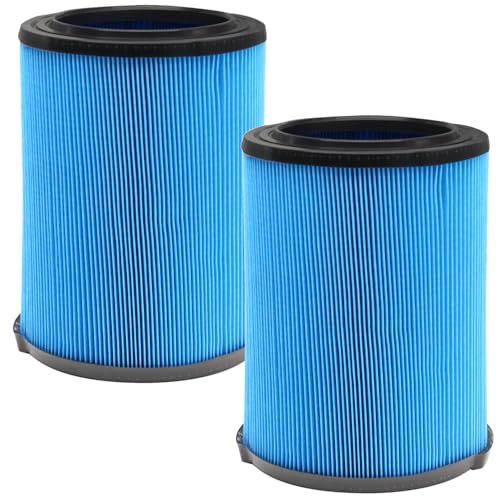
Filtration decides whether a vacuum collects fine dust or simply redistributes it. Look closely at what filter is installed, what it is rated to catch, and how the filter housing is sealed. A good filter in a leaky housing still lets dust pass around it.
You will see several terms in product descriptions. Standard cartridge filters are fine for chips. Fine-dust or high-efficiency filters catch smaller particles. HEPA-rated filters meet a recognized standard for capturing very small particles, but the rating applies only if the whole machine is built and sealed to maintain it. Look for specific language in the manufacturer’s documentation, and rely on stated ratings rather than marketing phrases such as “ultra-fine” that have no defined meaning. Dust classification standards also exist in some regions and describe how well a vacuum is suited to different dust hazard levels. Check what applies where you live.
Filter bags add another layer. A disposable collection bag sits inside the tank and traps fine dust so the filter clogs less. Bags also make emptying cleaner, because you remove the bag rather than dumping loose powder. Foam sleeves are meant for wet use and should be removed for dry fine dust unless the manufacturer instructs otherwise.
Filter-cleaning systems help too. Some vacuums have a manual flapper, a reverse-pulse feature, or an automatic cleaning cycle that knocks dust off the filter surface. They extend working time between clogs but do not replace periodic filter inspection and replacement.
Airflow, suction, and hose size
Vacuum specifications usually list horsepower, amps, airflow, and water lift or sealed suction. These measure different things, and each has a role.
Airflow, measured as volume moved over time, determines how well the vacuum carries fine dust away from a tool. Water lift (also called sealed suction) describes the strength of the vacuum at a closed intake, which matters for pulling dust through long or narrow hoses and for picking up heavy debris. Woodworking dust collection at a sander generally benefits from good airflow with a reasonably wide hose. Horsepower figures printed on consumer vacuums are often peak ratings and can mislead. Compare airflow and amp ratings, measured the same way, when manufacturers provide them.
Hose diameter has a huge effect. A narrow hose restricts airflow and clogs on chips. A wide hose carries more air but may not fit small tool ports. Most power tool ports are smaller than the vacuum’s hose, so adapters or tapered fittings are common. Keep the hose as short and straight as the job allows, because length and bends reduce performance. A smooth-bore hose generally moves air better than a heavily ribbed one, although flexibility matters for handheld tools.
Capacity, portability, and noise
Tank capacity is the volume of debris the vacuum can hold before you empty it. A small tank is easy to move but fills quickly with chips, while a large one holds more but weighs more and takes up space. A mid-size tank suits many home shops. If you pair the vacuum with a separator, the separator’s bucket takes the load and the vacuum tank rarely fills.
Portability depends on wheels, handle design, cord length, and hose storage. A vacuum on casters that tracks smoothly behind you will get used more than a heavy one you have to drag. Cord management also matters: a long cord avoids using extension cords that can lose power.
Shop vacuums are loud. Some have noise-reduction features, such as insulated motor housings or lower-speed modes, but you should still wear hearing protection. Where manufacturers publish sound ratings, compare them using the same measurement method. Quiet operation is a real quality-of-life benefit in an attached garage or a basement under living space.
Connecting to your tools
A vacuum is only as useful as its connection to the tool. Check these points before you buy.
- Port sizes. Measure the dust ports on your sander, saw, router, and other tools. Look for adapter sets or universal cuffs that cover several diameters.
- Hose attachments. A swivel at the tool end prevents the hose from twisting and dragging. Quick-connect fittings make switching tools faster.
- Automatic switches. A tool-activated outlet starts the vacuum when you start the tool and keeps it running briefly afterward. Verify that the outlet’s rating matches your tool’s power consumption.
- Floor and bench tools. Floor tools, crevice tools, and brush attachments make cleanup quicker. They matter more than people expect because cleanup is where a vacuum spends much of its time.
For table saws, miter saws, and planers, a standard shop vacuum often cannot move enough air to capture all the chips. It can help at the dust port, but a larger collector is better suited to those machines. Sanders, routers, and handheld sanders are where a good shop vacuum shines.
Cyclone separators and pre-separation
A cyclone separator spins incoming air so heavier debris falls into a bin before the air reaches the vacuum. Because most of the volume never touches the filter, the filter stays clean and suction stays stronger. A separator also makes emptying easy, since you dump a bucket instead of a filter-clogged tank.
Separators come as lids on a bucket, as bolt-on units, or as built-in features of some vacuums. Check that the hose connections are airtight and that the bucket or lid is rated for the suction level, because a weak container can collapse under strong vacuum. Sizing matters too: pick a separator whose inlet and outlet match your hose diameter. A mismatched connection restricts airflow.
| Setup | Filter life | Suction over time | Emptying | Typical use |
|---|---|---|---|---|
| Vacuum alone | Shorter with fine dust | Drops as filter clogs | Messy for fine powder | Light use, general cleanup |
| Vacuum with bag | Longer | Better than vacuum alone | Remove and discard the bag | Sanding, fine dust |
| Vacuum with cyclone separator | Much longer | Stays steadier | Dump the separator bucket | Regular sanding and routing |
| Dust extractor with filter cleaning | Long, with cleaning cycle | Steady with automatic cleaning | Bag or container | Daily professional use |
Care, emptying, and safety
Good habits keep the vacuum working and the shop safer.
- Empty the tank or bin before it is full, because overfilled containers reduce airflow.
- Wear a respirator while emptying, since moving fine dust into a bin or bag releases a cloud.
- Clean or replace filters according to the manufacturer’s directions. Tap or brush gently outdoors, away from your face, and never use compressed air in a way that blows dust back into your breathing zone.
- Inspect hoses for cracks and clogs, and check the gaskets and seals where the filter meets the housing.
- Do not vacuum hot embers, smoldering material, or flammable liquids. Sparks and hot debris can ignite dust inside a canister. Sanding metal and wood in the same vacuum can create sparks, so keep them separate.
- Be careful with unusual materials. Some finishes, coatings, and treated woods may contain substances that require special handling and equipment. Consult official guidance.
- Keep the vacuum on a circuit that can handle it along with your tools, and use properly rated extension cords if needed.
- Store hoses loosely coiled, and keep the vacuum in a dry spot.
Common mistakes to avoid
- Trusting the stock filter for fine dust. A general-purpose filter often passes small particles. Check the rating and consider a better filter or a bag.
- Using too small a hose. Narrow hoses clog and starve the tool of airflow.
- Skipping pre-separation. Without a separator, the filter loads quickly and suction falls.
- Relying on peak horsepower numbers. Look for airflow and sealed suction figures instead.
- Dumping dust carelessly. Emptying a container indoors without protection can re-release fine dust.
- Dropping personal protection. A vacuum reduces exposure, but it does not eliminate it.
- Ignoring port compatibility. A vacuum that cannot connect to your tools will sit unused.
Who should choose what
A hobbyist with occasional projects in a garage can start with a mid-size wet/dry vacuum, a fine-dust filter, a bag, and a set of adapters. Add a separator if sanding becomes frequent.
A serious hobbyist who sands weekly will benefit from a separator plus a good filter, or a dust extractor if the budget allows. An automatic tool-start outlet makes the setup nearly effortless.
A professional or full-time shop should strongly consider a dust extractor with certified fine filtration and automatic filter cleaning, along with a dust collector for the large machines.
A shop in a living space, such as a basement or attached garage, should prioritize filtration quality, sealed housings, and lower noise, because exhaust air shares your home.
Buying checklist
- Check the filter type and any published rating, and confirm that replacement filters are available.
- Look for a sealed housing so air cannot bypass the filter.
- Compare airflow and sealed suction figures, not just horsepower.
- Measure your tools’ dust ports and buy matching adapters.
- Choose a hose diameter and length that balance reach with airflow.
- Plan for a cyclone separator or filter bags from the start.
- Pick a tank size you will actually empty, and check weight and caster quality.
- Consider noise if the shop shares walls with living space.
- Confirm cord length and your circuit capacity.
- Budget for a respirator, eye protection, and hearing protection.
Frequently asked questions
Can I use a regular household vacuum for sawdust?
It is not a good idea. Household vacuums are not designed for the volume of fine dust woodworking creates, and the filters clog fast. Fine dust can pass through to the motor and exhaust. A dedicated shop vacuum or dust extractor is better suited.
What is the difference between a shop vac and a dust extractor?
A dust extractor is built for power tools, typically offering finer filtration, filter-cleaning features, and a tool-triggered outlet. A shop vacuum is a general-purpose wet/dry machine. With an upgraded filter and separator, a shop vacuum can work well for many hobby tasks.
Do I need a HEPA vacuum?
Not for every task, but fine dust is the main reason people consider one. If you choose HEPA, check that the entire machine is rated to maintain that performance, not just the filter. Look for the manufacturer’s documented ratings and consult official guidance for your situation.
Will a shop vacuum work with my table saw?
It can help at a saw’s dust port, but most shop vacuums do not move enough air to capture everything from large machines. A larger collector is more effective for table saws, jointers, and planers. A vacuum is usually best on sanders, routers, and small tools.
How often should I clean the filter?
It depends on how much dust you collect and whether you use a separator or bag. Check the filter regularly, and clean or replace it when suction drops or it looks heavily loaded. Follow the manufacturer’s instructions for the filter type.
Why does my vacuum lose suction?
The most common causes are a clogged filter, a full tank, a blocked hose, or an air leak at a connection. Check each in turn. A separator greatly reduces filter clogging.
Can I vacuum water and sawdust with the same machine?
Wet/dry vacuums can handle liquids, but wet material mixes with fine dust to create sludge that clogs filters. Remove or change filters as the manufacturer requires for wet pick-up, and clean the tank thoroughly afterward.
Is wood dust dangerous?
Fine wood dust can irritate the eyes, nose, and lungs, and some species are known to cause reactions in sensitive people. Dust can also be a fire hazard when it accumulates. Use dust collection, ventilate the shop, wear a suitable respirator, and consult official safety guidance for your materials.
Conclusion
The best shop vacuum for woodworking dust is not the loudest or the one with the biggest horsepower claim. It is the one with a fine-dust filter in a sealed housing, enough airflow, a hose that fits your tools, and some means of keeping chips off the filter. Most shops get excellent results from a mid-size vacuum plus a cyclone separator. Move up to a dust extractor when your use justifies it, and keep wearing protective gear. Clean air and a tidy shop make every project more enjoyable.
These links can help you start comparing equipment and accessories:
- Shop vacuums and dust extractors
- Cyclone separators
- Fine-dust filters and filter bags
- Dust port adapter sets
Disclosure: As an Amazon Associate, we earn from qualifying purchases. This comes at no extra cost to you.
Related guides
More from Amazon
Programs that pair well with the guide above. Offers and eligibility are set by Amazon and may change.
A free business account with business pricing and bulk-buying tools for work, shop or home office.
Create a business accountFree shipping on eligible items, Prime Video and more. Eligible new members can start with a free trial.
Start a Prime free trialAudiobooks and podcasts to listen to on the go. Eligible new members can start with a free trial.
Try Audible freeAd-free music streaming. Eligible new subscribers can start with a free trial.
Try Music Unlimited freeAs an Amazon Associate we earn from qualifying purchases.

Write Your Review
No reviews yet. Be the first to share your experience!