Best Band Saws for Workshop Production of Repeated Curved Parts
What's inside
As an Amazon Associate I earn from qualifying purchases. This post may contain affiliate links at no extra cost to you.
Making one curved part is easy enough with a jigsaw or handheld router. Making 50 identical curved parts is different. The machine has to hold a steady feed rate, accept a proper fence or template, keep the blade tracking accurately, and remove dust without forcing you to stop every few minutes.
For workshop production, a stationary band saw is usually the best balance of capacity, control, and operating cost. The right choice depends less on advertised horsepower than on throat depth, wheel size, blade guides, table stability, and how well the saw supports a repeatable cutting method.
As an Amazon Associate we earn from qualifying purchases at no extra cost to you.

Contents
What matters for repeated curves
Throat depth determines how far a workpiece can extend from the blade. For chair parts, cabriole-style components, guitar blanks, and similar work, a 14-inch saw with roughly 12 to 14 inches of usable throat is adequate for many jobs. If your parts are wide or you need to cut curves from large panels, an 18-inch saw gives noticeably more working room.
Cutting height matters even when you are not resawing. A 6-inch capacity is comfortable for laminations and smaller hardwood parts. A machine with 10 to 12 inches of capacity gives more freedom for thick blanks, but it also needs a stiffer frame and a properly tensioned blade. Do not assume that a taller capacity automatically means a better curved-part saw; excessive blade exposure can make a narrow blade wander.
Wheel diameter affects the types of blades the saw can use. Larger wheels generally put less severe bending stress on the blade, which is useful when running wider blades or cutting thick stock. A 14-inch saw is the common workshop standard. An 18-inch or larger machine is worthwhile when production includes thick hardwood, substantial resawing, or large templates.
The best saw types for this work
| Machine type | Best use | Main limitation |
|---|---|---|
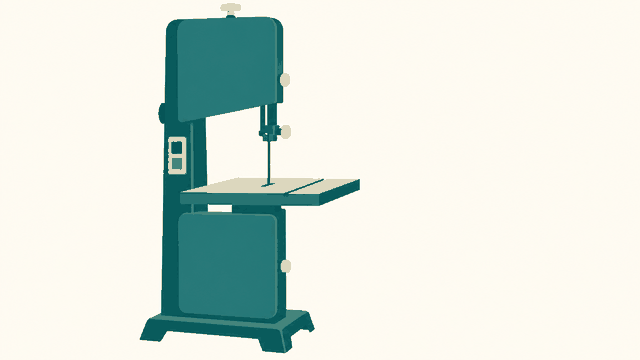
| 14-inch enclosed-frame band saw | General curved parts, furniture components, small-batch production | Less capacity and stiffness than larger machines |
| 14-inch saw with riser block | More cutting height at moderate cost | Usually less rigid for thick stock and resawing |
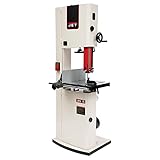
| 18-inch heavy-frame band saw | Thick hardwood, wide templates, continuous workshop production | Higher cost, larger footprint, and greater power demand |
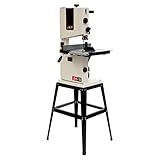
| Small benchtop band saw | Thin parts, light-duty curves, occasional hobby work | Limited throat, small table, and less consistent tracking |
For most serious home workshops and small production shops, a good 14-inch woodworking band saw is the sensible starting point. It is large enough for most furniture curves without taking the space or budget of an industrial machine.
A riser block can be a cheaper way to gain cutting height. It is fine when you occasionally cut thicker blanks and mainly use narrow blades. It is less attractive if the saw will spend hours resawing dense lumber, because the added frame height can make alignment and tensioning more demanding. For routine production in thick material, buy a machine designed for the capacity rather than upgrading a smaller one.
Blade selection and setup
Blade choice has more effect on curved cuts than a modest difference in motor horsepower. A 1/4-inch blade with 4 to 6 teeth per inch can follow relatively tight curves. A 3/8-inch blade is a better general-purpose choice for medium curves because it is easier to control and less prone to twisting. A 1/2-inch blade is useful for straight cuts and resawing, but it will not turn sharply without distorting the cut.
For production, keep several blades prepared for specific jobs instead of using one compromise blade. A skip-tooth blade clears waste effectively in thicker softwood. A regular-tooth blade often leaves a more controlled cut in hardwood. A blade with 3 or 4 teeth engaged in the stock at all times is a practical starting point; too many teeth pack with dust, while too few increase vibration and roughness.
Set the blade tension according to the blade manufacturer’s instructions, not just the scale on the saw. Many built-in tension gauges are approximate. With the machine unplugged, adjust the upper and lower guides close to the blade without touching it, then set the thrust bearings just behind the blade. Guides positioned too far away allow the blade to twist when the workpiece enters a curve.
Failure modes are predictable. A blade that drifts during a straight approach is often dull, incorrectly tensioned, or poorly tracked. A curve that cuts wider at the bottom usually indicates guide problems, excessive feed pressure, or a blade that is too narrow for the material. Burn marks mean the blade is rubbing, dull, or being fed too slowly. Replace a blade when sharpening no longer restores tracking; fighting a damaged blade wastes more time than its cost.
How to make repeated parts accurately
A template is more reliable than trying to redraw every part. Make one accurate master from plywood, MDF, or plastic, and leave a straight reference edge if possible. Use a bearing-guided template bit at the router after roughing out the curves on the band saw, or use a shop-made guide and keep the band saw cut slightly outside the final line.
Do not cut directly against a loose template near the blade. Clamp the template securely to the blank, or use a dedicated pattern-cutting fixture with a pivot, stop, or bearing. For parts that are too large to maneuver safely, make a sled that supports the work and prevents the stock from rotating into the blade. A fixture that saves two seconds per part can pay for itself quickly across a batch of 100.
Leave about 1/16 inch of waste for a final router-trimming operation. Trying to cut exactly on the finished line increases the chance of ruining a part when the blade wanders. If the saw is expected to produce finished edges directly, use a finer blade and test the feed rate on scrap first. The trade-off is slower cutting and more frequent cleaning of the gullets.
Features worth paying for
A heavy cast-iron table, rigid trunnion, positive blade tracking adjustment, and accessible guide controls matter more than decorative features. A quick-release blade tension lever is useful when switching between curve and resaw blades. Two-speed machines can be helpful for different materials, though many woodworkers get equal practical benefit from keeping the blade selection correct.
Dust collection should connect close to the lower wheel and blade area. A 4-inch port connected to a collector capable of roughly 400 CFM at the machine is a reasonable target, although actual airflow depends on hose length and fittings. Poor dust extraction packs sawdust into the lower wheel, reduces tracking accuracy, and creates a fire hazard around resinous wood.
A quality 18-inch band saw is justified when parts are wide, blanks are thick, or the machine will run daily. Otherwise, spend the difference between an entry-level and better 14-inch saw on blades, a stable mobile base, dust collection, and a proper template fixture. Those upgrades usually improve repeated curves more than an extra fraction of horsepower.
What to buy for your shop
Choose a 14-inch enclosed-frame saw for most furniture and craft production, especially when parts are under 6 inches thick and fit within a 12-inch throat. Choose an 18-inch heavy-frame saw for frequent thick-stock work, large templates, or production that cannot tolerate frequent blade changes and realignment.
The cheaper benchtop option is acceptable for occasional thin plywood curves and small parts. It becomes false economy when the table flexes, the guides are difficult to adjust, or the blade loses tension during a long batch. Before buying, take a sample blank and template size, measure the required throat and cutting height, and confirm that the saw can accept the blade widths your process needs. That simple check prevents buying capacity you cannot use—or a machine that makes every repeated curve a separate experiment.