Best Band Saws for Cutting Curved Dovetail Drawer Components
What's inside
As an Amazon Associate I earn from qualifying purchases. This post may contain affiliate links at no extra cost to you.
Curved dovetail drawer components are a demanding band saw job. The cuts are often narrow, the workpieces may be valuable hardwood, and a small error can ruin the fit between a drawer front, side, or curved transition piece. The best saw is not necessarily the largest one. You need controlled blade tracking, enough throat depth for the work, a table that stays square, and a fence or guide system that does not interfere with curved cuts.
As an Amazon Associate we earn from qualifying purchases at no extra cost to you.

Contents
What the Saw Must Do
For most drawer work, a band saw with a 12- to 14-inch wheel diameter and roughly 6 inches of resaw capacity is the practical minimum. A 14-inch saw with 12 inches of resaw height gives more room, but that extra capacity matters mainly when cutting thick stock or resawing drawer sides. It does not automatically make curved cuts more accurate.
Look for a rigid cast-iron or heavy-gauge steel frame, upper and lower blade guides that can be adjusted close to the work, and a table at least 14 inches wide. A table that flexes when you push a workpiece through a curve makes it difficult to keep the cut perpendicular. A solid trunnion is also important. If the table shifts when tilted or locked, the two halves of a dovetail will not match reliably.
For a focused search, compare 14-inch woodworking band saws rather than judging machines by motor horsepower alone. A 1- to 1-1/2-horsepower motor is usually enough for drawer components. A well-guided 1-horsepower saw can outperform a poorly aligned 1-1/2-horsepower machine.
Features That Matter for Curved Dovetails
| Feature | What to look for | Why it matters |
|---|---|---|
| Wheel size | 12 to 14 inches | Provides a useful balance of control, capacity, and footprint |
| Throat depth | At least 12 inches | Leaves room to rotate curved drawer parts without hitting the frame |
| Resaw capacity | 6 inches minimum; 10 to 12 inches is more versatile | Handles thicker drawer sides and future resawing work |
| Blade guides | Ball-bearing or ceramic guides with easy adjustment | Reduces blade wandering at the start and end of a cut |
| Table tilt | Positive, repeatable locking mechanism | Helps maintain consistent bevels and paired components |
| Dust collection | 4-inch port with a lower wheel enclosure | Curved cuts produce fine dust and obscure layout lines |
For tight curves, the blade is more important than an extra inch of capacity. A 1/4-inch blade with 6 to 10 teeth per inch is a good general choice for small drawer components. A 3/16-inch blade can follow tighter curves, but it is easier to twist, dull, or break if you force the stock. Use a 3/8-inch blade when the curve is broad or when the workpiece is thick enough that a narrow blade wanders.
Choose a blade with a proper tooth set. Too much set leaves a rough, oversized kerf and increases the amount of material that must be removed during fitting. Too little set can cause the blade to pinch in dense hardwood. Keep a separate blade for curved work instead of trying to use one blade for resawing, straight cuts, and small radii.
Best Band Saw Types for the Job
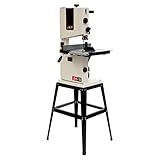
A benchtop band saw is the low-cost option. It can cut curved drawer components from thin stock, especially when the parts are less than 1-1/2 inches thick and the curves are generous. It is a reasonable choice for an occasional project. The limitations are typically a small table, weaker blade tension, less effective guides, and little room for safe hand positioning.
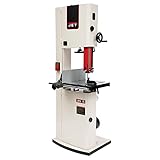
A 14-inch floor-standing band saw is the best all-around category for a serious hobbyist or small cabinet shop. It normally offers a larger table, better guide adjustment, more stable tracking, and enough throat depth for curved drawer fronts. If you are buying one machine for furniture work, start here. You can find current options by comparing floor-standing 14-inch band saws.
A larger 17- to 18-inch saw makes sense when you routinely resaw wide boards or cut thick stock. For curved dovetail components alone, it is usually unnecessary. These machines cost more, take more floor space, and may require a dedicated circuit. Buy the larger class because you need resaw height or production capacity, not because the number sounds better.
Setup and Cutting Method
Install a sharp blade and tension it according to the manufacturer’s instructions. Then check that the blade tracks near the center of the upper wheel, set the thrust and side guides just behind the blade gullets, and verify that the table is square to the blade. Place a straightedge against the blade rather than trusting the factory table scale.
Test the setup on scrap from the same species and thickness as the drawer parts. Make a curved cut, then check whether the kerf is perpendicular and whether the blade drifts. If the blade consistently leaves the layout line on one side, correct the fence or your feed angle before cutting expensive stock. Do not compensate for drift by twisting the workpiece through the curve; that creates a tapered cut and makes matched parts difficult.
Cut outside the layout line, leaving approximately 1/32 inch for a flush-trim bit, spokeshave, or sanding. For a dovetail component, that allowance is especially useful because the final joint depends on consistent reference faces. Use a push stick or purpose-made push block when the cut brings your hands close to the blade, and keep the blade guard as low as practical—normally within 1/4 inch of the stock.
Common Failure Modes
If the blade wanders at the beginning of a cut, the usual causes are a dull blade, insufficient tension, guides set too far away, or feeding too quickly. If the cut burns, reduce feed pressure, clean resin from the blade, or use a blade with fewer teeth per inch. Burning on hardwood is often a symptom of rubbing rather than inadequate motor power.
When paired drawer components do not match, check your reference faces and blade angle before blaming the saw. Mark the face side and cut both mating parts with the same setup whenever possible. A fence is useful for straight entry cuts, but remove it or keep it clear when following a curve. For occasional work, a band saw blade assortment can be cheaper than forcing one general-purpose blade to handle every radius and thickness.
The cheaper machine is fine when you cut thin drawer parts a few times a year and are willing to tune it carefully. Spend more for a rigid 14-inch saw when you make several drawers, work in dense hardwood, or need repeatable matched components. In this job, accurate setup and the right blade usually produce a larger improvement than buying the biggest motor.