Jointer vs Planer: Which Machine Should Flatten a Board First?
What's inside
As an Amazon Associate I earn from qualifying purchases. This post may contain affiliate links at no extra cost to you.
A jointer and a planer both remove wood, but they solve different problems. A jointer makes one face flat and one edge square to that face. A thickness planer makes the opposite face parallel to the face already flattened. For a rough board that is twisted or bowed, joint it first, then plane it to thickness.
As an Amazon Associate we earn from qualifying purchases at no extra cost to you.


Contents
What each machine does
A jointer has a flat infeed table, a cutterhead, and an outfeed table. You press the board against the tables and feed it over the knives or cutterhead. The machine cuts high spots until the face rides steadily on the tables. Once that face is flat, you can joint an edge against the fence to make it straight and square.
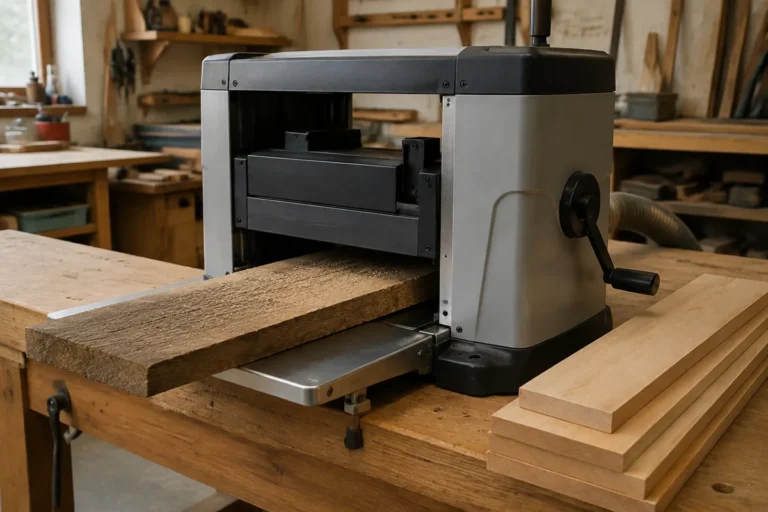
A planer feeds a board beneath a cutterhead using rollers. Its bed supports the board, while the cutterhead trims the top face to a set height. Because the board rides on its underside, the planer follows the shape of that underside. It can make a board consistently thick, but it cannot reliably remove a twist or bow by itself.
Which machine should flatten a board first?
For solid lumber with uneven faces, use a jointer first. Flatten one face, then put that face down on the planer bed. Plane the opposite face until it is parallel. Flip and repeat with light cuts if needed to reach your target thickness. Joint one edge and rip the other edge parallel on a table saw.
If you plane a twisted board before flattening it, the rollers can press the board flat temporarily. The cutterhead then cuts a surface parallel to the board’s bent underside. Once the board leaves the machine and relaxes, it can spring back, leaving you with two faces that are smooth but still twisted relative to each other.
This sequence assumes the board is sound and has enough thickness to lose material. A board with severe cup, deep checks, or twist may need to be cut shorter or ripped into narrower pieces before flattening. Removing a lot of material can expose internal stress and cause the board to move again.
Jointer vs. planer at a glance
| Task | Jointer | Planer |
|---|---|---|
| Flatten one face | Yes; its main job | Only if the underside is already flat or supported by a sled |
| Make faces parallel | No | Yes, after one face is flat |
| Straighten an edge | Yes, with the fence | No |
| Set consistent thickness | No | Yes |
| Typical width limit | Often 6 or 8 inches on benchtop machines | Often 12 or 13 inches on portable machines |
When a planer can work without a jointer
A planer is enough when the board already has a stable, flat reference face—for example, lumber that was flattened by a supplier or a panel assembled from accurately milled stock. It is also useful for bringing boards to a common thickness after you have established a flat face another way.
You can flatten a rough board with a planer and a rigid sled. Secure the board to the sled with shims or wedges so it cannot rock, and make shallow passes until the exposed face is flat. Then remove the board, turn it over, and plane the opposite face. This is a workable substitute for a jointer, especially for wide stock, but the sled takes setup time and reduces the planer’s usable height. A loose shim or unstable board can shift and spoil the cut.
For occasional projects, a sled may be cheaper than buying a jointer. If you routinely mill rough lumber, a jointer is faster and simpler. A benchtop jointer suits short, narrow boards and a limited shop budget, but its short tables make long stock harder to control. For longer boards, table length matters more than a large motor rating.
Choosing the right capacity
Jointer width determines the widest face you can flatten in one pass. A 6-inch jointer is common in small shops; an 8-inch machine handles more furniture stock, but costs more and needs more floor space. You can flatten a wider panel in sections with a planer sled or a router setup, but that is slower than a machine wide enough for the work.
Planer width sets the maximum board width, while the opening height sets maximum thickness. Portable planers commonly handle boards around 12 or 13 inches wide. Check the actual cut capacity, especially if you expect to plane tall legs or glued-up panels. A portable thickness planer is often the better first purchase if you mostly buy surfaced lumber and need repeatable thickness.
Neither machine replaces careful feeding. Take light cuts—often about 1/32 inch on a jointer for ordinary hardwood, less for difficult grain—and avoid forcing a bowed board flat against the tables. On a planer, deep cuts can bog down the motor, leave ridges, or increase snipe: a deeper cut near the board’s leading or trailing end. Supporting long boards level with the machine helps prevent feed problems.
What should you buy first?
If your lumber is rough-sawn and you want to mill it yourself, a jointer and planer are a useful pair. The jointer creates the reference face; the planer makes the board parallel and brings it to thickness. If you can afford only one, choose based on the stock you actually use. Buy a planer first for already-flat lumber or projects where thickness consistency is the main need. Buy a jointer first if your boards arrive bowed or twisted and you have another way to thickness them, such as a sled or access to a shared planer.
For a budget shop, paying a lumber dealer to surface boards can be cheaper than buying both machines, especially if you work with only a few boards a year. But surfaced stock may still move after acclimating, and the service may not mill it to your exact final thickness. The right choice depends less on which machine sounds more versatile and more on whether your starting boards need a flat reference face.