Band Saw vs Planer for Processing Thick Rough-Sawn Slabs
What's inside
As an Amazon Associate I earn from qualifying purchases. This post may contain affiliate links at no extra cost to you.
Contents
The short answer
A band saw and a planer do different jobs when you are processing thick rough-sawn slabs. The band saw removes excess thickness and can cut around defects. The planer produces a smooth, parallel face and consistent thickness, but it needs a reasonably flat, stable reference surface before it can work safely.
For most slabs, neither machine solves the entire problem alone. A typical workflow is to flatten one face with a router sled, wide jointer, or carefully supported planer sled, then use the planer to bring the opposite face parallel. A band saw becomes useful when the slab is too thick for the planer, when you want to resaw it into thinner boards, or when you need to remove a large amount of waste before milling.
As an Amazon Associate we earn from qualifying purchases at no extra cost to you.


What a band saw does best
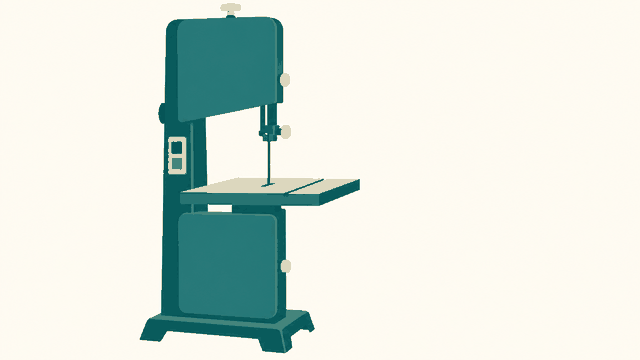
A band saw is the better first machine when the rough stock is substantially oversized. A 14-inch saw with a 6-inch resaw capacity can split a 5-inch slab into two boards, provided the blade, guides, fence, and motor are up to the job. Larger 18- or 20-inch machines commonly offer 10 to 14 inches of resaw height, which is more practical for thick hardwood.
Resawing can save a great deal of wood. Instead of turning a 3-inch slab into planer shavings, you can split it into two pieces roughly 1-1/4 inches thick, leaving allowance for flattening. This is especially useful with expensive walnut, maple, cherry, or salvaged beams.
Use a coarse, sharp blade rather than a narrow scroll-cutting blade. A 3/4-inch blade with roughly 2 to 3 teeth per inch is a reasonable starting point for straight resaw cuts on many larger saws. Feed steadily without forcing the stock. If the cut wanders, the blade may be dull, improperly tensioned, too narrow for the task, or poorly aligned.
The main failure mode is a wandering cut that produces a tapered board. Pinching the blade is another risk, particularly when internal tension closes the kerf behind the blade. Mark the cut line on both ends, support the slab securely, and never try to hold an unstable slab against the fence by hand. A tall resaw fence and a correctly tuned band saw resaw blade are worthwhile upgrades.
What a planer does best
A thickness planer excels after one face is flat. It references that face on its bed and cuts the opposite face parallel to it. For furniture parts, this is faster and more repeatable than hand planing. A 13-inch benchtop planer is enough for many boards, while a 15-inch stationary planer offers more capacity and generally better dust collection and feed support.
Planer capacity is not just the advertised width. Check the maximum height, which may be around 6 inches on a benchtop machine and 8 to 12 inches on larger machines. A thick slab that technically fits may still be too heavy or awkward to feed safely. Leave at least 1/16 inch of extra thickness for cleanup, and more if the slab has serious twist or tear-out.
Do not put a rocking, cupped slab directly into a planer and expect it to flatten. The rollers can press the slab down temporarily; once it leaves the machine, the original cup returns. The cutter head then follows that shape and removes material unevenly. Severe twist can also cause poor feeding, snipe, or a slab becoming trapped under the cutter head.
For warped stock, mount the slab to a rigid, flat sled with shims or hot-melt glue. Run only the high spots through until one face is flat, remove the sled, and then plane the opposite face normally. A sled adds setup time and reduces usable thickness, but it is cheaper than replacing a damaged cutter head or a kicked-out workpiece. A 15-inch thickness planer is a better long-term choice than a small machine if you regularly process wide hardwood.
Band saw versus planer
| Consideration | Band saw | Planer |
|---|---|---|
| Primary job | Resawing, ripping, and removing large waste | Making a flat reference face and consistent thickness |
| Works well on cupped stock | Usually, if the slab is supported securely | No, unless used with a sled |
| Typical material loss | Kerf plus later milling allowance | Shavings from every high spot and pass |
| Surface quality | Rough saw marks requiring milling | Smooth, but possible tear-out and snipe |
| Best value when | Slabs are too thick or need to be split | Stock is already fairly flat and needs sizing |
Which machine should you buy first?
Buy the band saw first if your slabs are commonly thicker than your planer’s maximum capacity, if you want to resaw valuable boards, or if you need to cut around knots and cracks. It is also the more forgiving machine for irregular outlines, but it does not leave a furniture-ready surface.
Buy the planer first if your rough boards are already close to flat, usually under 6 inches thick, and your main goal is producing straight, parallel stock. A planer is often the cheaper and faster option for ordinary boards. If you are buying one for occasional home-shop work, a quality 13-inch woodworking planer can be sufficient. Do not pay for a large stationary model merely because it is quieter if you will never process wide or heavy stock.
A practical slab workflow
First, let the slab acclimate in the shop and inspect it for screws, stones, bark inclusions, and metal. Use a metal detector on reclaimed material. Mark the desired thickness and decide whether cracks should be cut away before milling.
Next, remove loose bark and cut the slab to manageable length. If it is far too thick, resaw it on the band saw, leaving approximately 1/8 to 1/4 inch for flattening on each face. If it is within planer capacity but badly twisted, use a sled or flatten the first face with a router sled or jointer.
Once one face is flat, plane the other face in shallow passes. Removing 1/32 inch per pass is safer on difficult hardwood than trying to take 1/8 inch. Listen for motor strain, watch for tear-out near reversing grain, and support long slabs at both ends. Finish with a light cut, then let the wood rest before final dimensioning; movement can reveal stress that was hidden during machining.
Safety and dust control
Both machines produce hazardous dust, and slab milling can generate it quickly. Use dust collection sized for the machine, keep guards and pressure bars adjusted, and wear hearing and eye protection. Never reach into a planer throat while the cutter head is moving. On a band saw, keep your hands out of the blade path and use push devices for short sections.
The right purchase depends on the slab, not the machine’s advertised horsepower. For thick, valuable, irregular stock, the band saw handles the rough conversion and the planer handles final sizing. For ordinary rough boards, the cheaper planer is often enough—provided you flatten one face first.