Best Stationary Planers for Processing Thick Live-Edge Slabs
What's inside
As an Amazon Associate I earn from qualifying purchases. This post may contain affiliate links at no extra cost to you.
Contents
What a planer can—and cannot—do with a live-edge slab
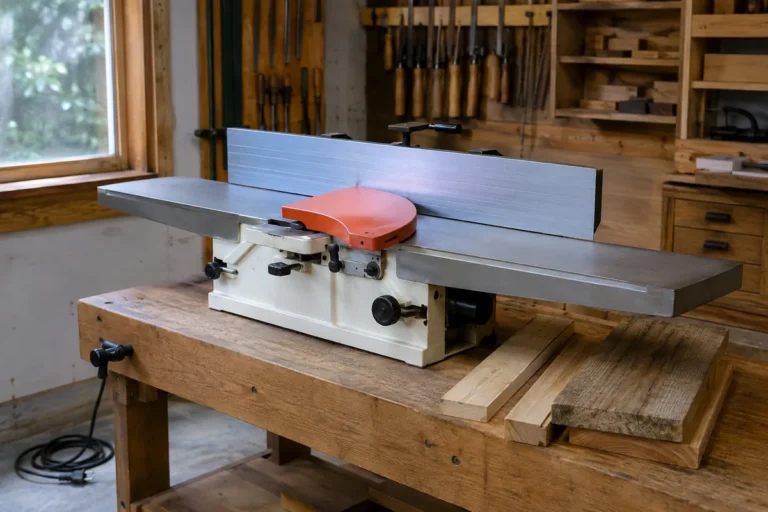
A thickness planer makes the two broad faces of a board parallel and brings it to a consistent thickness. It does not flatten a twisted slab by itself: a board that rocks or bows can come out thinner while keeping much of its original distortion. For a slab, start with one flat reference face, made with a router sled, a wide-belt sander, or a suitably sized jointer. Then plane the opposite face.
Check the machine’s maximum width and thickness before shopping. A 13-inch planer cannot accept a slab wider than its opening, and a stated maximum thickness is not the same as enough clearance for every setup. Measure the slab after removing bark and loose material. Also account for knots, embedded grit, and moisture: metal fragments or sand can wreck knives, while wet stock can stain the bed and move after milling.
Choose by slab size and workload
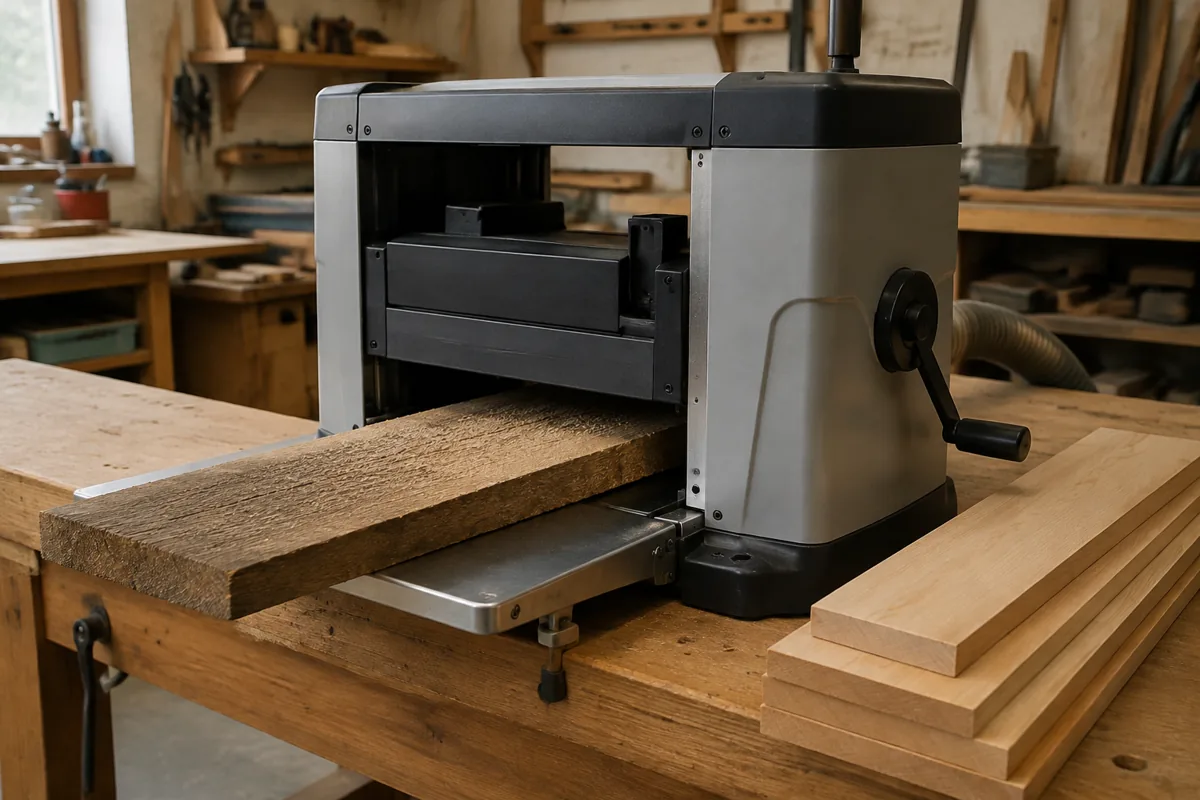
For occasional slabs narrower than about 12 inches, a portable planer is usually the practical choice. It costs less, fits a small shop, and is easier to move. Its limits are real: short tables, modest cutterhead capacity, and a narrow opening make it a poor match for wide or very heavy stock. Use rollers or a helper to support long slabs, but keep the slab level as it enters and exits; sagging can cause snipe or a sudden change in cut.
If your slabs routinely exceed a portable planer’s width, look at a wide planer or a commercial thickness planer. These machines are expensive and need floor space, power, and safe material handling. They also do not eliminate the need for flattening the first face. For unusually wide slabs, a router sled or wide-belt sander may remain the more sensible finishing route.
Compare 13-inch benchtop thickness planers if your stock fits the opening and you value lower cost and portability. If you process thick stock often, search wide stationary thickness planers and compare actual capacity, feed rate, and power requirements rather than buying on the word “industrial.”
Planer types compared
| Type | Best fit | Main trade-off |
|---|---|---|
| Portable, two-knife cutterhead | Occasional slabs up to roughly 12 inches wide | Lowest cost; noisier, more knife maintenance, limited capacity |
| Portable, helical-style cutterhead | Small shops processing figured or knotty stock | Usually costs more; individual inserts can be rotated or replaced |
| Stationary wide planer | Frequent work with slabs wider than portable machines accept | High purchase cost, space and power needs, heavy material handling |
Helical-style heads use small replaceable carbide inserts, often arranged at an angle. They can leave a cleaner surface on reversing grain and may reduce the severity of tear-out, but they cannot prevent it in every board. Inserts also cost money, and a nicked insert can leave a repeating mark until you rotate or replace it. Straight knives are cheaper to sharpen or replace, but a damaged edge affects a wider strip of the cut.
Features worth paying for
A sturdy bed and a reliable thickness scale matter more than a long feature list. A portable planer with adjustable infeed and outfeed tables is easier to tune for snipe. Many machines leave a short dip near each end; sacrificial leader and follower boards can reduce it, but check the finished slab before trimming to final length. Depth stops help repeat settings, though verify them with calipers rather than assuming the scale is exact.
Feed speed affects finish and throughput. A two-speed machine can take a slower cut for figured grain and a faster cut for ordinary stock. Dust collection is not optional: planers produce a large volume of chips quickly. Check the port diameter and whether your extractor can keep up. A clogged chute can force chips back onto the knives and mark the face.
For thick slabs, motor power is useful but not a substitute for sensible cuts. Take light passes—often around 1/32 inch on difficult grain—and inspect the surface after each pass. Deep cuts can bog down a portable machine, leave ridges, or pull loose fibers from knots. Never plane stock with loose bark, hidden fasteners, or cracks that could catch at the cutterhead.
A safer, more repeatable setup
Remove bark and loose inclusions, then inspect both faces and edges for nails, wire, and grit. Confirm the wood is dry enough for the intended project; a slab that is still losing moisture may cup or crack after machining. Securely flatten one face before thicknessing. If using a sled or carrier, make sure it is stable and cannot shift as the rollers pull the work through.
Measure thickness at several points and mark high areas. Set the cut for a small reduction, feed the slab with its flat reference face down, and support it without lifting or steering it into the cutterhead. Keep hands away from the opening and use the manufacturer’s hold-down and anti-kickback safeguards. Do not force a slab that stalls or chatters; stop the machine and find the cause. Check for fresh tear-out, chip buildup, and snipe before increasing the cut.
When a cheaper planer is enough
Choose a basic portable unit if your slabs fit its width, you work on them occasionally, and you are willing to flatten one face by another method. A costlier cutterhead is worthwhile when you regularly plane figured wood, want fewer broad tear-out patches, or value quick insert changes. A wide stationary machine makes sense when capacity is a recurring bottleneck—not merely because the slabs are thick. If the slab is too wide for your machine, stop at a flat reference face and finish with a router sled or sander instead of trying to feed it through an undersized planer.