Best Table Saws with Accurate Miter Gauges for Furniture Parts
What's inside
As an Amazon Associate I earn from qualifying purchases. This post may contain affiliate links at no extra cost to you.
Furniture parts demand more than a straight rip. Crosscut rails, stiles, drawer components, and small panels need repeatable angles, clean support, and a miter gauge that does not shift halfway through a batch. A table saw can do this well, but the saw’s included gauge is often the weak link.
The best setup depends on your shop and the size of the parts. A cabinet saw gives the most stable platform, while a contractor saw costs less and is easier to move. For occasional furniture work, a decent saw with an aftermarket gauge can be a better buy than paying for a premium saw whose stock gauge still has play.
Contents
What Makes a Miter Gauge Accurate
Accuracy starts with the table slot. The gauge bar should fit with minimal side-to-side movement, but it must still slide freely from end to end. A loose fit can turn a nominal 90-degree crosscut into a visibly open frame joint. A gauge that binds is also dangerous because pushing harder can twist the workpiece.
Look for a gauge with adjustable expansion discs or a similar method of removing slot play. A long fence is useful for furniture parts because it supports more of the workpiece. A scale with positive stops at 0, 15, 22.5, 30, and 45 degrees speeds up common cuts, but the stops should be calibrated rather than trusted blindly.
Before cutting expensive stock, check the gauge against the blade using the five-cut method. Cut a narrow strip from a square panel, rotate the panel between cuts, and use the final cut to magnify the error. If the final strip measures 1/32 inch wider at one end over a 20-inch cut, the angular error is roughly 0.09 degrees. That is enough to accumulate into a poor-fitting cabinet or picture frame.
Best Table Saw Types for Furniture Parts
| Saw type | Best use | Typical strengths | Main compromise |
|---|---|---|---|
| Cabinet table saw | Frequent furniture production | Rigid table, powerful motor, strong dust collection | High cost and limited mobility |
| Contractor table saw | Small shops and mixed projects | Good capacity, easier to move, reasonable price | More vibration and usually a less refined stock gauge |
| Hybrid table saw | Dedicated hobby shops | Cabinet-style base with moderate price | Performance varies widely by model |
| Portable jobsite saw | Occasional work or limited space | Low price and easy storage | Small table, shorter gauge, less support |
Best Cabinet Saws for Repeated Parts
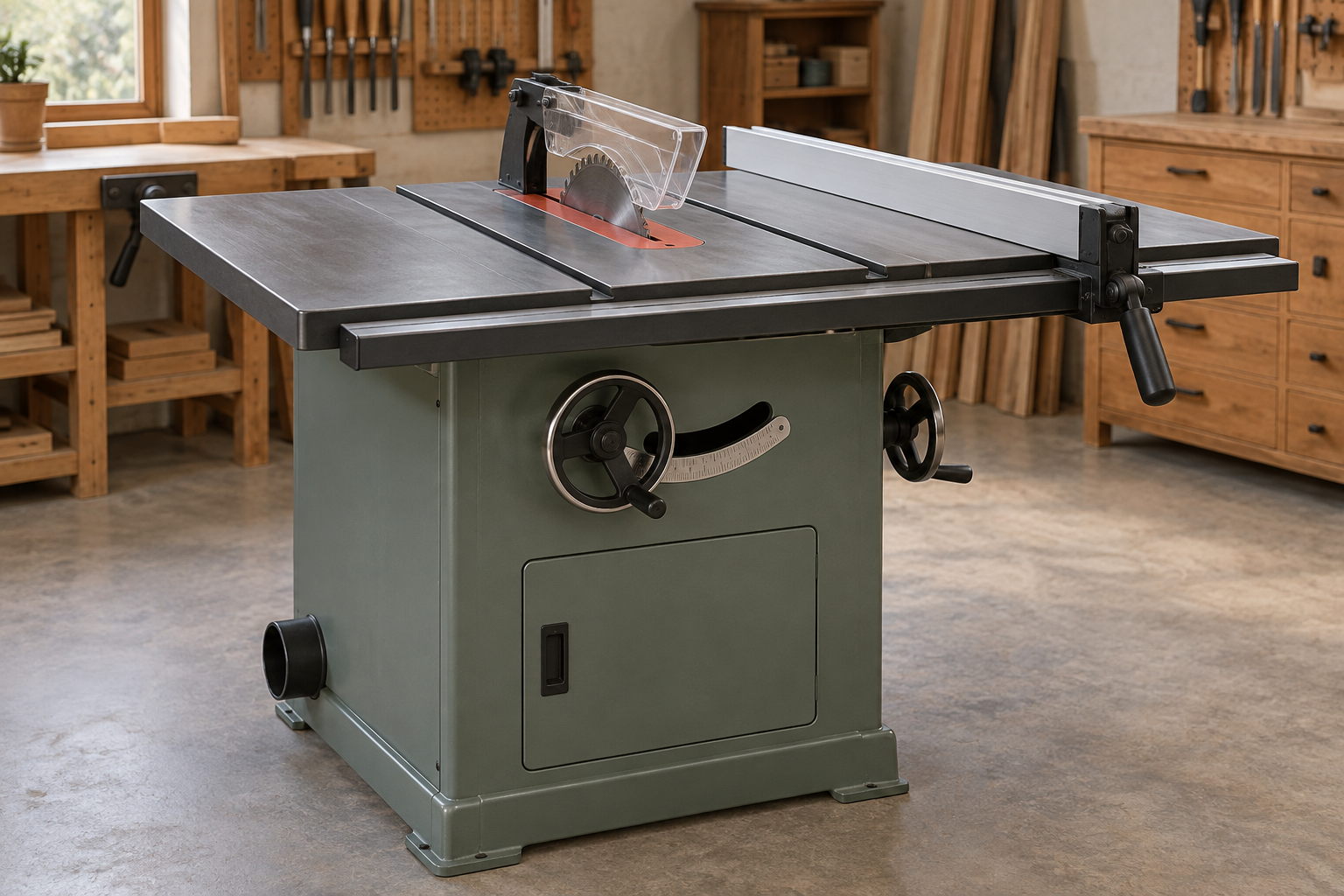
A cabinet saw is the strongest choice when you regularly cut furniture components. Its heavier base and cast-iron top reduce movement while a long crosscut sled or high-quality gauge is in use. The extra mass also helps when cutting thick hardwood, where vibration can cause the workpiece to creep against the gauge fence.
Choose a cabinet saw with a flat table, reliable blade-height mechanism, and a fence that locks parallel without lifting at the rear. A 3-horsepower motor is appropriate for a dedicated 240-volt shop and gives useful reserve for thick maple or oak. For a small garage with a 120-volt circuit, a lower-powered saw can still produce excellent parts if the blade is sharp and the cuts are not rushed.
Most cabinet saws include a basic miter gauge. It may be adequate for rough crosscuts, but furniture work often justifies an precision table saw miter gauge. The upgrade is worthwhile when you make repeated angled parts or do not want to build a crosscut sled.
Best Contractor and Hybrid Saws
Contractor and hybrid saws are the practical middle ground. They are accurate enough for furniture parts when placed on a solid stand and tuned carefully. The lower mass means you should avoid leaning heavily on the table during a cut, and a mobile base should be locked before use.
For most home woodworkers, a hybrid or contractor saw with a 1-3/4 to 2-horsepower motor offers enough capacity. Check that the table has a standard 3/4-inch by 3/8-inch miter slot; this makes it easier to find compatible gauges and sled hardware. A saw with a 30-inch or greater rip capacity is helpful for panels, but it does not automatically improve crosscut accuracy.
A good contractor table saw with a cast-iron table is often the better value than a budget cabinet saw with a poor fence or difficult alignment. Spend the difference on a straight crosscut sled, a sharp combination blade, and dust extraction.
When a Portable Saw Is Enough
A portable jobsite saw is fine for shelves, small boxes, utility furniture, and occasional replacement parts. It becomes frustrating for wide panels and long miters because the table and included gauge provide little support. Small parts can also fall into the gap around the blade or get trapped between the gauge and fence.
If you use one, add a rigid outfeed surface and support the workpiece at the same height as the saw table. Keep the miter gauge fence short enough that it cannot contact the blade. A portable saw paired with an table saw crosscut sled kit can produce very accurate 90-degree parts, often better than its stock gauge. The cheaper option is fine when your parts are short, square cuts and production volume is low.
Setup and Buying Checklist
After assembly, align the blade parallel to the miter slot within about 0.003 inch over the blade’s usable diameter. Set the fence parallel as well; a fence that toes inward can pinch the workpiece and cause burning or kickback. Verify the blade is 90 degrees to the table, then calibrate the miter gauge at 0 and 45 degrees.
Prefer a gauge with a long, replaceable fence and a positive locking handle that does not interfere with the workpiece. For narrow furniture parts, add a sacrificial wooden face and clamp a stop block to it. Never trap a short offcut between the blade and the fence. Use the miter gauge or sled on one side of the blade, and remove or reposition the rip fence when it can contact the cut piece.
For the most reliable results, buy the heaviest saw your shop can support, but do not assume weight fixes poor setup. A carefully tuned contractor saw with a stable gauge will outperform an expensive cabinet saw that has a loose slot, misaligned blade, or unsupported workpiece.