Best Stationary Jointers for Low-Dust Indoor Workshops
What's inside
As an Amazon Associate I earn from qualifying purchases. This post may contain affiliate links at no extra cost to you.
A stationary jointer can make clean, straight reference faces, but it is also one of the messiest machines in a small indoor shop. The cutterhead throws chips at high speed, and a weak dust setup can leave piles under the stand and fine debris in the air. For low-dust use, judge a jointer by its hood and port, the collector you can actually run, and the room’s electrical and space limits—not just its bed length.
As an Amazon Associate we earn from qualifying purchases at no extra cost to you.



Contents
What to buy for your shop
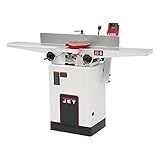
For most home workshops, a 6-inch benchtop or floor-standing jointer is enough for boards up to about 5 inches wide. It is usually the practical choice when floor space, budget, or dust-collection capacity is limited. A 8-inch machine handles wider stock and often has longer tables, but it costs more, takes more room, and can overwhelm a small collector when fed aggressively.
Benchtop machines are easier to store, but their shorter beds make it harder to joint long boards accurately. Floor-standing models are steadier and generally offer longer tables, though they need a permanent footprint. Before buying, measure the infeed and outfeed clearance needed for your longest stock; a 6-foot board needs considerably more than the machine’s table length.
For a first machine, compare 6-inch benchtop jointers if portability matters, or 6-inch floor-standing jointers if you have room for a dedicated setup. Don’t assume a larger dust port means a machine will be clean; the hood’s shape and your collector’s airflow matter just as much.
Dust collection: what actually keeps chips in
Jointers produce coarse chips, not just fine dust. A shop vacuum may capture some debris on a small benchtop machine, but it can clog quickly and usually cannot move enough air through a 4-inch port. A dust collector with a 4-inch hose is a better match for many stationary jointers. Check the machine’s port diameter and collector requirements before purchase; reducers, long hoses, and sharp bends reduce airflow.
As a practical starting point, use a collector rated around 600–1,000 CFM at the machine, while remembering that published ratings are often measured without restrictive ductwork. Keep the hose short, use a blast gate, and avoid narrow adapters where possible. Empty the bag before it is packed full: a loaded filter or bag can sharply reduce suction, so chips escape even when the port is connected.
Some jointers leave a chip pocket around the cutterhead or have a hood that catches shavings. If chips spill from the cabinet, inspect for a blocked chute, loose hose connection, or buildup under the tables. Never reach into the cutterhead area while the machine is plugged in. Fine dust can remain airborne after the visible chips settle; use suitable respiratory protection and ventilate the room, especially when working with irritating or sensitizing wood species.
Comparing common jointer setups
| Setup | Best fit | Dust and accuracy trade-offs |
|---|---|---|
| 6-inch benchtop | Small shops, occasional projects, limited storage | Smaller footprint and often lower cost; short beds demand careful support on long boards. |
| 6-inch floor-standing | Regular use with room for a permanent machine | Longer tables help control stock; needs a stable collector connection and more floor space. |
| 8-inch floor-standing | Wide stock and frequent furniture work | More capacity, but higher purchase and space costs; collector must handle the chip volume. |
These are broad categories, not guarantees of performance. A well-adjusted 6-inch jointer can produce better work than a poorly set up 8-inch machine. If you regularly flatten boards wider than 6 inches, an 8-inch jointer may save glue-up steps, but it still will not flatten a panel wider than its capacity in one pass.
Setup and use to reduce mess
Place the jointer so long boards can travel straight through without striking a wall or another machine. Level and secure a floor-standing unit according to its instructions; vibration can loosen fittings and make chip collection less reliable. On a benchtop model, clamp or bolt it to a solid bench. A wobbly support makes it harder to guide stock consistently and can lead to uneven cuts.
Set knives or inserts carefully and check table alignment before judging cut quality. Dull or nicked knives leave ridges, tear-out, and extra cleanup; a cutterhead that needs maintenance may also pack chips into the hood. Take light cuts—about 1/32 inch is a reasonable starting point for many jobs—and reduce the cut for difficult grain or wide stock. Heavy cuts raise the chance of tear-out, overload the motor, and send more chips toward a collector that may already be near its limit.
Use push blocks, keep hands clear of the cutterhead, and joint only stock that sits securely on the tables. A jointer is not a thickness planer: it makes one face flat and one edge square to that face, but it does not bring the opposite face parallel. After establishing a flat reference face, use a planer for thicknessing. If dust escapes despite a clear hood and clean filter, slow the feed rate, inspect the duct run, and consider a stronger collector before replacing the machine.
A short buying checklist
Before ordering, confirm the cutting width, table length, port size, available replacement knives or inserts, and the machine’s electrical requirements. Verify that the machine fits your doorway and that its stand or bench leaves room for long stock. Look for accessible height adjustments and a cutterhead guard that returns freely; damaged or sticky guards are a safety problem, not a minor convenience.
If your work is occasional and mostly involves narrow boards, the cheaper 6-inch benchtop option can be entirely adequate. Spend the difference on a sound collector, a good filter, and a stable support. If you joint long boards weekly or routinely work near the machine’s capacity, a floor-standing model’s longer tables may be worth more than an extra two inches of width.