How to Choose a Stationary Jointer for a Narrow Workshop
What's inside
As an Amazon Associate I earn from qualifying purchases. This post may contain affiliate links at no extra cost to you.
A stationary jointer can flatten a board’s face and straighten an edge, but it can also take over a small shop. The right choice depends less on the biggest cutterhead you can afford than on the longest boards you need to handle, the space available for infeed and outfeed, and how often you’ll use the machine.
Contents
Measure the working space, not just the footprint
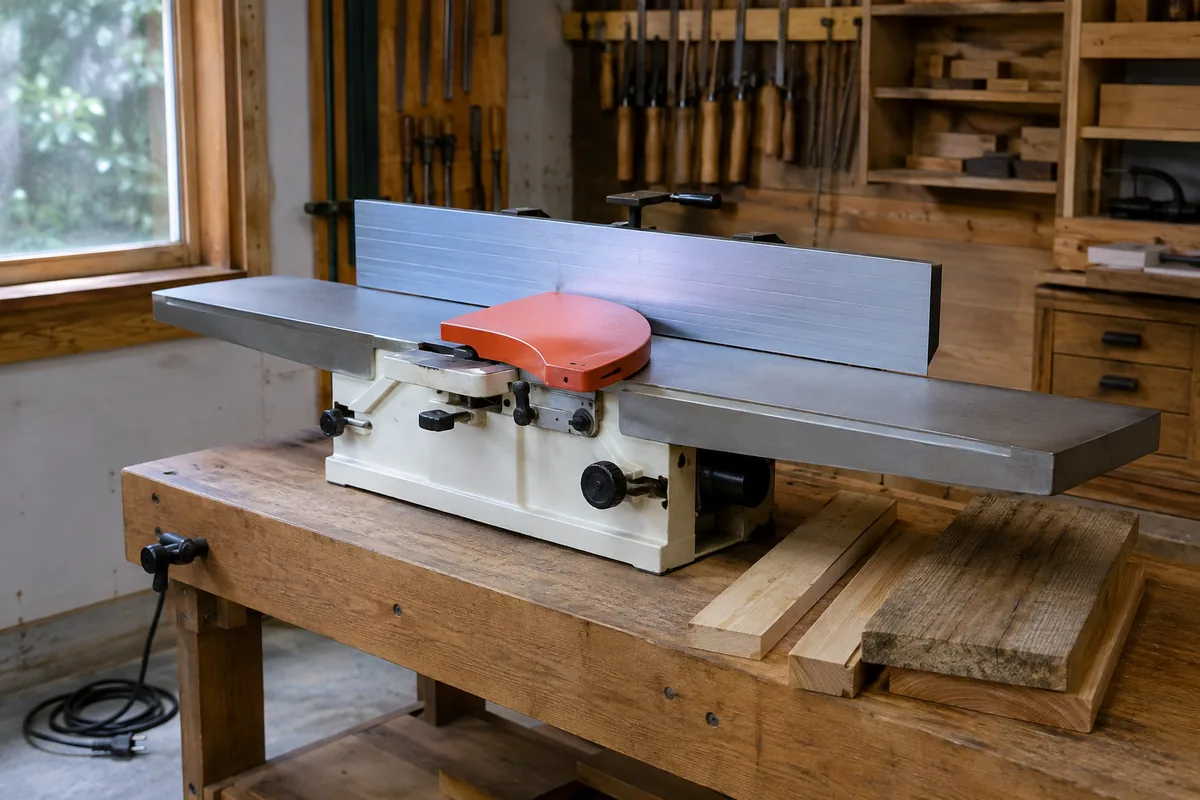
Measure the machine’s base, then account for the board moving through it. A 6-inch jointer with 6-foot-long beds may occupy roughly 2 feet by 3 feet, but a 6-foot board needs several more feet of clear approach and exit space. Allow room to stand beside the cutterhead and adjust the fence, too. Check the manufacturer’s bed length and overall dimensions; layouts vary.
In a narrow shop, a jointer may share a work zone with a table saw or planer. That works if the machines can be moved or the stock can travel through a clear aisle without crossing a wall, doorway, or pile of offcuts. A wheeled base helps reposition the machine, but it does not make a long board easier to control in a cramped corner. If you can’t safely support the board through the cut, a smaller footprint is not a real space saving.
Choose width and bed length for your stock
Most small-shop buyers are deciding between a 6-inch and an 8-inch jointer. A 6-inch model handles typical furniture rails, cabinet parts, and narrow boards. It costs less and is usually easier to fit into a tight shop. Its limit is straightforward: boards wider than 6 inches cannot be jointed flat across their face in one pass. You can sometimes rip a wider board, joint the pieces, and re-glue them, but that adds work and may not suit the project.
An 8-inch jointer gives more capacity for wide panels and rough lumber, but usually costs more, weighs more, and needs longer beds and stronger support. Don’t buy the extra width just because it sounds future-proof if most of your stock is 4 inches wide and your shop cannot accommodate the machine.
Bed length matters when straightening edges. Longer beds help bridge dips and humps in a long board; short beds require more careful handling and make it easier to produce a curved edge by rocking the workpiece. For frequent work on stock around 6 feet long, prioritize a longer bed and adequate support over a bigger cutterhead on a compact machine.
Compare the main stationary options
| Type | Best fit | Main trade-off |
|---|---|---|
| Bench-top jointer | Very limited space, short stock, occasional use | Short beds make long edges harder to straighten; many models have limited width. |
| 6-inch floor-standing jointer | General small-shop furniture and cabinet work | Good capacity for common stock, but cannot face-joint boards over 6 inches wide. |
| 8-inch floor-standing jointer | Frequent use with wider or rougher lumber | Higher cost, greater weight, and more space required. |
A bench-top unit can be a reasonable, lower-cost choice if you mostly joint short parts and can accept its limits. For regular furniture work, compare 6-inch floor-standing jointers with 8-inch floor-standing jointers by bed length, fence, cutterhead, and service parts—not width alone.
Check the cutterhead and fence
Traditional straight-knife heads use replaceable knives and are often the more affordable choice. They can leave a good surface when sharp and correctly set, but dull knives tear out figured grain and need adjustment or replacement. A helical or segmented cutterhead uses small inserts; it typically costs more up front, and a damaged insert can often be rotated rather than requiring a full knife setup. It is not a cure for tear-out in difficult grain, and replacement inserts add ongoing cost. Choose based on maintenance preference and budget, not claims that one head eliminates finishing.
The fence should be rigid, easy to set square to the table, and tall enough to support the stock you edge-joint. Check how it locks at both ends; a fence that shifts under pressure can produce an edge that is not square. For a narrow shop, a fence that tilts or stores compactly may help, but secure locking and repeatable alignment matter more than a folding feature.
Plan for power, dust, and installation
Check the machine’s voltage, amperage, and plug before buying. Many smaller jointers run on a standard 120-volt circuit, while larger machines may require 240 volts. Confirm the circuit can handle the load, especially if a dust collector or another machine shares it. A weak or overloaded circuit can trip during a cut, leaving the board awkwardly positioned.
Jointer chips are bulky. A dust port connected to a suitable collector helps keep the cutterhead area and floor clear, but verify the port diameter and whether your collector can move enough air for the machine. Poor extraction leads to packed chips, messy cleanup, and chips interfering with work. Also check shipping weight and delivery access: a heavy floor-standing jointer may not fit through a narrow doorway in its assembled form.
Avoid common buying mistakes
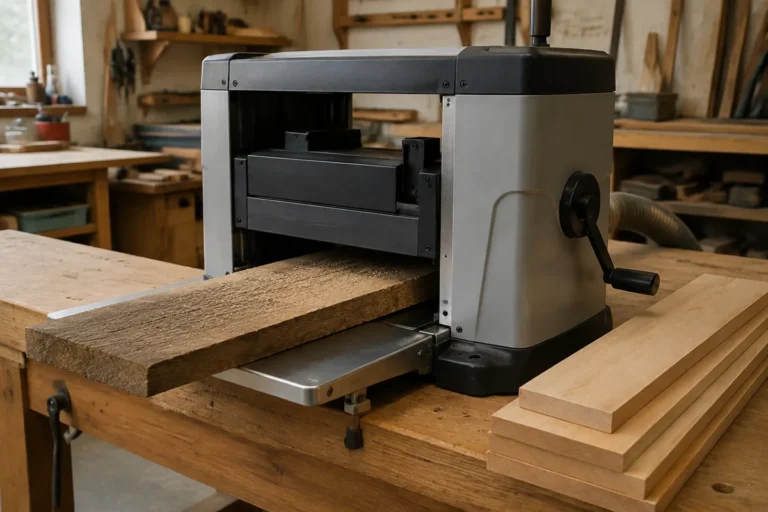
Do not treat a jointer as a thickness planer. A jointer makes one face flat and one edge straight; a planer brings the opposite face parallel to the jointed face. For a small shop building furniture, the pair is more useful than an oversized jointer alone. If you already own a planer but need to joint wider stock than your machine allows, a wider jointer may solve a real bottleneck.
Before ordering, confirm table coplanarity adjustment, knife or insert availability, fence squareness adjustment, dust-port size, and whether a mobile base is included or optional. Check the return and warranty terms as well: a table that is badly out of alignment can take time to diagnose, and shipping a heavy machine back is difficult.
For occasional short parts and severe space limits, a bench-top jointer is a fair compromise. For a typical small woodworking shop, a 6-inch floor-standing machine with the longest practical beds is often the balanced choice. Step up to 8 inches when you regularly work wider boards and have the room, power, and dust collection to support it.