Best Planers with Robust Chip Ejection for Long Work Sessions
What's inside
As an Amazon Associate I earn from qualifying purchases. This post may contain affiliate links at no extra cost to you.
A thickness planer can remove stock quickly, but long sessions expose its weakest point: chip handling. A machine that ejects shavings cleanly for two boards may clog when processing a stack of wide, resinous, or damp lumber. Packed chips can stall the cutterhead, reduce finish quality, overheat the motor, and force you to stop every few minutes to clear the hood.
The best planers for sustained work combine a reasonably large chip outlet with a rigid dust hood, strong blower action, and a cutterhead that does not overload easily. Dust collection still matters. No benchtop planer should be expected to move a full load of chips through a narrow hose without help from a suitable extractor.
As an Amazon Associate we earn from qualifying purchases at no extra cost to you.


Contents
What Makes Chip Ejection Work
Chip ejection starts at the cutterhead. As each knife cuts, the rotating head throws chips toward the exhaust hood. A high-speed cutterhead can move a surprising amount of material, but only if the hood does not leak and the chips have a clear path out.
Look for a dust port around 4 inches in diameter. Some compact machines use a 2-1/2-inch port, which is easier to connect to a shop vacuum but more likely to restrict airflow during heavy cuts. A 4-inch hose connected to a collector with roughly 600 to 1,000 CFM at the machine is a more practical setup for long runs. The published collector rating is often measured with no hose attached, so actual airflow will be lower.
Chip buildup usually comes from one of four problems: taking too deep a cut, feeding wood faster than the machine can clear it, using an undersized collector, or running with a loose or poorly shaped hood. Resinous pine and wet boards are particularly troublesome. They make chips stick to the hood and can quickly reduce the opening.
Best Planer Types for Long Sessions
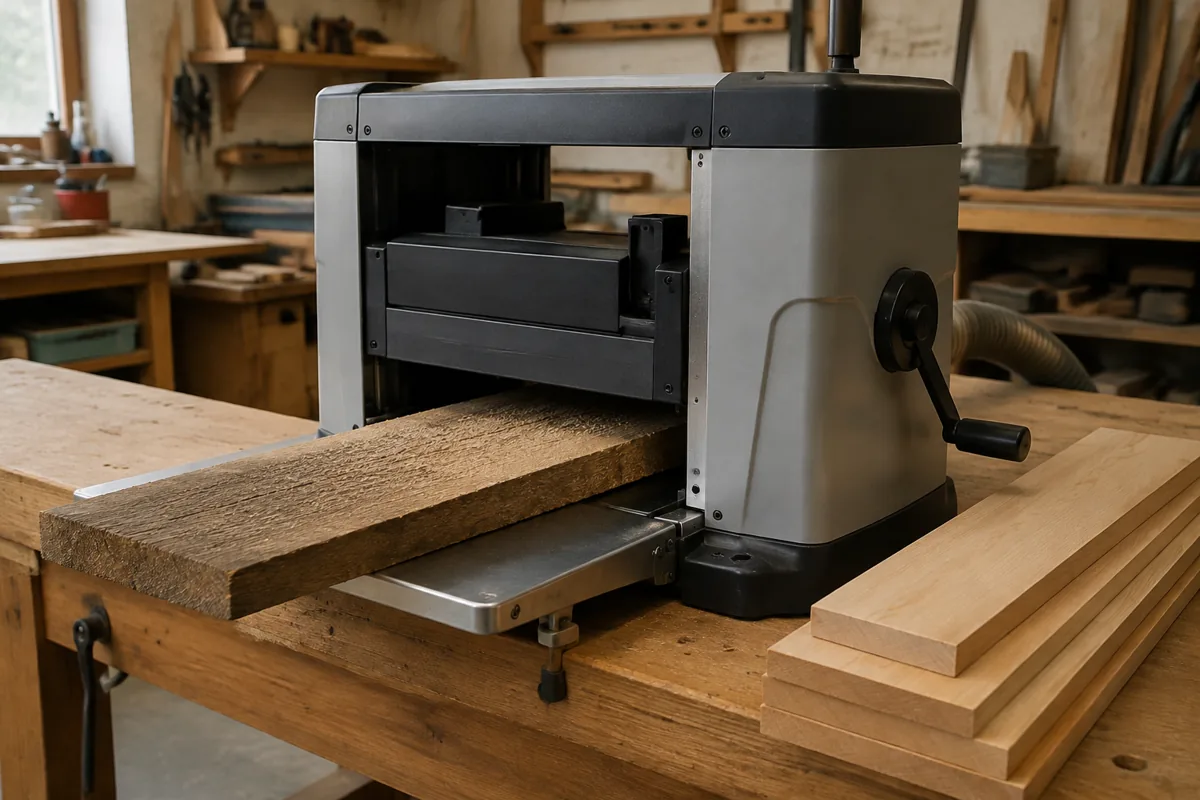
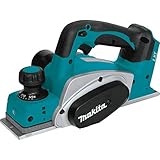
A portable benchtop planer is the sensible choice for most small shops. It is affordable, easy to store, and capable of flattening boards up to about 12 or 13 inches wide. For occasional furniture parts, a well-set-up benchtop thickness planer with a 4-inch dust port is usually enough.
For repeated milling, a heavier stationary planer is more comfortable. Its longer bed, stronger feed rollers, larger motor, and more substantial chip hood reduce interruptions. These machines are also less likely to move across the floor when feeding wide hardwood. The trade-off is cost, footprint, and the need for a dedicated electrical circuit in some cases.
Spiral or helical cutterheads are worth considering when noise, tear-out, and knife changes matter. Their small replaceable inserts often produce shorter chips than straight knives, but they do not automatically solve a weak dust-collection system. A straight-knife planer with a strong collector can eject chips better than a helical machine with a restricted hose.
| Planer type | Typical width | Chip-ejection strengths | Best use |
|---|---|---|---|
| Compact benchtop | 10–12 inches | Good blower action, but sensitive to small hoses | Occasional work and limited space |
| Heavy benchtop | 12–13 inches | Better feed stability and larger hoods | Regular furniture and cabinet parts |
| Stationary floor planer | 15 inches or more | Large ports, powerful motors, fewer stalls | Long production-style sessions |
| Helical-head planer | Usually 12–15 inches | Shorter, more manageable chips; quieter cutting | Hardwood, figured stock, and frequent use |
Features Worth Paying For
A two-speed feed system is useful when the machine will run for hours. The faster setting is efficient for rough sizing; the slower setting generally improves finish quality and reduces the load on the cutterhead. It also gives chips more time to clear when removing material from difficult hardwood.
Ample motor power helps, but horsepower figures can be misleading. A planer that can remove 1/16 inch from softwood may bog down at the same depth in maple. For long sessions, a machine that remains stable at a 1/32-inch finishing cut is often more useful than one advertised with a larger peak horsepower number.
Dust hoods should attach firmly and maintain a smooth interior. Flexible plastic hoods that sag toward the cutterhead can catch chips. Check that the port does not sit directly against a wall or support when the planer is placed on a stand. Leave enough room behind the machine for the hose to make a gradual bend rather than a sharp kink.
Knife access also affects productivity. Reversible disposable knives are quick to replace and eliminate sharpening, while traditional knives can be cheaper over years if you already own a sharpening system. If you process dirty reclaimed lumber, disposable knives may be the cheaper option in practice because one damaged edge does not interrupt the whole job.
Set Up Dust Collection Before Milling
Connect the collector before starting the planer, not after chips begin spilling from the hood. Use the largest hose the machine supports, keep it as short as practical, and avoid reducers unless necessary. A cyclone separator is helpful for long sessions because planer chips fill a collector rapidly and can clog a filter before the bin looks full.
For a compact planer used occasionally, a strong shop vacuum with a cyclone pre-separator can be fine. It is cheaper and easier to store, although the smaller hose may restrict output. If the hood begins puffing chips back into the room, stop and fix the airflow instead of continuing. A clogged filter, full separator, or blocked hose can make an otherwise capable planer appear defective.
A 4-inch cyclone dust separator for woodworking is usually a better investment than upgrading from one decent planer to another. It protects the collector, keeps suction more consistent, and reduces the time spent emptying bags.
Buying Recommendations by Workload
Choose a basic benchtop planer if you mill a few boards per month, have limited power, or can tolerate short breaks to clear chips. Spend more on a heavy benchtop or floor model if you routinely process hardwood, run boards wider than 10 inches, or need to mill several hundred linear feet in one session.
Before buying, verify the actual dust-port size, maximum cutting width, minimum stock thickness, feed rate, and replacement-knife cost. A planer with excellent ejection is still a poor purchase if replacement parts are difficult to find. For demanding shops, compare 15-inch stationary planers with helical cutterheads, but do not pay for that capacity when your stock is mostly narrow trim.
Finally, make shallow passes. Removing 1/16 inch in one pass may be possible, but several passes at 1/32 inch often produce fewer stalls, cleaner chips, and less strain on the feed system. That operating habit does more for reliable long-session performance than a large motor rating alone.