Best Compact Floor-Standing Jointers for Narrow Workshops
What's inside
As an Amazon Associate I earn from qualifying purchases. This post may contain affiliate links at no extra cost to you.
Floor-standing jointers solve one specific problem: flattening one face and squaring one edge so every other machine in the shop has a reliable reference. In a narrow workshop – a single-car garage, a 10×16 shed, a basement with 7-foot ceilings – the usual advice to “buy the biggest jointer you can afford” is useless. You need a machine that fits against a wall, runs on 120V, rolls out of the way, and still leaves a bed long enough to joint boards without rocking.
As an Amazon Associate we earn from qualifying purchases at no extra cost to you.

Contents
What “Compact Floor-Standing” Really Means
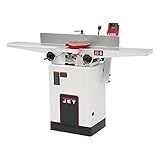
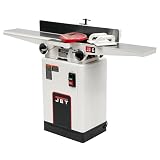
A true compact floor-standing jointer is not a benchtop unit bolted to a stand. It has its own enclosed base, motor mounted low for stability, and beds supported by the base casting rather than a workbench. Typical footprint is 28 to 34 inches long by 18 to 24 inches deep, plus handle overhang. Weight lands between 180 and 320 pounds. That mass matters – lighter than about 160 pounds and the machine will walk or vibrate when taking a 1/16-inch cut on 6-inch hard maple.
Total bed length is the number to watch. Compact 6-inch models usually run 54 to 57 inches. Compact 8-inch models stretch to 65 to 72 inches. A 46-inch benchtop bed will joint a 30-inch board well, but on a 42-inch board you will get taper or a slight bow because the board tips off the outfeed table. If you regularly work with 4- to 5-foot stock for small tables or cabinets, the extra 10 inches of bed on a floor-standing model pays off immediately.
6-Inch vs. 8-Inch in a Tight Shop
For narrow shops, the choice comes down to stock and power, not just price.
A 6-inch jointer needs 1 HP on 120V/13-15A, fits through a 28-inch doorway on its mobile base, and handles about 90% of what most furniture makers buy as S4S or rough 4/4 lumber. Limitation: you cannot face-joint a 7-1/2-inch wide board for a panel glue-up. You will rip it, joint, then glue, which adds a seam.
An 8-inch jointer needs 1.5 to 2 HP. Most compact 8-inch models can still run on 120V at 1.5 HP if you have a dedicated 20A circuit, but 2 HP versions often require 240V. That is a deal-breaker in many garages where the only 240V is for the dryer. Width also costs floor space: an 8-inch machine is typically 4 to 6 inches wider at the base and 40 to 60 pounds heavier. If you joint 6/4 or 8/4 slabs, or you want to flatten 8-inch wide boards in one pass before sending them to a 13-inch planer, the 8-inch size is worth rearranging for. If you mostly build boxes, nightstands, and face frames from 4-6-inch boards, the 6-inch machine leaves you more room for an actual assembly table.
Be honest: a used 6-inch floor-standing jointer in good condition is fine for a beginner. You will outgrow width before you outgrow bed length, and width is cheaper to fix later with a planer sled than length is.
Cutterhead and Table Design Trade-Offs
Straight-knife cutterheads with two or three knives cut cleanly and are cheapest to buy. Sharpening or resetting them is the pain point. If you nick a knife on a staple or grit, you are pulling all knives, resetting height to within 0.001 to 0.002 inch across the width, and checking with a dial indicator. In a small shop without a dedicated sharpening setup, that is an afternoon lost.
Helical or segmented spiral heads with 4-sided carbide inserts are louder in price but quieter in use – typically 3 to 5 dB lower – and you rotate one insert in two minutes when damaged. They also reduce tearout on figured maple or reversing grain by 30 to 50% compared to straight knives at the same feed rate. Trade-off: they leave very faint scallops. On most woods you will not see them after one light planer pass or 120-grit sanding, but if you do a lot of hand-plane finishing directly off the jointer, straight knives can leave a slightly flatter surface.
For tables, avoid wedge-bed designs on a floor-standing machine if you can. Parallelogram tables stay coplanar when you raise and lower the infeed table, which is critical when you change cut depth from 1/32 to 1/16 inch. With wedge beds, a worn or dirty dovetail way causes the infeed table to drop slightly out of parallel, resulting in a tapered cut or snipe at the end of the board. Parallelogram adjustment takes 10 minutes with an Allen key; wedge-bed scraping is a shop project.
Comparison: What Fits and What It Costs You
Dimensions and power are real constraints in narrow shops. This table compares the common size classes you will find as compact floor-standing machines, not specific model numbers, so you can measure your actual space.
| Class | Cut Width | Bed Length | Footprint (L x D) | Weight | Motor / Circuit | Best For |
|---|---|---|---|---|---|---|
| Compact 6″ Straight Knife | 6 in | 54-56 in | 30 x 19 in | 180-220 lb | 1 HP / 120V 15A | Tightest spaces, lowest budget, light use |
| Compact 6″ Helical | 6 in | 55-60 in | 31 x 20 in | 200-250 lb | 1 HP / 120V 15A | Low noise, figured wood, minimal maintenance |
| Compact 8″ Parallelogram Helical | 8 in | 66-72 in | 34 x 23 in | 280-330 lb | 1.5 HP / 120V 20A or 2 HP / 240V | Face-jointing wider boards, longer beds |
Ceiling height is rarely an issue – even with the fence tilted 45 degrees you stay under 42 inches tall – but handle and fence overhang does matter. A fence that extends 36 inches adds 6 inches to your effective depth when stored. Look for models where the fence slides or lifts off without tools if you need to park the jointer within 20 inches of a wall.
What to Look For Before Buying
Fence quality decides accuracy more than cutterhead does in a small shop. A good fence locks without deflection when you push a 4-foot board against it with 5 to 8 pounds of lateral pressure. Extruded aluminum fences are lighter but flex more than cast iron or steel box fences. Test this: lock the fence at 90 degrees, put a square against it, push in the middle of the fence with your hand. If you see light under the square move more than 0.003 inch, you will fight edge joints that are not square.
Mobile bases are not optional in narrow workshops. A built-in mobile base with two fixed wheels and one or two swivel casters lets you pull the machine out, joint, and push it back against the wall in under a minute. Aftermarket universal bases work but raise the machine 2 to 3 inches and add wobble. If the jointer you are considering does not include an integrated base, budget $80 to $140 for a decent aftermarket one and check that your dust hose still reaches.
Dust collection on jointers is often underspecified. A 6-inch jointer produces chips fast – a 4-inch port with 350 to 450 CFM at the tool keeps the cutterhead clear. A 2-1/2-inch shop vacuum will clog on heavy cuts. If you buy a machine with a 4-inch port, plan to run it to a dust collector or a high-volume dust extractor, not a standard shop vac. Many compact models include a 4-inch dust collection hose for jointer adapter, but the included plastic blast gate is usually the first thing to crack.
Check table flatness and coplanarity on assembly. Place a 48-inch straightedge diagonally across both tables with the infeed table set to zero. You should not be able to slip a 0.002-inch feeler gauge under it anywhere. If you can, return or level the tables before you cut anything. This single check prevents 80% of the “my jointer makes a bow” complaints.
Practical Picks for Small Spaces
If your shop is under 120 square feet, or you share the garage with a car, a 6-inch helical floor-standing machine is the sweet spot. It rolls easily, runs on any household circuit, and bed length is just enough for 36- to 48-inch parts. Search for a 6 inch helical jointer floor standing and filter for parallelogram beds – you will find compact options that balance weight and stiffness without needing 240V.
If you have a dedicated 20A circuit and can give up an extra 6 inches of wall length, a compact 8-inch parallelogram machine is a buy-once option. You get a 70-inch bed that actually supports a 5-foot board and you stop ripping wide boards just to flatten them. When shopping, compare 8 inch parallelogram jointer models on bed length and fence material, not just motor power. A 1.5 HP motor that does not trip your breaker is more useful than a 2 HP motor you cannot wire.
Do not buy a benchtop jointer and put it on a cabinet to save $200 if you joint anything over 30 inches long. The vibration, short beds, and flexing fences create more work than they save. The cheaper option is fine if you only joint edges for cutting boards or small boxes and you already own a good planer sled for faces. Otherwise, the floor-standing base pays for itself in flat reference faces.
Setup Mistakes That Waste Space
The two failure modes that show up in narrow shops are snipe from improper outfeed height and kickback from short infeed tables. Set the outfeed table exactly level with the knife apex at top dead center. Too low and the board drops at the end of the cut, scooping 0.005 to 0.010 inch off the trailing 3 inches. Too high and the board bumps and stops.
Keep the guard on and set the fence so it covers the unused portion of the cutterhead – exposed knives next to a wall where you cannot stand to the side is how hands get pulled in. Push blocks with non-slip soles and a heel are safer than push pads on jointers because they keep your hands above the cutterhead, not behind it.
Finally, plan workflow direction. In a narrow shop, you want to feed from the open side of the garage or doorway toward the wall, not parallel to the long wall where a 6-foot board hits the door. A 5-minute tape layout on the floor before you bolt down the mobile base stops you from having to spin the whole machine every time you joint a longer board.

