Best Table Saws with Riving Knives That Follow Blade Tilting
What's inside
As an Amazon Associate I earn from qualifying purchases. This post may contain affiliate links at no extra cost to you.
A table-saw riving knife is useful only if it stays correctly positioned as the blade moves. On a saw designed so the knife follows the blade’s height and tilt, it remains close behind the teeth during bevel cuts without requiring a separate adjustment. That reduces the chance of a workpiece pinching the blade, though it does not prevent every kickback or replace a blade guard.
Contents
What “follows blade tilting” means
A proper riving knife mounts to the blade assembly, not to the table or cabinet. When you tilt the blade for a bevel cut, the knife tilts with it; when you raise or lower the blade, the knife moves too. It should sit just behind the blade, with its top below the blade’s highest tooth so stock can pass over it.
Check the saw’s manual for the knife’s specified thickness and compatible blade kerf. The knife must be thicker than the blade plate but thinner than the kerf. If it is too thick, the work can bind; if too thin, it may not keep the cut open. A knife intended for a full-kerf blade may not suit a thin-kerf blade. Confirm compatibility before buying replacement blades or knives.
Which type of saw makes sense?
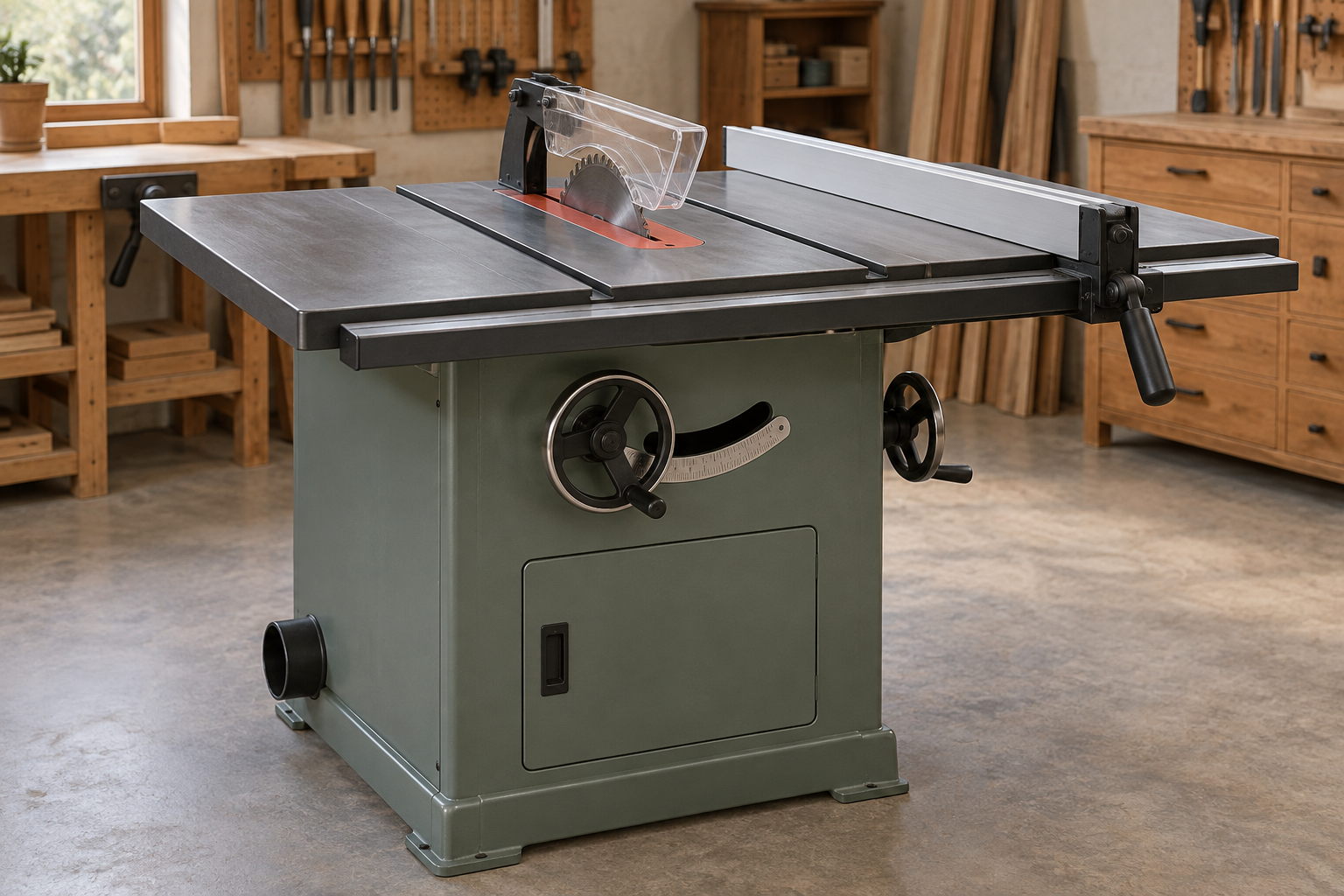
For frequent shop work, a cabinet saw is the most stable option, but it costs more, weighs several hundred pounds, and needs floor space and suitable dust collection. A contractor-style saw or hybrid saw can offer a full-size table and a riving knife at a lower price, with less mass or a smaller footprint. Portable jobsite saws are easier to move and store; their compact tables and fences can be limiting when cutting wide sheet goods.
Do not assume every saw with a blade guard includes a riving knife that follows blade tilt. Some older designs use a fixed splitter attached behind the throat plate. Ask the seller or check the manual for explicit confirmation that the knife moves with both blade elevation and bevel angle. Also check whether the saw offers a low-profile knife for non-through cuts such as grooves. Never use a standard riving knife for a dado stack unless the manual specifically allows it.
Comparison by shop and workload
| Saw category | Best fit | Main trade-off | What to verify |
|---|---|---|---|
| Cabinet saw | Regular furniture and cabinet work | High cost, weight, and space requirements | Knife follows bevel and height; knife/blade compatibility |
| Hybrid or contractor-style saw | Stationary home shop with moderate use | Less mass or capacity than many cabinet saws | Fence alignment, table support, and included knife options |
| Portable jobsite saw | Small shops or work that moves between sites | Smaller work surface and less support for large panels | Knife movement, stand stability, and fence locking |
Useful product searches
If you have room and expect to rip hardwood or make repeated bevel cuts, compare cabinet table saws with riving knives. Pay attention to the fence, arbor adjustment, dust port, and whether the machine can be wired for your shop’s electrical supply. A powerful saw is not a bargain if the fence drifts or the knife is awkward to reinstall after changing throat plates.
For a smaller budget or limited floor space, a hybrid table saw with a riving knife may be enough. A portable jobsite table saw with a riving knife can also work for occasional projects, provided you can support the work securely and verify that the knife follows the blade on bevel cuts.
Setup checks that matter
Before the first cut, unplug the saw and check that the knife is centered behind the blade. The gap should be small and consistent, with no contact when you turn the blade by hand. Check alignment again after changing a blade or adjusting the saw; a knife that rubs, sits noticeably off-center, or is difficult to install needs attention before use. Follow the manual’s adjustment procedure rather than bending the knife to fit.
Keep the blade guard and dust collection installed for ordinary through-cuts when practical. The guard helps keep hands away from the blade; the riving knife helps prevent the kerf from closing around it. For a bevel cut, verify that the knife still tracks the blade and that the work clears the guard. Use a push stick when your hands would otherwise come close to the blade, and use infeed or outfeed support for long stock. A riving knife cannot stabilize a narrow offcut or correct a board that is warped, twisted, or poorly supported.
Common failure modes
A frequent mistake is choosing a saw based on the word “splitter” in a listing. A splitter may be fixed relative to the table and can leave a gap or become misaligned when the blade tilts. Another is removing the knife for a cut and forgetting to reinstall it. If a cut requires taking it off, use the correct procedure and restore the knife and guard before returning to normal ripping.
Do not force stock through a cut that begins to pinch, slow the blade, or pull sideways. Stop the saw and diagnose the cause: blade and knife mismatch, poor alignment, a dull blade, internal wood stress, or inadequate support are all possibilities. For most buyers, the best choice is the least expensive saw that fits the work while providing a verified, blade-following knife, a dependable fence, and enough table support—not simply the heaviest or most powerful machine.