Best Cordless Circular Saw For Framing
Key takeaways
- An editorial buying guide to the best cordless circular saw for framing, judged on shoe flatness, depth capacity, bevel detents and battery platform rather than spec sheets.
What's inside
As an Amazon Associate I earn from qualifying purchases. This post may contain affiliate links at no extra cost to you.
Framing punishes a circular saw in ways trim work never does. You are cutting wet 2x material at shoulder height, plunging into subfloor, ripping sheathing on a stack of studs, and dropping the saw on a joist a dozen times a day. That is the context in which we judge the best cordless circular saw for framing, and it is why the winner on paper is often not the saw you want on a wall deck. A 7-1/4 inch blade that will not cross-cut a 4×4 in one pass, a stamped shoe that flexes under a rafter cut, or a bevel scale you cannot read with sawdust on it will cost you more time than any advertised RPM figure will ever save.
We are a review desk, not a lab, so we will be direct about method. We evaluate framing saws on mechanical criteria we can inspect and verify by hand: shoe flatness and stiffness, blade-to-shoe squareness out of the box, depth and bevel adjustment quality, guard action, sightline to the blade, brake behavior, and how the tool sits in a battery ecosystem you already own. We do not publish fabricated cut counts or stopwatch data. Where we reference tool lines such as DeWalt XR and FlexVolt, Milwaukee FUEL, Makita LXT and XGT, Ridgid Octane or Metabo HPT MultiVolt, we are describing categories of capability, not endorsing a single part number.
As an Amazon Associate we earn from qualifying purchases at no extra cost to you. Product prices and availability are accurate as of the date shown and are subject to change.


Framing Saw Formats at a Glance
Before shopping, decide which of the four common cordless formats you are buying into. This choice constrains everything else, and it is where most buyers go wrong.
| Format | Typical Depth at 90° | Best For | Trade-Off |
|---|
| Format | Typical Depth at 90 Degrees | Best For | Main Trade-Off | |
|---|---|---|---|---|
| 6-1/2 in sidewinder | About 2-1/8 in | Sheathing, single 2x stock, remodel work | Will not cross-cut 4× | 4 in one pass |
| 7-1/4 in sidewinder | About 2-1/2 in | General framing, wall plates, stacked cuts | Heavier, more battery draw | |
| 7-1/4 in rear-handle | About 2-1/2 in | All-day production framing, ripping sheets | Bulk, price, needs high-output battery | |
| 7-1/4 in worm-drive style | About 2-1/2 in | Bevel-heavy rafter and stair work | Narrowest sightline for right-handed users |
The practical read on that table: if you frame occasionally as part of remodel work, a 6-1/2 inch sidewinder on a battery platform you already own is the honest answer. If framing is the job rather than a step in the job, a 7-1/4 inch rear-handle saw is worth the extra weight because of blade capacity, sightline and the way it tracks through a long rip.
How We Judge the Best Cordless Circular Saw for Framing
Our criteria are ranked by how often a shortcoming actually stops work.
Shoe Flatness and Stiffness
This is the first thing we check and the most commonly compromised. Lay a straightedge across the shoe both lengthwise and diagonally. Stamped steel shoes are acceptable when they are heavily ribbed at the depth pivot; thin, unsupported stampings will twist when you lever the saw through a bind. Magnesium shoes generally hold flatter and shrug off drops better, but the material label alone is not the tell. Look at how the shoe is braced where the depth lever clamps, and check that the front edge has not been dented in transit. A shoe that rocks will cost you square cuts on every plate you mark.
Squareness and Bevel Detents
Check blade-to-shoe square with a machinist square, not the printed scale. Many saws arrive a degree off, and a good framing saw makes that a two-minute fix with an accessible stop screw. On the bevel side, we want positive detents at 22.5 and 45 degrees, a stop that can be defeated for over-bevel past 45, and a lever you can throw with a gloved hand. Cast bevel scales stamped into the housing survive; printed decals do not.
Depth Capacity and the 4×4 Test
The single most useful capability question in framing is whether the saw cuts a 4×4 in one pass. Only a 7-1/4 inch blade class does this reliably, and even then the depth lever must let you get full plunge without the guard fouling. If you build decks, headers, or posts, this criterion alone should decide your format.
Guard Action, Sightline, and Brake
Retract the lower guard cold. It should return under spring pressure with no hesitation, because a lazy guard is what makes a saw kick when you start a bevel cut on a sloped surface. Sightline matters more on a framing saw than a trim saw: blade-left designs and rear-handle layouts put the cut line in view for right-handed users, which is why they dominate on production crews. An electric brake is now standard on brushless tools and it is not a luxury when you are cutting overhead or off a ladder.
Dust and Debris Management
Nobody hooks a vacuum to a framing saw, so the question is where the chips go. We want an ejection port that throws waste forward and away from the operator, ideally with a rafter hook that does not sit in the discharge path. On saws used indoors for remodel demolition, a port that accepts a standard hose adapter is a genuine advantage worth paying for.
Battery Platform Reality
A 7-1/4 inch saw is a current-hungry tool. Running one on a compact 2.0Ah pack will produce thermal cutouts and a frustrating day. Plan on high-output or high-capacity packs, and treat the platform as the real purchase. Two decent saws on batteries you own beat one excellent saw that starts a second charger collection.
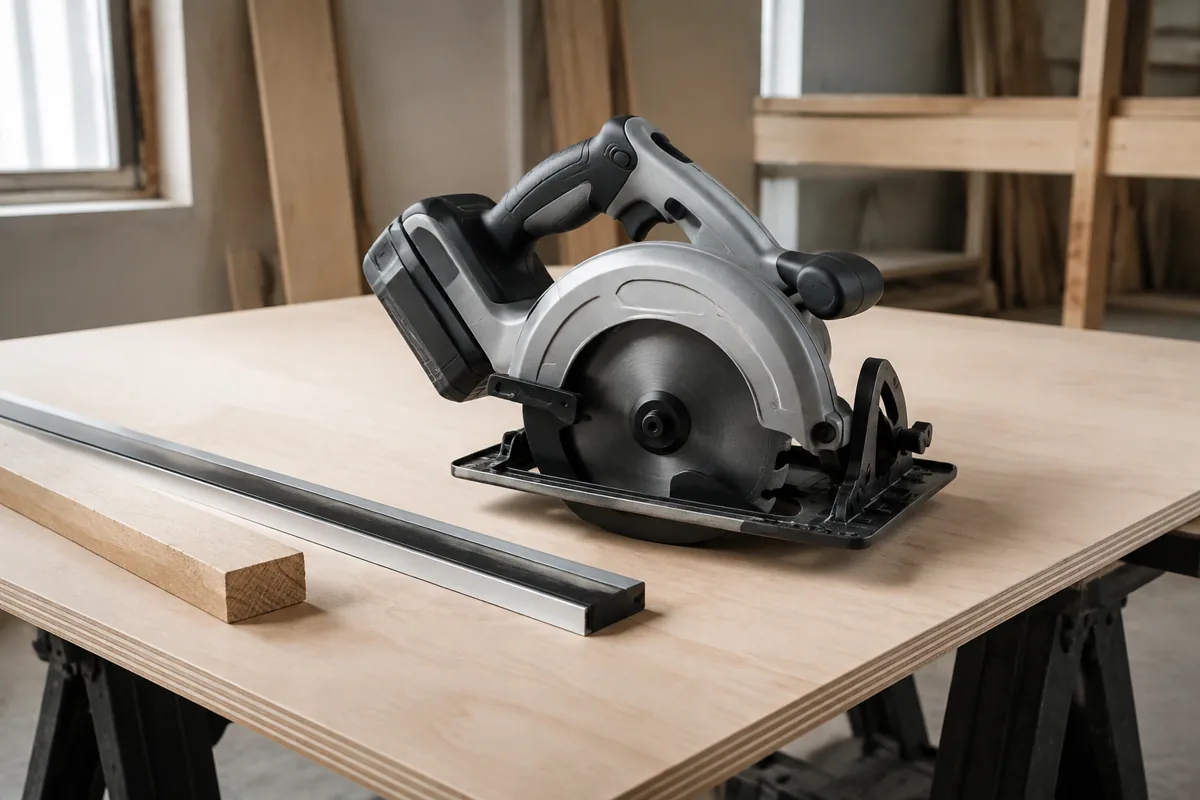
7-1/4 in Cordless Rear-Handle Framing Saw
If framing is your primary work, buy the rear-handle format and stop agonizing. You get full 4×4 depth, the best sightline for right-handed cutting, and a chassis that tracks through long rips in sheathing without wandering. Budget for two high-output packs at minimum, and expect a tool that is noticeably heavier than a sidewinder in your hand and on a ladder.
Where Spec Sheets Mislead You
No-load RPM is close to meaningless on its own. What you feel in a cut is torque delivery under load and how the electronics respond when the blade starts to bog, and neither of those appears in marketing copy. Two saws with identical RPM figures can behave completely differently in wet lumber depending on motor design and pack output.
Blade quality is the other blind spot. Most framing saws ship with a 24-tooth framing blade of modest quality. Swapping to a good thin-kerf 24T carbide blade improves cut speed and runtime more than moving up a tool tier, and it costs a fraction of the difference. If you compare two saws using the blades they came with, you are comparing blades.
Weight figures published without a battery are also worth ignoring. Ask what the saw weighs with the pack you intend to run, because that is the number your shoulder deals with at plate height. A saw listed as light on a compact battery may be heavier in real use than a rival paired with a slimmer high-output pack.
6-1/2 in Brushless Circular Saw for Remodel Framing
For remodelers and serious DIY builders, the 6-1/2 inch brushless sidewinder is the sensible pick. It handles sheathing, plates, studs and subfloor cuts on the battery platform you already own, and it stays manageable overhead. Accept that 4×4 posts need two passes, and check shoe flatness with a straightedge as soon as it arrives.
Trade-Offs of Going Cordless for Framing
- ✔ No cords to drag across a deck or through a stud bay
- ✔ Instant starts for one-off cuts, which speeds layout work
- ✔ Electric brakes and blade-left sightlines are now common
- ✔ Shares batteries with your drills, impacts and recip saws
- ✘ Runtime and heat management require high-output packs
- ✘ 7-1/4 in cordless saws are heavier than corded equivalents
- ✘ Kit prices sit well above comparable corded saws
- ✘ Battery-related thermal cutouts under sustained ripping
Setup Checks Before the First Cut
Do these four things on any new framing saw and you will avoid most of the complaints found in negative reviews. First, verify blade-to-shoe square with a reliable square and correct the stop screw. Second, confirm the bevel returns to a true zero and that the 45 degree detent lands where the scale claims. Third, check depth-of-cut at full plunge against a scrap 4×4 or 2x if you bought a 6-1/2 inch saw, so you know your real capacity rather than the advertised one. Fourth, replace the included blade with a quality thin-kerf 24T before you judge the tool’s power.
FAQ
Is a 6-1/2 inch saw enough for framing? For remodel framing, sheathing and single 2x material, yes. The limitation is 4×4 stock and thick built-up beams, which need two passes and careful marking to keep the kerf aligned. If posts and headers are routine work, step up to 7-1/4 inch.
Do I need a rear-handle saw or will a sidewinder do? A sidewinder is fine for most users and lighter overhead. Rear-handle saws earn their bulk on production crews because of sightline, tracking through long rips, and the leverage geometry when cutting from a stack.
Are cordless saws powerful enough for wet, treated lumber? Modern brushless saws paired with high-output batteries handle treated 2x material well, but pack choice matters more here than anywhere else. Compact batteries will trigger thermal protection during sustained cuts in wet stock.
Verdict
The best cordless circular saw for framing is a format decision first and a brand decision second. Production framers should buy a 7-1/4 inch rear-handle brushless saw with a stiff, well-braced shoe, cast bevel scale, positive detents and high-output batteries, and accept the weight. Remodelers and advanced DIY builders are better served by a 6-1/2 inch brushless sidewinder on the platform they already own, spending the difference on quality blades and a second high-capacity pack. In both cases, judge the specific saw in your hands the way we do: straightedge on the shoe, square against the blade, guard retracted cold, bevel lever thrown with a glove on. Those four checks tell you more about how a saw will frame a house than any spec sheet on the box.
Check prices on Amazon →