How to Choose Replacement Knives for a Stationary Planer
What's inside
As an Amazon Associate I earn from qualifying purchases. This post may contain affiliate links at no extra cost to you.
Contents
Start with the planer, not the knife listing
Replacement knives are not interchangeable just because two planers have the same cutting width. The knife must match the cutterhead’s length, width, thickness, hole pattern and, where applicable, bevel geometry. Start by finding the machine’s model and serial number, then check its manual or parts diagram. Measure the existing knife only as a cross-check; a worn, resharpened or incorrectly fitted blade can give you the wrong dimensions.
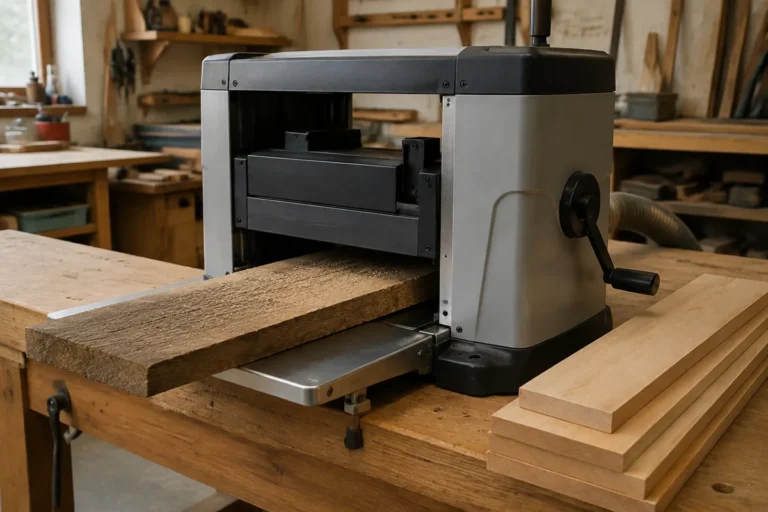
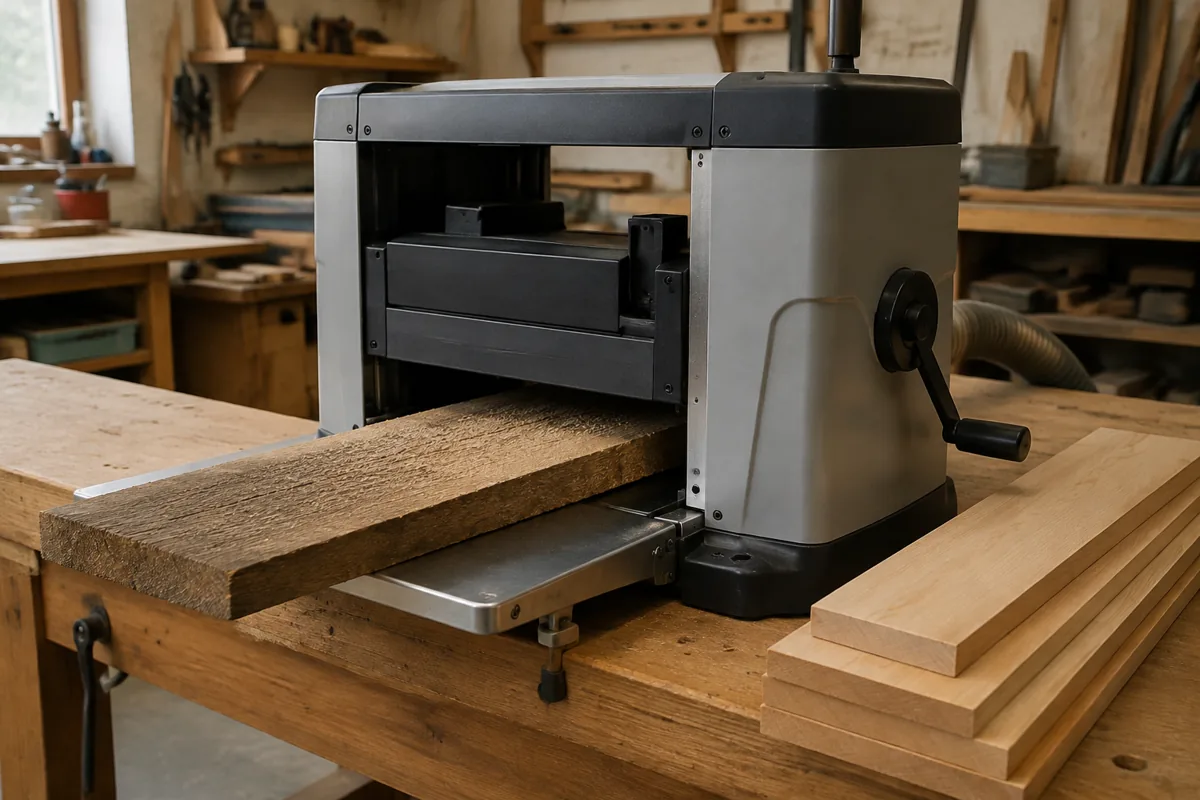
For a conventional two- or three-knife cutterhead, the manual usually specifies a reversible or resharpenable high-speed steel (HSS) knife. Many newer planers use a helical or spiral head with small indexable inserts instead. Those inserts are not replacements for straight knives: confirm the cutterhead type before ordering. If the original knives are missing, use the manufacturer’s parts information rather than guessing from the machine’s advertised capacity.
Choose the knife material for your stock
HSS knives are the common, lower-cost choice for general shop work. They can be sharpened, and a sharp set handles ordinary softwood and clean, dry hardwood well. The trade-off is edge life: abrasive material, knots, dirty reclaimed boards and some engineered wood products can dull or nick HSS quickly. A small nick may leave a raised line down the full width of a planed board.
For longer runs or abrasive stock, consider carbide planer knives, if your cutterhead accepts them. Carbide generally holds an edge longer but costs more and is more brittle; a hard impact can chip it rather than merely dull it. “Carbide” is not a universal upgrade: the knife still must match the machine, and some cutterheads are designed only for a particular blade material or thickness.
Resharpenable HSS makes sense if you have access to a qualified sharpening service and can keep spare knives on hand. Compare sharpening cost, shipping and downtime with the price of a new set. Very thin disposable knives may not have enough material for repeated sharpening; follow the maker’s guidance instead of assuming they can be re-ground.
Compare the main replacement options
| Option | Best fit | Main trade-off |
|---|---|---|
| OEM or machine-specified HSS set | General-purpose planing and straightforward fit | Usually a sensible price, but edge life depends on stock and use |
| Compatible premium HSS set | Frequent use when a consistent edge and reliable sizing matter | Costs more; confirm exact dimensions and hole layout |
| Carbide knives | Long runs or abrasive stock, when the head is designed for them | Higher initial cost and greater sensitivity to impact |
| Indexable inserts | Planers with a matching helical or spiral cutterhead | Not compatible with straight-knife heads; insert geometry and screw fit matter |
A compatible HSS replacement knife set is often the practical choice for a home shop, provided the dimensions and locating features match the manual. Paying extra for a premium brand is hard to justify if you plane a few boards a month and can replace or sharpen the standard knives economically.
Check fit, quantity and set details
Before buying, compare the listed knife length, width and thickness with the specification for your exact planer. Check whether the set contains the required number of knives: a two-knife head needs two matching blades, while a three-knife head needs three. Some listings describe one knife, others a pair or a complete set. Confirm what is included rather than comparing prices by headline alone.
Look for the correct holes, slots or locating notches and the specified fastener arrangement. A blade that is close in length or thickness may not seat properly, even if it appears to fit the cutterhead. Avoid filing holes or forcing a mismatched knife into place. If the manual calls for disposable double-edged knives, confirm which edge is supplied and whether both edges are usable.
When buying third-party knives, use a seller that provides dimensions and a clear compatibility list. Search by the planer’s exact model number as well as knife dimensions, then verify both against the manual. If those details are missing or contradictory, choose a known compatible set or ask the manufacturer before ordering. A low price is no bargain if the blades cannot be safely clamped or indexed.
Know when to replace or rotate knives
Watch the planed surface and the cutterhead’s sound. Tear-out can come from grain direction, excessive depth of cut or dull knives; a repeating ridge or line often points to a nicked edge. Burning, fuzzy fibers and a rough finish are also reasons to inspect the knives, but first rule out feed problems and unsuitable settings. Do not keep increasing the depth of cut to compensate for a dull edge.
On reversible knives, rotate or reverse them only if the manual permits it and the second edge is still sound. On a multi-knife head, replacing or rotating just one blade can create a height mismatch and leave a step or ridge in the work. Follow the maker’s instructions for changing the full set and for setting knife projection. Some machines use alignment jigs; others have self-seating knives. Do not assume the procedure is the same across planers.
Install knives safely and accurately
Disconnect the planer from power before opening the cutterhead area; an off switch is not enough. Wear cut-resistant gloves while handling loose knives, keep fingers clear of the edges and use the specified wrench and setting tool. Clean pitch and debris from the cutterhead and clamps before installation. Dirt under a knife can prevent even clamping and cause poor cutting or movement.
Tighten fasteners in the sequence and to the method stated in the manual. A knife set too high or unevenly can strike the work, leave ridges or damage the cutterhead. After installation, rotate the head by hand only if the manual allows it and check for interference before reconnecting power. Make a shallow test pass on scrap and inspect the finish. If there is unusual vibration, a new knocking sound or a repeating defect, stop the machine and recheck the installation rather than continuing to feed stock.