How to Plane Softwood Without Crushing the Surface
What's inside
As an Amazon Associate I earn from qualifying purchases. This post may contain affiliate links at no extra cost to you.
Softwood is easy to machine, but its low density makes it easy to dent, crush or tear out. A planer can leave grooves beneath the rollers, fuzzy fibers on the face, or chipped edges at the end of a board. The fixes are mostly about support, sharp knives, light cuts and feed direction—not buying the biggest machine.
Contents
Why softwood gets crushed
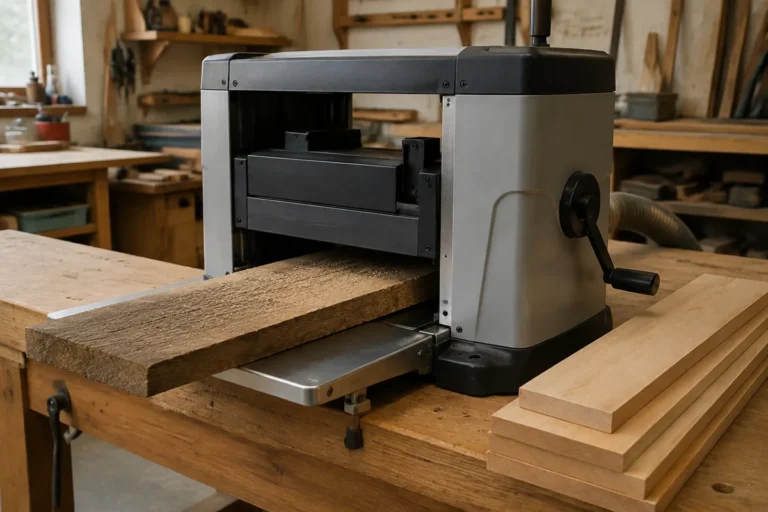
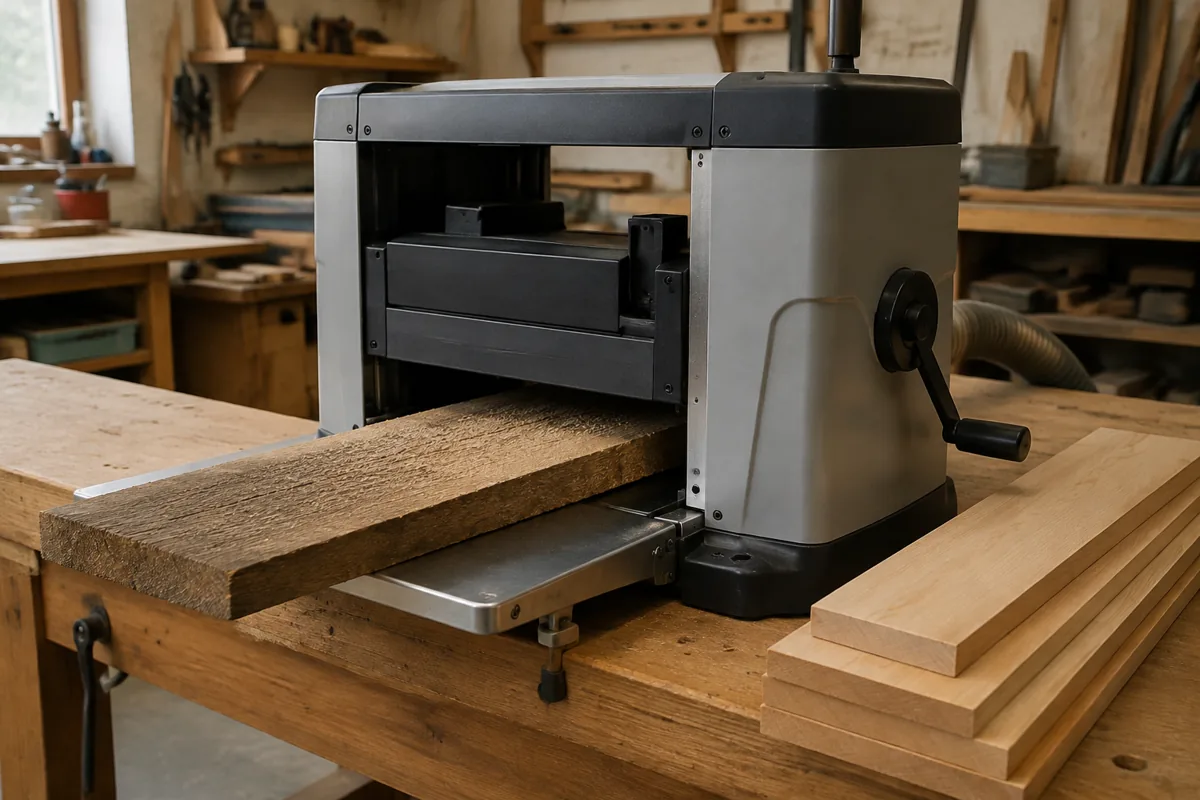
In a thickness planer, infeed and outfeed rollers press the board against the bed while cutterhead knives remove material. On soft stock, excessive roller pressure or a board that is bowed, twisted or poorly supported can leave dents. A dull or poorly set knife tends to bruise and pull fibers instead of cutting them cleanly.
Softwood also varies considerably. Clear, straight-grained pine may plane cleanly, while knotty or resinous stock can tear out even with sharp knives. Grain direction can change along one board, so a setting that works at one end may produce chips at the other.
Prepare the board and machine
Check the board for nails, screws and grit before it reaches the cutterhead. Metal damages knives; grit dulls them. Let stock acclimate in the shop if it has just come from a cold, damp or hot storage area. If moisture content is changing rapidly, planing now can expose movement that makes the board cup or twist later.
Use a jointer or another suitable method to establish one flat face before thickness planing. A planer makes opposite faces parallel; it does not reliably flatten a bowed board. Feeding a rocking board can cause uneven cuts and poor roller contact. If you do not own a jointer, a shop-made planer sled can support a board for a light flattening pass, provided it is secured against shifting and is compatible with your machine.
Inspect knives for nicks and buildup. Clean resin from the cutterhead and knives with a product approved by the manufacturer, with the machine unplugged. A sharp knife matters more than an especially fine finishing pass: dull edges compress soft fibers and leave a fuzzy surface. Keep hands clear of the opening, use the guard and follow the planer manual for knife changes and minimum stock length.
Set a light cut and steady feed
For softwood, start with a cut of about 1/32 inch (0.8 mm) per pass. If the board and planer are behaving well, you may be able to increase toward 1/16 inch (1.6 mm), but there is little benefit in forcing a deeper cut just to save one pass. Heavy cuts raise cutting load, increase tearout risk and can make a portable planer bog down. Take lighter cuts on wide, knotty or irregular stock.
Set the depth before feeding, and avoid changing it while a board is under the cutterhead unless the manual explicitly allows that. Feed at the machine’s normal rate; do not push or pull a board through a powered planer to compensate for stalling. Listen for a change in motor pitch and stop if the machine strains or the board stops moving.
Use boards long enough for your planer’s stated minimum and support long stock level at both ends. An unsupported board can tip as it enters or exits, causing snipe—deeper cuts near the ends. Properly aligned infeed and outfeed tables or roller stands can help. Stands must be set level with the bed; set too high or low, they can lift or drop the board and worsen snipe.
Choose the right fix for the symptom
| Symptom | Likely cause | First adjustment |
|---|---|---|
| Parallel dents or tracks | Rollers pressing into soft stock, debris, or feed rollers out of adjustment | Clean the bed and rollers; check the manual for roller pressure adjustment |
| Fuzzy or crushed fibers | Dull knives, resin buildup or an overly heavy cut | Clean or sharpen knives and reduce the depth per pass |
| Chips or torn grain | Cutting against changing grain, knots, or a blunt knife | Try reversing board direction and take a lighter pass |
| Deeper cuts near board ends | Snipe from board tipping or machine setup | Support both ends and check table alignment and feed setup |
| Uneven thickness across width | Board not seated flat, machine misalignment or uneven support | Verify the reference face and check planer alignment |
If dents appear even on a clean, flat board, do not assume a heavier machine is the answer. Check the pressure and condition of the feed rollers, then consult the manual before making adjustments. Roller changes are model-specific; reducing pressure too far can cause slipping or inconsistent feeding.
Select tools for your work
A benchtop thickness planer is a practical choice for furniture parts and general shop stock. Compare cut capacity, knife availability, snipe reports and support for long boards rather than relying on motor horsepower alone. A benchtop thickness planer is often enough for occasional softwood work; a heavier floor-standing machine makes more sense for frequent use, wider stock or long production runs, but costs more and still needs correct setup.
For a small shop, an adjustable roller stand can be a cheaper, useful alternative to replacing a planer when long boards are tipping or sagging. It is not a substitute for a flat reference face, and it needs a stable floor and careful height adjustment.
Helical cutterheads with small replaceable inserts can reduce the severity of tearout in some situations and are convenient to maintain, but they are not a cure for dull edges, bad feed direction or unsupported stock. Straight-knife planers are less expensive and can leave an excellent surface when their knives are sharp and aligned. If you plane only a few boards a month, keeping knives clean and taking light passes is usually the better value.
Finish without damaging the face
Stop when the board reaches thickness; do not keep making passes just to chase a glossy surface. A planer leaves fine cutter marks, and softwood can burnish or compress under repeated contact. For a clean face, use a final light pass with sharp knives, then sand with a random-orbit sander using light pressure. Start around 120 grit and move to 150 or 180 if the finish requires it; finer sanding may be appropriate for some coatings, but can make softwood unevenly absorb stain.
Before changing knives, clearing a jam or cleaning the cutterhead, disconnect power and wait for all moving parts to stop. Wear hearing and eye protection, use dust collection, and never reach into the feed opening while the machine is plugged in. Those steps protect the operator—and help keep a straightforward planing job from becoming an expensive repair.