Sliding Table Saw vs Cabinet Saw for Accurate Furniture Parts
What's inside
As an Amazon Associate I earn from qualifying purchases. This post may contain affiliate links at no extra cost to you.
Contents
The real difference for furniture parts
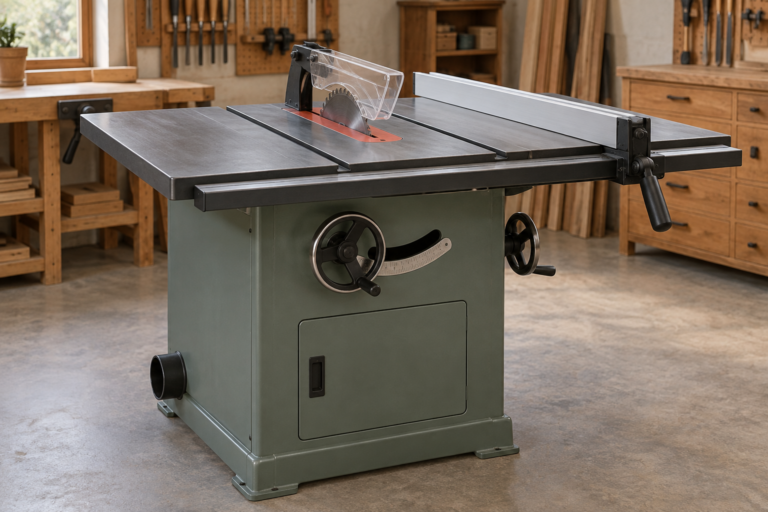
A sliding table saw and a cabinet saw can both produce accurate furniture parts. The key difference is how they support and guide the work. A cabinet saw uses a fixed table, fence, and crosscut miter gauge or sled. A sliding table saw carries the work on a moving table, usually against a fence that sets the crosscut angle. That moving support makes it easier to control large panels and repeat crosscuts without balancing the work on a small miter gauge.
Neither design guarantees accuracy. A sliding table saw with a misaligned scoring blade can chip sheet goods; a cabinet saw with a fence out of parallel can leave tapered rips. Setup, blade condition, measuring, and work support matter on both.
As an Amazon Associate we earn from qualifying purchases at no extra cost to you.


Which parts drive the choice?
Think about the largest and most frequent operation in your shop. Cabinet doors, drawer fronts, shelves, and case sides often start as full 4-by-8-foot sheets. A sliding table saw supports these panels during crosscuts, so the operator does less lifting and steering. That is a meaningful safety and repeatability advantage when breaking down several sheets.
For solid-wood furniture parts, the job is often ripping stock to width, followed by crosscutting to length. A well-set cabinet saw handles those operations very well. A crosscut sled with a stop block can make a batch of parts to the same length, while the rip fence handles long, straight cuts. The sled takes floor and storage space, but it costs far less than a sliding carriage.
Short parts need particular care on either machine. A small offcut trapped between the blade and fence can bind or become a projectile. Use a stop block positioned so the offcut cannot be pinched, and keep hands clear of the blade path. For repeat crosscuts, a sled or sliding table with a properly set stop is safer than measuring each piece beside the blade.
Sliding table saw vs. cabinet saw
| Factor | Sliding table saw | Cabinet saw |
|---|---|---|
| Large sheet handling | Strong support for crosscutting; less need to guide the panel by hand | Possible with extension tables, rollers, or a helper, but awkward for one person |
| Solid-wood ripping | Capable, though carriage setup is not essential for ordinary ripping | Excellent fit; a good fence and stable arbor suit repeated rips |
| Repeat crosscuts | Fast with a square sliding table and stop | Accurate with a well-made sled or miter gauge and stop block |
| Space and setup | Needs room for the carriage to travel and for long stock to enter and exit | Smaller footprint in many configurations; still needs infeed and outfeed clearance |
| Cost and complexity | Usually higher; alignment and service may be more involved | Usually lower for comparable cutting capacity; simpler to maintain |
What accuracy looks like in practice
For a cabinet or furniture carcase, a 1/32-inch error across a panel edge can show up as a gap, a proud corner, or trouble keeping the assembly square. On a sliding saw, check that the table cuts square to the blade: crosscut a test board, flip one half end for end, and compare the joint. A widening gap points to an angle error. Check the scoring blade separately on laminated panels; its cut should align with the main blade and be only wide enough to prevent chipping.
On a cabinet saw, check that the fence is parallel to the blade or just slightly farther away at the outfeed end, following the saw maker’s instructions. A fence that pinches the stock can cause burning or kickback; one that diverges too much can make cuts inconsistent. Verify the miter slot is parallel to the blade before relying on a sled. A sled that is out of square repeats the same error on every part.
Use a sharp, appropriate blade and make a test cut in the actual material. A 40-tooth general-purpose blade may work for mixed solid wood, while clean cuts in veneer-faced sheet goods often call for a finer-tooth blade and a scoring system or zero-clearance support. Tooth count alone does not determine cut quality; blade geometry and condition matter too.
When a sliding table saw makes sense
Consider a sliding table saw if you regularly break down full-size plywood or melamine, work alone, or need repeated, square panel crosscuts. The benefit is not just speed: the carriage supports the panel while it passes the blade, reducing the temptation to reach across or twist a large sheet.
Before buying, measure the shop, not just the machine footprint. The carriage must travel its full stroke, and the panel needs clear space beyond the blade. Check available dust collection, electrical requirements, scoring-blade adjustment, and local service support. A machine that cannot be aligned or serviced conveniently can become an expensive obstacle.
A sliding saw is not automatically better for every cut. It still needs a properly set fence for ripping, and its carriage does not replace safe blade guards, a riving knife, push sticks, or sound cutting technique.
When a cabinet saw is enough
A cabinet saw is the sensible choice for many small furniture shops that mostly process solid lumber or cut sheet goods occasionally. Add a stable outfeed table and a quality crosscut sled, and it can make accurate, repeatable parts without the space and cost of a sliding carriage. A helper, panel-handling cart, or track saw for breaking down large sheets can make the sheet-good workflow more manageable.
Look for a rigid fence that locks consistently, a riving knife, a blade guard, and enough motor capacity for the stock you actually cut. A cabinet table saw is often the better buy when the budget also needs to cover a jointer, planer, dust collection, or good blades. Those tools can improve the whole furniture-making process more than paying for a sliding table you rarely use.
Buy for your workflow
Choose the sliding table saw when large panels are routine and controlled crosscut support will save labor or reduce handling risk. Choose the cabinet saw when ripping solid stock is the daily work and sheet breakdown is occasional. If you are unsure, track your next few projects: note how many full sheets you process, how often you crosscut wide panels, and how much floor space the machine can occupy. The machine that fits those real tasks—not the one with the longer feature list—will make accurate parts easier to produce.