Cabinet Saw vs Sliding Table Saw for Production-Style Cabinet Work
What's inside
As an Amazon Associate I earn from qualifying purchases. This post may contain affiliate links at no extra cost to you.
Contents
The Basic Difference
A cabinet saw and a sliding table saw can both break down sheet goods, rip solid stock, and cut joinery. They are built around different ways of controlling the work, though. A cabinet saw uses a fixed table and usually relies on a rip fence, miter gauge, crosscut sled, or shop-built fixture. A sliding table saw uses a large carriage that moves past the blade, with a crosscut fence and often a scoring blade for panel work.
For production-style cabinet work, the choice is less about which machine makes a cleaner cut in isolation. It is about how quickly you can make repeatable cuts, how safely you can handle large panels, and how much floor space and maintenance the shop can support.
As an Amazon Associate we earn from qualifying purchases at no extra cost to you.
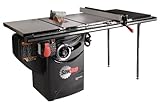


A quality cabinet table saw is often the better value for a small shop. A sliding table saw becomes more compelling when the work is dominated by sheet goods, repeated crosscuts, and high daily production.
Where a Cabinet Saw Works Best
A cabinet saw is the more flexible general-purpose machine. With a sharp combination blade, it can rip hardwood edging, cut solid-wood parts, size narrow strips, and handle plywood. Its rip fence is fast for repeated long cuts, and aftermarket jigs can cover many operations that a sliding table saw does less conveniently.
For cabinet shops building face frames, doors, drawer parts, and hardwood components, this flexibility matters. You can rip a 2-inch stile, cut a tenon with a dado stack, then switch to a crosscut sled without changing machines. A 3-hp saw is a practical size for many small production shops. It has enough power for thick hardwood while fitting on a typical 120-volt or 240-volt shop circuit, depending on the machine.
The main weakness is large-panel handling. A full 4-by-8-foot sheet is awkward on a fixed table, even with an outfeed table and side support. The panel can sag, shift, or press against the fence. Those problems show up as wandering cuts, chipped edges, and increased kickback risk. A track saw or panel-processing station is often the sensible companion for breaking down full sheets before the cabinet saw does final sizing.
Where a Sliding Table Saw Pays Off
A sliding table saw is designed around controlled crosscutting and panel processing. The workpiece is supported by the moving carriage, so the operator does not have to push a large panel across a stationary tabletop. A long crosscut fence and adjustable stop make repeated cabinet-part sizing quick and consistent.
Many machines also include a scoring blade. This small, separate blade makes a shallow cut before the main blade and greatly reduces chipping in melamine, veneer plywood, and other finished sheet goods. Without scoring, you may need a specialized blade, a zero-clearance insert, masking tape, or a sacrificial edge. Those methods can work, but they add setup and do not always prevent bottom-face breakout.
The carriage also improves safety when crosscutting wide panels. The panel is held against the fence while the carriage carries it through the blade. That is generally more controlled than balancing a 30-inch-wide cabinet side against a miter gauge. It does not eliminate risk: the fence must be square, the panel must be supported, and hands still need to stay clear of the blade.
The trade-off is size, cost, and specialization. A sliding table saw can occupy substantially more floor space than a cabinet saw, particularly with the carriage fully extended. The carriage, scoring system, fence, and alignment points also add maintenance. A small error in the sliding table’s parallelism or crosscut fence can produce parts that are consistently wrong, which is worse than an occasional isolated mistake.
Cabinet Saw vs. Sliding Table Saw
| Factor | Cabinet saw | Sliding table saw |
|---|---|---|
| Best at | Ripping, solid stock, general-purpose work | Panel sizing and repeat crosscuts |
| Sheet-good handling | Requires support, helpers, or a separate breakdown method | Carriage supports large panels directly |
| Finished-face tear-out | Depends on blade, setup, and technique | Scoring blade can produce cleaner cuts in coated panels |
| Floor-space demand | Moderate, especially with an outfeed table | High; carriage travel must remain clear |
| Typical value | Better for mixed work and lower-volume shops | Better when panel work and repeatability dominate |
Accuracy and Production Reality
Both machines can produce cabinet parts within normal woodworking tolerances, but the operator workflow is different. On a cabinet saw, a properly aligned rip fence and a reliable crosscut sled can routinely hold cuts within roughly 0.5 mm over typical cabinet-part lengths. The limiting factor is often handling rather than the saw itself.
On a sliding table saw, the crosscut fence and stop system make repeated lengths easier to maintain. If the fence is set accurately, cutting ten identical parts is less dependent on how the operator holds each piece. That advantage becomes significant when a job contains dozens of cabinet sides, stretchers, or shelves.
Production speed also depends on how parts arrive at the saw. If full sheets are already broken down, a cabinet saw may be fast enough and considerably cheaper. If the operator regularly takes full sheets from a stack and turns them into accurately sized parts at one station, the sliding table layout saves lifting and repositioning.
Which One Should You Buy?
Choose a cabinet saw if your shop makes a mix of hardwood and sheet-goods parts, production is measured in a few kitchens or furniture projects per week, or floor space is limited. Put the savings toward a strong outfeed table, side support, dust collection, and a good crosscut sled. A table saw crosscut sled can make a major difference in repeatability without buying a second large machine.
A cabinet saw is also the cheaper option when you already own a track saw or can break sheets down with a helper. In that workflow, the track saw makes rough or initial cuts, and the table saw brings parts to final width. It is slower than a dedicated panel saw or sliding carriage, but perfectly reasonable for a one-person shop.
Choose a sliding table saw when most of your work involves melamine, veneer panels, or plywood; when repeated crosscuts account for a large part of the day; or when one operator must safely process full sheets. Look for a rigid carriage, an easy-to-read crosscut fence, dependable stops, and a scoring system with simple height and lateral adjustment. A sliding table saw for woodworking is a poor purchase if the shop cannot leave enough clearance for the carriage to travel.
Setup Details That Matter
Before comparing horsepower, check dust collection and electrical requirements. Cutting melamine creates fine dust, and a poorly controlled scoring blade can clog or leave a dirty edge. Keep separate blades available for ripping hardwood and cutting panels; forcing one dull combination blade to do everything increases burning and tear-out.
Common failures are predictable: a crosscut fence that is not square, a stop that allows a part to creep, insufficient panel support, and a scoring blade set too deep. A scoring blade should make a shallow preliminary cut, not remove a wide groove. Test on scrap from the actual material, then inspect both faces before committing to production parts.
For most small cabinet shops, the practical answer is a well-equipped cabinet saw plus a sensible panel-breakdown method. For a shop processing sheet goods continuously, the sliding table saw earns its space by reducing handling, setup variability, and finished-edge damage.