Band Saw vs Table Saw for Cutting Curves in Thick Stock
What's inside
As an Amazon Associate I earn from qualifying purchases. This post may contain affiliate links at no extra cost to you.
Contents
Short answer: use a band saw
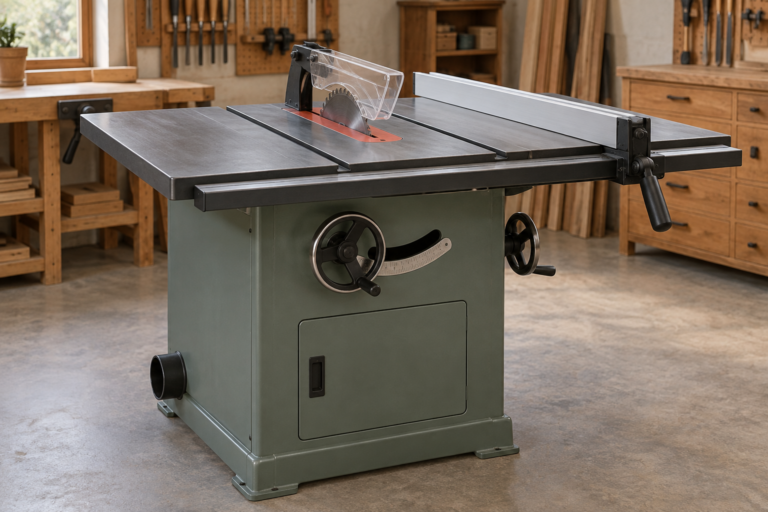
For cutting curves in thick stock, a band saw is the right machine. Its narrow blade can turn through a curve, and the work stays supported on a table. A table saw’s circular blade is designed for straight cuts; trying to steer stock into a curve is dangerous and can cause binding or kickback.
If you already own a table saw, keep it for ripping the blank to width or cutting straight reference edges. For the curve itself, use a band saw, a jigsaw for smaller work, or a suitable handheld tool. The choice between band saws comes down to the thickness and radius you need to cut, how often you’ll do it, and how much cleanup you can tolerate.
Why band saws handle curves
A band saw’s blade runs in a continuous loop, so it cuts as the work is fed into it. The blade can follow a curved line, within limits set by its width and the radius of the curve. A narrower blade generally handles tighter curves; a wider blade is stiffer and tracks straighter, which is useful for resawing but less suited to tight turns.
Thick stock adds resistance and makes blade choice, tension, and feed rate more important. If you force the work around a curve, the blade can twist, wander off the line, or leave a tapered cut. A dull blade or insufficient tension can make those problems worse. Let the blade cut at its own pace, and plan to leave material for sanding or scraping.
Band saw vs. table saw for curved cuts
| Factor | Band saw | Table saw |
|---|---|---|
| Curved cuts | Designed for curves; blade width limits the turning radius. | Not suitable for steering stock through a curve. |
| Thick stock | Capacity depends on the distance between table and upper guides. | Blade height limits thickness, and the saw is intended for straight cuts. |
| Cut quality | Usually leaves a rough, sometimes slightly wavy edge that needs cleanup. | Leaves a straight edge on a straight cut; it does not produce a safe curved cut. |
| Best role | Cutting curves, roughing out shapes, and resawing when properly set up. | Ripping and crosscutting straight stock with appropriate guards and accessories. |
| Buying priority | Throat capacity, resaw height, blade support, and available blades. | Fence, blade capacity, dust collection, and safety equipment for straight work. |
Choose a band saw for the actual work
Check the saw’s listed resaw capacity—the maximum height of stock it can accept beneath the upper guides—and its throat capacity, the distance from the blade to the frame. Resaw capacity matters for thick pieces; throat capacity matters when a large blank has to rotate through a broad curve. Neither number tells you how well the saw cuts, but either can rule out a machine that is too small.
For occasional curves in furniture parts or shop projects, a small benchtop band saw can be adequate if its capacity suits the stock. It is often the cheaper option, but limited power and a small frame can make thick hardwood slow to cut and harder to keep on line. For frequent work in thick material, a larger floor-standing saw offers more capacity and typically more room to support and turn the piece. A woodworking band saw is the relevant category to compare; match the machine to your stock rather than buying extra capacity you will rarely use.
Look at blade availability, too. A saw is less useful if you cannot readily get blades in widths and tooth pitches suited to your work. Fine teeth are helpful for cleaner cuts in thinner stock; for thick stock, too many teeth can clog with sawdust and cut slowly. Follow the saw and blade makers’ guidance for blade width, tension, and material thickness.
Cutting thick curves without fighting the blade
Draw the curve clearly and mark the waste side. Make relief cuts from the waste edge toward the curve, especially where the outline turns sharply. These short cuts let waste pieces fall away instead of trapping the blade and forcing it sideways. Do not cut through the line: leave roughly 1/16 to 1/8 inch for cleanup, adjusting the allowance to the accuracy of the saw and the finish you need.
Set the upper blade guide close to the work—often about 1/8 inch above it, or as close as the machine’s design allows. Use the fence for straight sections, not to force a curved blank into a fixed path. Feed steadily without twisting the stock. If the cut starts to drift, stop advancing and back the work out only if it can be done without binding the blade; forcing it forward can kink or break the blade.
After the cut, smooth the edge with a spindle sander, sanding drum, or hand tools. For a curve that must match a template, leave enough extra wood to bring the edge accurately to the line. A band saw is a roughing tool for many finished shapes, not a guarantee of a polished curve straight off the table.
When another tool is the better choice
A table saw is the wrong choice for a curve, but it may be all you need for the straight cuts around the job. It can dimension stock safely when used with the proper setup; do not rotate or pivot a workpiece into a circular blade to trace an arc. That can pinch the blade and throw the work back toward you.
For a one-off curve in moderately thick stock, a jigsaw can be cheaper than buying a band saw, provided the cut is within its depth and the blade can reach the radius. It may wander more in thick material, and the edge often needs substantial cleanup. A spindle sander can help refine inside curves after rough cutting, but it cannot replace the saw for removing most of the waste.
If the curve is too tight for an available band-saw blade, consider breaking it into shorter cuts, using a jigsaw, or changing the design to a smoother radius. If the stock exceeds the saw’s rated capacity, do not remove guards or improvise a setup to make it fit. Have the material cut with an appropriate machine, or split the work into pieces that can be safely handled.