Table Saw vs Band Saw for Cutting Curves and Straight Stock
What's inside
As an Amazon Associate I earn from qualifying purchases. This post may contain affiliate links at no extra cost to you.
A table saw and a band saw can both cut straight stock, but they approach curves in opposite ways. A table saw’s spinning blade cuts a straight line as the workpiece moves past it. A band saw’s narrow, continuous blade can follow a curve, and it can also resaw thick stock. Choose based on the cuts you make most—not on which machine sounds more versatile.
As an Amazon Associate we earn from qualifying purchases at no extra cost to you.


Contents
The quick answer
For accurate, repeatable straight cuts in boards and sheet goods, buy a table saw. For curves, rough shapes, and resawing boards into thinner pieces, buy a band saw. If you need both kinds of work, one machine is not a safe substitute for the other: a table saw cannot cut an interior curve, and a band saw is slower and less reliable for long, dead-straight edges.
For occasional curved cutouts in thin material, a handheld jigsaw may be a cheaper, more practical choice than buying a band saw. For a small woodworking shop that regularly breaks down plywood or rips lumber to width, a table saw is usually the more useful first stationary machine.
How the machines compare
| Job or feature | Table saw | Band saw |
|---|---|---|
| Long straight rip cuts | Fast and accurate with a well-aligned fence | Possible, but harder to keep straight over long stock |
| Crosscuts | Good with a miter gauge or sled | Possible, but setup and accuracy are less convenient |
| Curves | Not suitable; the blade cuts straight | Designed for curved cuts; minimum radius depends on blade width |
| Resawing thick boards | Limited by blade height and generally unsuitable for tall stock | One of its main strengths, within the machine’s capacity |
| Typical kerf | About 1/8 inch with a standard full-kerf blade | Often around 1/16 to 1/8 inch, depending on blade |
| Main risk | Kickback, especially during ripping | Blade drift, wandering cuts, or a broken blade |
Straight stock: table saw advantage
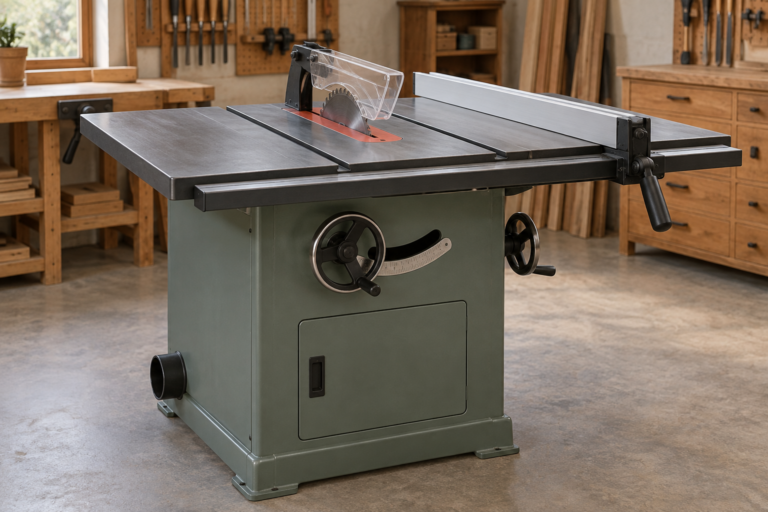
A table saw earns its place through speed and repeatability. Set the rip fence once and you can cut multiple boards to the same width. With a crosscut sled or properly adjusted miter gauge, it also handles repeatable square cuts. A sharp, suitable blade and a fence parallel to the blade matter: poor alignment can burn the wood, pinch the blade, or encourage kickback.
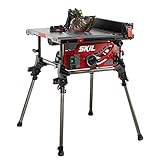
For a first machine, a contractor-style or cabinet-style table saw for woodworking is the category to consider if ripping and panel work are regular jobs. A smaller jobsite saw can be fine for a garage shop, but check its fence, table size, and support for long stock. A wide sheet of plywood is awkward and risky to guide alone on a small saw; use outfeed support or break it down with a track saw or circular saw first.
Do not use a table saw to make a curved cut by turning the work into the blade. The blade is exposed above the table, and twisting or binding the stock can cause a kickback. Use the right machine for the cut.
Curves and resawing: band saw advantage
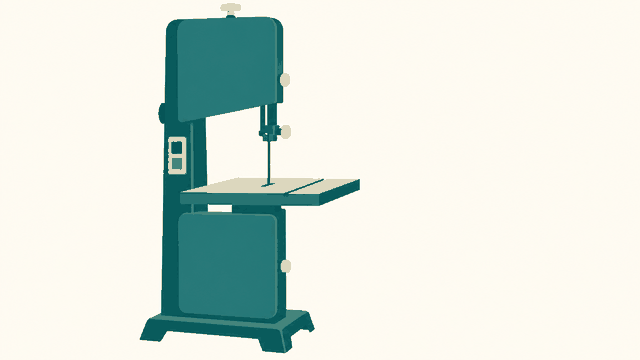
A band saw’s thin blade can turn through curves that a table saw cannot make. Blade width controls how tight a curve it can follow: narrow blades make tighter turns but are easier to deflect, while wider blades track straighter on broad curves and resaw cuts. Check the blade maker’s recommended minimum radius rather than forcing a wide blade around a tight pattern.
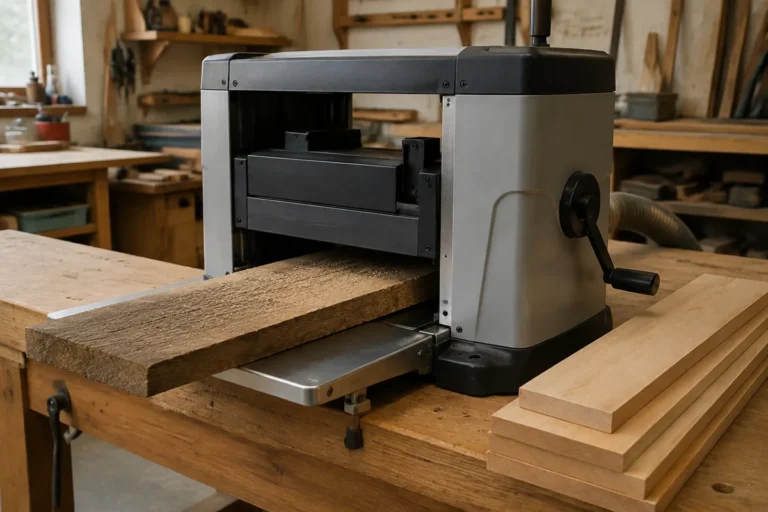
Band saws are also useful for resawing a thick board into thinner boards or veneer. The cut wastes less wood than a typical table-saw kerf, but the result still needs enough extra thickness for planing. A practical target is to leave roughly 1/16 to 1/8 inch for cleanup on each face, then adjust for blade drift, stock condition, and the accuracy of your setup. A modest saw with limited resaw capacity cannot safely or cleanly handle stock taller than its stated capacity.
Look at throat capacity, resaw height, blade guides, and the availability of blades when choosing a woodworking band saw. The number on the spec sheet is not the whole story: a machine may have enough height for a cut but lack the power or rigidity to do it cleanly. For a few occasional curves in thin plywood, a jigsaw costs less and takes up less space. A band saw makes more sense when curves, solid-wood parts, or resawing are recurring jobs.
Accuracy, setup, and common failures
Table saw cuts depend heavily on the fence and blade being aligned. Verify that the fence runs parallel to the blade and that the blade is square to the table for ordinary ripping and crosscutting. Use a riving knife, keep the guard in place when practical, and never stand directly behind the workpiece during a rip. A push stick is essential when your hands would otherwise approach the blade.
Band saws need their blade tension, tracking, and guides set for the blade being used. If a cut wanders, the cause may be a dull or damaged blade, poor tension, unsuitable blade width, or blade drift—not simply a need to push harder. Feed at a steady pace and let the blade cut. For straight cuts, test the blade on scrap and adjust the fence to match its natural drift. Forcing a curve tighter than the blade can manage can twist it, spoil the cut, or break the blade.
Which one should you buy first?
Buy a table saw first if your project list is mostly furniture parts, cabinet panels, shelves, and repeated cuts to width. Buy a band saw first if you make chair parts, curved templates, bandsawn boxes, or resawn stock—and already have another safe way to make straight cuts. If your work is evenly split, choose based on the job that is hardest to outsource or do with a hand tool. Do not count a machine’s theoretical capabilities as useful unless its capacity and setup suit the stock you actually handle.
Budget for blades, stands or outfeed support, and dust collection as well as the machine. A good blade can improve cut quality, but it cannot make an underpowered saw handle stock beyond its capacity. Conversely, the cheapest machine may be entirely adequate for occasional hobby work if you accept slower cuts and spend time checking setup. Buy for the work you repeat, and use the other machine—or a hand tool—for the cuts it does better.