Wood Router Plunge vs Fixed: Which Base Should You Buy?
What's inside
As an Amazon Associate I earn from qualifying purchases. This post may contain affiliate links at no extra cost to you.
For most woodworkers, the best answer to “wood router plunge vs fixed” is a fixed base for frequent edge work and a plunge base for stopped cuts, mortises, template routing, and variable-depth work; if your budget allows only one router, choose the base that matches your most common operation.
As an Amazon Associate we earn from qualifying purchases at no extra cost to you.



Contents
Wood router plunge vs fixed: the essential difference
A fixed-base router holds the motor at a set height while you work. You adjust the cutting depth before switching the router on, lock the height, and guide the tool across the material. This makes it compact, quick to position, and particularly comfortable when the router is riding on an edge guide or trimming an edge.
A plunge router lets the motor and bit move vertically on spring-loaded posts. You start with the bit above the work, lower it to a preset stop or a measured depth, and then retract it at the end of the cut. That movement makes it safer and more controllable for cuts that begin in the middle of a board rather than at an edge.
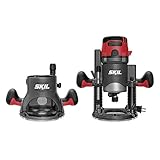
Some routers accept interchangeable fixed and plunge bases. That can be an excellent compromise, but check the complete package: a motor sold with only one base may require a separate compatible base, and not every base fits every motor.
Head-to-head comparison
| Factor | Fixed base | Plunge base | Practical consequence |
|---|---|---|---|
| Typical depth range | About 25–75 mm, depending on router size | About 50–90 mm of plunge travel, depending on model | Plunge bases offer more convenient in-cut depth control; neither should be pushed to its maximum depth in one pass. |
| Common collet sizes | 1/4 in (6.35 mm); larger models often include 1/2 in (12.7 mm) | 1/4 in (6.35 mm); larger models often include 1/2 in (12.7 mm) | Match the collet to the shank; a 1/2-inch bit is not interchangeable with a 1/4-inch collet. |
| Approximate tool weight | 1.5–3.5 kg for compact and mid-size corded routers | 2.0–4.5 kg for comparable corded routers | The plunge mechanism adds bulk and can cause fatigue during long edge-routing sessions. |
| Edge work | Excellent | Good, but usually less nimble | A fixed base is easier to balance against a straightedge, bearing, or router table. |
| Stopped grooves and mortises | Possible with a careful ramp-in or auxiliary jig | Excellent | Plunge action starts and ends a cut without sliding the bit in from an exposed edge. |
| Template routing | Best when the template is accessible from an edge | Best for internal templates and openings | A plunge base makes it easier to lower the bit inside the template after the router is positioned. |
| Setup speed | Usually faster | Usually slower because stops and plunge tension need adjustment | Fixed bases suit repeated, identical edge profiles; plunge bases suit changing depths. |
| Typical starting price | Approximately $80–$250 for corded consumer and mid-range tools | Approximately $120–$350; combination kits commonly cost more | Market prices vary by power, accessories, and whether the tool is cordless. |
These are useful buying ranges rather than guarantees. Compact trim routers may weigh less than 1.5 kg and use only 1/4-inch or 6 mm shanks, while heavy-duty routers can exceed 4 kg and accept larger bits.
Where a fixed base is the better choice
Edge profiles and laminate trimming
For roundovers, chamfers, rabbets, flush trimming, and decorative edge profiles, a fixed base is normally the easier tool. The base stays at a predictable height, the motor is lower and more compact, and the router is less tiring to steer along a board edge. A compact fixed or trim router is especially convenient for trimming laminate, veneer, and small hardwood parts.
Router-table work
A fixed-base router is often the simpler choice for a router table because its height can be adjusted from above or below with a lift or table mechanism. Before buying, confirm that the router is approved for the intended table arrangement and that its switch, collet, and height-adjustment controls remain accessible.
Repeated production cuts
If you are making 20 identical shelf edges or cutting the same rabbet on several cabinet parts, fixed depth is an advantage. Set the height once, make a test cut, and repeat. A plunge mechanism can be locked, but its springs and sliding posts add movement that is unnecessary for this kind of work.
Where a plunge base earns its extra size
Mortises and stopped grooves
A plunge router is the natural choice for hinge mortises, loose-tenon slots, stopped dados, and cable channels. Mark the start and end points, position the base, lower the bit gradually, and use the depth stop to repeat the cut. Make several shallow passes rather than removing the entire depth at once.
For example, to cut a 12 mm-deep mortise in three passes, set the depth stop at approximately 4 mm, 8 mm, and 12 mm. This reduces motor load, produces less tear-out, and gives the bit a better chance to clear chips.
Template routing
Plunge action is valuable when a template surrounds an opening. Place the router on the template with the bit retracted, turn it on, and lower it into the material. This avoids trying to enter from an edge or tilt a running router into a cut.
Use a template guide, bearing-guided bit, or both according to the jig design. Account for the offset between the bit and guide bushing: if a bushing is 20 mm in outside diameter and the bit is 12 mm in diameter, the cutting path is offset by 4 mm from the template edge on each side. That offset must be included when sizing the template.
Variable-depth work
Plunge bases make it faster to cut a shallow recess, test the fit, and deepen it without disassembling the setup. This is useful for signs, inlays, hinge plates, and repeated recesses where the final depth is established gradually.
Decision matrix: which base suits your situation?
| Your situation | Recommended choice | Why |
|---|---|---|
| Beginner making shelves, boxes, and simple edge profiles | Fixed or compact combination router | It is lighter, easier to control, and has a shorter learning curve for edge work. |
| One router for furniture, joinery, and templates | Combination kit with both bases | You avoid buying a second motor when your projects expand. |
| Mostly cabinet edges and flush trimming | Fixed or compact trim base | Fast setup and low fatigue matter more than plunge travel. |
| Frequent mortises, stopped dados, or inlays | Plunge base | Controlled entry and exit are safer and more repeatable. |
| Limited storage or occasional DIY use | Compact fixed router, unless templates are central to your projects | It takes less room and usually costs less. |
| Heavy production work or large raised panels | Full-size plunge router, often with a separate fixed or table setup | Greater power and 1/2-inch-bit capacity are more important than minimum weight. |
Setup details that affect accuracy
On a fixed base, install the bit with the shank fully seated but not bottomed out, set the depth with the router unplugged, and lock the base firmly. Make a test cut in scrap from the same material. Even a height error of 0.5 mm can be visible on a small roundover or leave a proud laminate edge.
On a plunge base, check that both posts move smoothly, set the turret stop, and verify the deepest stop with a depth gauge or test piece. The router should plunge squarely without one post binding. Hold the base flat before lowering the bit; beginning at an angle can enlarge the entry point or cause a sudden sideways movement.
For either base, use a straightedge or guide when the cut must be dimensionally exact. Do not rely on the edge of a rough board. Use multiple passes, especially in hardwood, and move the router against the bit’s rotation when hand-guiding it. Keep the feed rate steady: moving too slowly can burn the wood, while moving too quickly can overload the motor and leave a rough surface.
Ownership, wear, and common mistakes
The parts most likely to need attention are collets, base-locking mechanisms, guide bushes, plunge-post surfaces, and carbon brushes on some corded motors. Resin and dust can make plunge posts sticky, so vacuum the tool after use and wipe exposed metal with a suitable dry lubricant recommended by the manufacturer. Avoid flooding the posts with oily lubricant, which can attract abrasive dust.
Inspect collets for corrosion, packed dust, or damage. A dirty collet can prevent the bit from gripping concentrically, producing vibration and an uneven profile. Replace damaged or visibly worn collets rather than compensating by tightening excessively.
- Never adjust depth while the router is connected to power.
- Do not use a large bit at the maximum speed without checking its speed rating.
- Do not take a deep cut in one pass simply because the motor has enough power.
- Use hearing and eye protection, and connect dust extraction where practical.
- Support both the workpiece and the router base; a narrow or overhanging board can tip unexpectedly.
Bottom line
Choose a fixed base when your priority is quick setup, comfortable edge work, trimming, or repeated cuts. Choose a plunge base when you need controlled entry into the middle of a board, stopped cuts, mortises, inlays, or internal templates. If your projects span both groups and the budget permits, a combination router with interchangeable bases is usually the most flexible purchase. The right answer in the wood router plunge vs fixed decision is less about which base is more powerful and more about where the bit must start, how often the depth changes, and how accurately you need to repeat the cut.