Best Table Sanders for Smooth, Consistent Woodworking Results
What's inside
As an Amazon Associate I earn from qualifying purchases. This post may contain affiliate links at no extra cost to you.
The right table sander for most small shops in 2026 is a benchtop oscillating spindle/belt combo or a 12-inch disc sander for shaping, stepping up to an open-end drum sander like the SuperMax 16-32 or JET 18-36 only if you routinely flatten glued-up panels. Which one earns bench space depends on what you’re actually sanding—edges and curves, or wide flat stock—so this guide compares the main types on sanding surface, abrasive changeover, stock capacity, dust control, and footprint.
As an Amazon Associate we earn from qualifying purchases at no extra cost to you.

Contents
What “Table Sander” Actually Covers
“Table sander” is an umbrella term for any stationary sander where the work rests on a fixed table instead of you holding the tool. Three designs dominate the market, and they solve different problems:
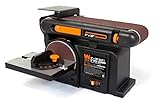
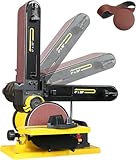
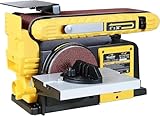
- Benchtop disc/belt combo sanders – a vertical disc (usually 6–12 inches) plus a horizontal or tilting belt. Best for shaping, squaring ends, and bevel work. Table top sanders in this class start around $150–$400.
- Oscillating spindle sanders – a rotating drum that also moves up and down. The go-to for inside curves and template work. Roughly $150–$350 for benchtop units like the WEN 6524 or Triton TSPS450.
- Drum sanders – a wide horizontal drum that thickness-sands boards and panels fed underneath. The only true “production” option here, handling stock 16–44 inches wide. Expect $900–$3,000+.
If your main frustration is hand-sanding edges and curves, a combo or spindle table top sander solves it. If it’s flattening cutting boards and panel glue-ups, only a drum sander does that job consistently.
Comparison: Representative Table Sanders by Category
| Model | Type | Sanding Surface | Max Stock Capacity | Dust Port | Weight | Typical Price Range |
|---|---|---|---|---|---|---|
| WEN 6502T | Belt/disc combo | 4×36 in belt + 6 in disc | Hand-held workpieces only | 2.5 in | ~40 lb | $130–$180 |
| RIKON 50-112 | Belt/disc combo | 4×36 in belt + 6 in disc | Hand-held workpieces only | 2.5 in | ~50 lb | $250–$350 |
| WEN 6524 | Oscillating spindle | 5 spindle sizes (½–2 in) | Curved/irregular workpieces | 1.5 in | ~36 lb | $140–$200 |
| Powermatic OES9138 | Oscillating spindle | 9 spindle sizes, 24×24 in table | Curved/irregular workpieces | 4 in | ~250 lb (floor) | $900–$1,200 |
| SuperMax 16-32 | Open-end drum | 16 in drum (32 in with two passes) | Up to 3 in thick, 32 in wide | 4 in | ~150 lb | $1,100–$1,400 |
| JET JWDS-2244 | Closed-end drum | 22 in drum | Up to 4 in thick, 44 in wide (dual pass on open models) | 4 in | ~300 lb with stand | $1,700–$2,200 |
| Grizzly G0458Z | Open-end drum | 18 in drum (36 in two-pass) | Up to 4.5 in thick | 4 in | ~170 lb | $900–$1,200 |
Two numbers in that table matter more than the rest. First, dust port size: drum sanders demand a real dust collector (600+ CFM recommended), not a shop vac—a shop vac on a drum sander leaves abrasive strips loaded with dust that burns and glazes your stock. Second, open-end vs. closed-end drums: open-end machines let you flip a panel and sand double the drum width, which is how a 16-inch drum sands a 30-inch tabletop.
Decision Matrix: Match Your Situation to a Sander
| Your situation | Best type | Why |
|---|---|---|
| Hobbyist, garage shop, mostly edge work and small parts | Benchtop belt/disc combo | Cheapest entry, bolt-down or clamp to any bench, belt tilts for bevels |
| Furniture maker doing curves, templates, chair parts | Oscillating spindle sander | Oscillation prevents burning and spreads wear across the sleeve |
| Cutting boards, panels, glued-up tabletops weekly | 16–18 in open-end drum sander | Two-pass capacity covers most tabletops; smallest drum sander footprints |
| Production shop, daily panel work, cabinets | 22–25 in drum sander or wide-belt | Single-pass widths, conveyor feed rates up to ~10 FPM, heavier duty cycles |
| Tight space, must stow between uses | Compact combo sander (~40 lb) | Drum sanders need infeed/outfeed room—roughly 8 ft of clear floor for 4-ft panels |
Sanding Surface Size and Stock Capacity
Sanding surface determines what passes through the machine. On combo sanders, a 4×36-inch belt handles most edge work; moving to a 6×48-inch belt (like the Jet J-41002 class) matters mainly for long, straight edges such as rail stock. On drum sanders, drum width is the headline spec, but check three related numbers:
- Thickness capacity – typically 3–4.5 inches, enough for nearly any furniture work.
- Minimum stock length – often 2.5–3 inches; shorter pieces need a sled or carrier board.
- Conveyor speed – variable 0–10 FPM is standard; slower feed gives finer finishes on figured wood.
A worked example on footprint: a SuperMax 16-32 is roughly 22 inches deep and 26 inches wide on its stand, but sanding a 4-foot tabletop needs the table length on both sides of the drum—about 110 inches of clear infeed/outfeed path. Measure your shop’s longest clear run before buying, not the machine’s spec sheet dimensions.
Abrasive Changes: The Hidden Time Cost
How fast you swap grits affects real-world throughput more than motor horsepower:
- Hook-and-loop discs change in seconds—one reason disc sanders dominate small shops.
- Sanding belts release via a tension lever; expect about a minute per change.
- Spindle sleeves slide off once you loosen the drum nut; keep sleeves in all common grits since they’re $3–$8 each.
- Drum wraps are the slowest—velcro-backed rolls (JET/SuperMax style) take 5–10 minutes per change versus 15+ for older clip systems. If you frequently run 80→120→180 grit sequences, velcro-wrap machines save real time weekly.
Dust Control Reality Check
Every table sander machine benefits from extraction, but requirements scale sharply. Spindle sanders and small combos run acceptably on a 2.5-inch shop vac hose. Drum sanders don’t: sanding a 24-inch panel generates enough fine dust to overwhelm a vac in minutes, and dust caked between the abrasive and the conveyor roller is the leading cause of sandpaper glazing and burned stock. Budget for a 1.5 HP+ dust collector if you go the drum route—it’s part of the machine’s real cost.
Ownership Realities: What Wears and What Breaks
- Consumables first: Abrasives are the ongoing cost. Drum sander rolls run roughly $25–$45 per 25-yard roll; figure one roll lasts a hobbyist 2–4 months of regular use.
- Conveyor belts: Drum sander feed belts eventually wear or get scorched by thin stock; replacements cost $60–$120 and last most owners several years.
- Tables on combo sanders: Cast iron tables stay flat; stamped aluminum ones on budget machines can flex under pressure, throwing off square-edge work. Check table rigidity if precision matters.
- Common mistakes: Taking more than 1/32 inch per drum pass (causes burning and motor strain), feeding end-grain cutting boards without a sled (chips the trailing edge), and skipping dust extraction then blaming the sandpaper.
FAQ
Can a table top sander replace a planer?
No—drum sanders dimension stock slowly (max ~1/32 in per pass) and excel at final thickness and surface finish, not rough flattening. Most shops pair a planer for bulk removal with a drum sander for tear-out-free finish passes on figured wood.
Is a benchtop or floor-model sander better for a small shop?
Benchtop versions of combo and spindle sanders lose almost nothing in capability. For drum sanders, floor stands are standard anyway—the question is drum width, not mounting.
What CFM does a drum sander need?
Manufacturers typically specify 400–600 CFM minimum at the machine through the 4-inch port. A 1.5 HP dust collector with a short hose run satisfies this; a shop vac does not.
Bottom line: for under $400, a benchtop belt/disc combo or spindle sander handles the shaping work most small shops actually do. When flat panels become routine rather than occasional, a 16–18 inch open-end drum sander is the smallest upgrade that genuinely replaces hand sanding on wide stock.