Best Oscillating Sanders for Detail Work and Fine Finishes
What's inside
- What an Oscillating Sander Actually Does for Detail Work
- Spec Comparison: The Machines Worth Considering
- The Ridgid Question — and the “Ridgid vs. Rigid” Confusion
- Jet Options: Shop-Grade Alternatives
- Corded vs. Battery, and the Handheld Alternative
- Decision Matrix: Match Your Situation to a Pick
- Ownership Realities Nobody Mentions in Listings
- FAQ
- What an Oscillating Sander Actually Does for Detail Work
- Spec Comparison: The Machines Worth Considering
- The Ridgid Question — and the “Ridgid vs. Rigid” Confusion
- Jet Options: Shop-Grade Alternatives
- Corded vs. Battery, and the Handheld Alternative
- Decision Matrix: Match Your Situation to a Pick
- Ownership Realities Nobody Mentions in Listings
- FAQ
As an Amazon Associate I earn from qualifying purchases. This post may contain affiliate links at no extra cost to you.
The best oscillating sander for most detail work in 2026 is a benchtop oscillating spindle sander with a tilting table in the 1/2–2 inch spindle range — the Ridgid EB4424 remains the benchmark for corner reach and accessory flexibility, while the Jet JBOS-5 suits heavier shop use and budget buyers do well with Wen or Triton equivalents. Below is how to match the machine to your actual work.
As an Amazon Associate we earn from qualifying purchases at no extra cost to you.

Contents
- What an Oscillating Sander Actually Does for Detail Work
- Spec Comparison: The Machines Worth Considering
- The Ridgid Question — and the “Ridgid vs. Rigid” Confusion
- Jet Options: Shop-Grade Alternatives
- Corded vs. Battery, and the Handheld Alternative
- Decision Matrix: Match Your Situation to a Pick
- Ownership Realities Nobody Mentions in Listings
- FAQ
What an Oscillating Sander Actually Does for Detail Work
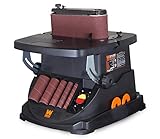
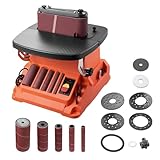
An oscillating spindle sander combines rotation with an up-and-down stroke — typically 58–75 oscillations per minute at around 1,725–2,000 RPM. That vertical movement spreads wear across the whole sanding sleeve, prevents the burn marks and pigtail scratches a plain rotary drum leaves, and follows curves that a random-orbit sander cannot reach. For finish preparation on curved aprons, cabriole legs, templates, and cutouts, it is the tool that turns a 20-minute hand-sanding job into a two-minute pass.
Distinguish two machines people confuse:
- Oscillating spindle sander: benchtop machine, round drums 1/2″–4″, for inside curves and edge shaping. This is what most searches for “oscillating sander” mean.
- Oscillating edge/belt sander: a larger machine (often floor-standing, e.g., Jet OES-80CS) with an oscillating 6″×89″ belt for long, straight edges — cabinet parts, table aprons, door rails. Relevant if you search “oscillating edge sander,” but it’s a different budget and footprint class.
Spec Comparison: The Machines Worth Considering
| Model | Type | Oscillations/min | Spindle/Belt Sizes | Table Tilt | Weight | Power | Typical Price Range |
|---|---|---|---|---|---|---|---|
| Ridgid EB4424 | Spindle + oscillating belt | 60 | 4 spindles + 4″×24″ belt | 0–48° | ~45 lbs | Corded, 5A | $300–$400 |
| Jet JBOS-5 | Spindle | ~30 (1″ stroke) | 5 spindles (1/4″–2″) | 0–45° | ~82 lbs | Corded, 1/2 HP | $500–$650 |
| Wen 6510T / 6524 | Spindle (6524 adds belt) | 58 | 4–5 spindles | 0–45° | ~30 lbs | Corded, 3.5A | $130–$200 |
| Triton TSPS450 / TSPSP650 | Spindle | 58–60 | 5–6 spindles | 0–45° | ~35–45 lbs | Corded, 450–650W | $180–$280 |
| Jet OES-80CS | Oscillating edge sander | Belt oscillates | 6″×89″ belt | Fixed + tilting fence | ~300+ lbs | Corded, 1.5 HP | $2,500–$3,500 |
| Cordless detail multi-tools (e.g., Milwaukee M12 FUEL, Bosch GOP) | Oscillating multitool w/ delta pad | 10,000–20,000 OPM | ~3.5″ delta pad | N/A (handheld) | ~2–3 lbs | Battery, 12–18V | $100–$250 (bare) |
The Ridgid Question — and the “Ridgid vs. Rigid” Confusion
If you’ve searched “ridgid oscillating sander” or “rigid oscillating sander,” it’s the same machine — the brand is Ridgid, and the EB4424 is the model that made the category mainstream for hobbyist shops. Its standout feature is a convertible head: four spindle drums plus a 4″×24″ oscillating belt, so it covers both curved and straight-edge work in one ~$350 footprint. The cast-iron table tilts for bevel sanding, and onboard storage keeps sleeves and drums with the machine.
Honest limitations: the belt attachment is better at edge sanding than heavy stock removal, dust collection via the 2-1/2″ port is adequate but not great at the belt end, and sleeve changes on the largest drum are fiddly. Parts availability is excellent — sleeves, drums, and replacement belts are standard consumables you can source widely.
Jet Options: Shop-Grade Alternatives
The Jet JBOS-5 is the step up for daily use: a 1/2 HP induction motor that doesn’t bog down under pressure, a full 1″ oscillation stroke (deeper than most rivals, which means longer sleeve life), and a heavier cast-iron base that kills vibration — a real benefit when you’re sanding thin stock and feel every wobble. It also accepts a 1/4″ spindle, the smallest in the class, for tight scroll-saw cutouts.
The Jet oscillating edge sander (OES-80CS) is a different machine entirely — a 6″ oscillating belt on a cast-iron table for production edge work. Buy it if you’re running a cabinet shop; skip it if “detail work” means toys, instruments, and curved furniture parts.
Corded vs. Battery, and the Handheld Alternative
Every serious benchtop oscillating sander is corded — the duty cycle and vibration load make battery power impractical, so “cordless oscillating sander” searches land on oscillating multitools instead. That’s legitimate for detail work: a delta sanding pad on a multitool reaches inside cabinet corners, stair treads, and window sash that no benchtop machine can touch. Expect roughly 20–40 minutes of active sanding per 5Ah battery, aggressive pad wear in corners, and hand vibration that becomes tiring after ~15 minutes of continuous use.
Rule of thumb: spindle sander for parts you can bring to the machine; multitool for parts that can’t come to it.
Decision Matrix: Match Your Situation to a Pick
| Your situation | Best choice | Why |
|---|---|---|
| Hobbyist, occasional curved parts, under $200 | Wen or Triton spindle sander | Same OPM class as premium units; lighter build is fine for weekend use |
| Serious hobbyist, mixed curves and edges | Ridgid EB4424 | Spindle + belt covers 90% of detail sanding in one machine |
| Semi-pro shop, daily use, thin delicate stock | Jet JBOS-5 | Induction motor, low vibration, 1″ stroke extends sleeve life |
| Tight inside corners, on-site or installed work | Cordless oscillating multitool w/ delta pad | Only tool that reaches where spindle sanders can’t |
| Cabinetmaking, long straight edges in volume | Oscillating edge sander (Jet OES class) | Belt oscillation prevents loading on resinous woods |
Ownership Realities Nobody Mentions in Listings
- Sleeves are the real cost. A 6-pack of assorted-grit sleeves runs $15–$30 and an 80-grit sleeve wears out in 10–20 minutes on hardwood edges. Buy sleeves in bulk and size drums down when they’re worn — a “2-inch” drum that’s lost its grit still works on gentler curves.
- Dust collection is mandatory, not optional. Fine sanding dust stays airborne. Connect a shop vac to the 2-1/2″ port; without it, the table and your lungs collect the difference. Budget machines have worse shrouding — plan a better hose fit.
- Let the oscillation do the work. The most common mistake is pressing hard, which stalls the stroke, burns the wood, and glazes the sleeve. Light pressure, keep the part moving across the drum.
- What wears first: rubber drums compress over a few years (symptom: sleeves slip during use), and table inserts crack. Both are cheap replacement parts on Ridgid and Jet machines.
- Grit discipline for fine finishes: stop at 180 on the machine — beyond that, hand-sand with the grain to erase any residual cross-grain scratches before finishing.
FAQ
Is an oscillating spindle sander worth it if I already own a random-orbit sander?
Yes for curves. Random-orbit sanders can’t sand inside cutouts or fair a curved edge; a spindle sander does both in seconds and leaves a cleaner surface on end grain.
What’s the difference between an oscillating sander and an oscillating multitool?
“Oscillating” describes motion, not one machine. Spindle sanders oscillate a rotating drum vertically; multitools oscillate a flat pad side-to-side at very high frequency for corners and flush work. Many shops end up owning both.
Which spindle size matters most for detail work?
The 1/2″ and 3/4″ drums do the most detail work — they match common scroll-saw and bandsaw radii. A 1/4″ spindle (Jet JBOS-5) is a bonus for tight fretwork.