Best Bench Sanders for Small Shops and Detailed Woodworking
What's inside
As an Amazon Associate I earn from qualifying purchases. This post may contain affiliate links at no extra cost to you.
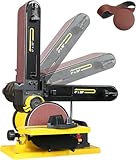
The best bench sander for most small woodworking shops is a combination belt-and-disc machine with a 4-by-36-inch belt, a 6- or 9-inch disc, adjustable work tables, and a motor of at least 1/2 horsepower; smaller machines save space, while heavier 1-horsepower models handle repeated shaping with less stalling.
As an Amazon Associate we earn from qualifying purchases at no extra cost to you.

Contents
Best bench sander picks by shop and workload
| Shop situation | Best machine type | Useful specification | Why it fits |
|---|---|---|---|
| Very limited bench space or occasional hobby use | Compact belt-and-disc bench sander | 1/3 to 1/2 hp; 4-by-36-inch belt; 6-inch disc; roughly 35–45 lb | Affordable, versatile, and easy to store between projects |
| General furniture, boxes, and small joinery | Mid-size combination sander | 1/2 to 3/4 hp; 4-by-36 or 6-by-48-inch belt; 9-inch disc | Offers useful surface area without consuming a full-time floor space |
| Frequent hardwood shaping | Heavy combination belt-and-disc sander | Approximately 1 hp; 6-by-48-inch belt; 9-inch disc; 90–120 lb | Greater tracking stability, cooling, and resistance to motor slowdown |
| Mostly edge sanding and small parts | Dedicated disc or narrow-belt sander | 9–12-inch disc or 3-by-18-inch belt | Uses less bench depth and gives better control on short workpieces |
| Curves, inside cutouts, and delicate profiles | Oscillating spindle sander | 1/2 hp or more; multiple spindle diameters | Better for inside curves than a flat belt-and-disc machine |
What to compare before buying a bench sander
Sanding surface: belt size matters more than headline power
A 4-by-36-inch belt is a practical all-round size for a small shop. It provides enough length to flatten edges and smooth moderate-sized parts, and belts are widely available in coarse, medium, and fine grits. A 6-by-48-inch belt gives a longer, wider contact area, which is useful for cabinet components and broad edges, but the machine is substantially larger and heavier.
The sanding surface should match the parts you actually make. A small 4-by-36 machine is convenient for drawer parts, toys, boxes, and general edge work. It is less comfortable for wide panels because the narrow belt encourages you to sand in sections. For large surfaces, a random-orbit sander or drum sander is usually more appropriate than trying to use a bench sander as a surface-finishing machine.
The disc is valuable for squaring ends, refining short edges, and sanding miters. A 6-inch disc keeps the machine compact; a 9-inch disc gives more usable area and tends to stay flatter against the workpiece. Whichever size you choose, check whether replacement adhesive-backed or hook-and-loop discs are easy to obtain.
Motor power and real workload
Motor ratings are useful only when considered alongside belt width, abrasive condition, and feed pressure. A 1/3-horsepower motor can be adequate for light hobby work, but it is easier to slow when sanding hardwood or pressing a broad edge against the belt. A 1/2-horsepower motor is a sensible minimum for a general-purpose bench sander. A 3/4- or 1-horsepower motor is preferable when the machine will run frequently or remove substantial material.
More power does not make careless sanding safe or automatically produce a better finish. Excessive pressure overheats the abrasive, rounds edges, and loads the motor. The best results come from a sharp, correctly chosen belt and light, consistent passes. A heavier motor is mainly valuable because it maintains speed when the workload increases.
Belt and disc functions
Combination machines are popular because one motor supports two useful operations. Look for a belt that can operate horizontally and vertically, or at least has a clearly useful vertical position. A vertical belt is convenient for end-grain work and controlled edge sanding; a horizontal belt can support small parts from above.
The belt platen should be flat and adequately supported. A removable platen is useful for slack-belt sanding, but this technique requires restraint: unsupported abrasive removes material quickly and can change a profile before you notice. A graphite-coated platen or graphite strip can reduce friction and heat, although it is a consumable component.
For the disc, examine the table rather than the disc diameter alone. A rigid table with a positive 90-degree stop is much more useful than a large disc mounted above a small, flexible table. A miter gauge is helpful for repeatable end cuts, but inexpensive gauges often have play. If accuracy matters, test the fit and plan to adjust or replace the gauge.
Table adjustment and alignment
Table adjustment is a major difference between a frustrating sander and a useful one. The disc table should tilt for bevels and lock without shifting as the knob is tightened. The belt table should remain square after adjustment, with enough support near the abrasive to prevent small parts from tipping.
Before choosing a bench top sander, check how much clearance the table provides around the belt and disc. A table that is technically adjustable but difficult to reach with a workpiece is not a practical adjustment. Also look for accessible tracking controls. Belts that wander toward one edge can damage their edges and make accurate sanding difficult.
Compact models versus heavy-duty bench sanders
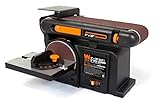
Compact machines such as the WEN 6502T represent the common small-shop format: a 4-by-36-inch belt, 6-inch disc, and approximately 1/2-horsepower motor. They are usually economical, often in the general market range of $120 to $220, and can handle routine shaping, end-grain work, and small furniture parts. Their limitations are a smaller work surface, lighter construction, and greater sensitivity to aggressive pressure.
Heavier machines such as the JET JSG-96 use a larger 6-by-48-inch belt and 9-inch disc format, with a substantially heavier stand or base and approximately 1 horsepower in many configurations. Typical market pricing is roughly $700 to $1,100. This type of sander is more stable and better suited to repeated hardwood work, but it occupies valuable floor or bench space and is excessive for occasional light sanding.
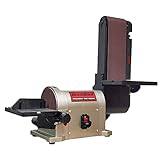
RIKON and similar mid-range combination sanders sit between those categories. They can be a good choice when a compact machine feels underpowered but a large industrial-style unit will not fit the shop. Compare the actual belt dimensions, motor rating, table construction, dust ports, and replacement-parts availability rather than choosing by brand reputation alone.
Dust collection and bench footprint
Dust control is important for visibility, cleanup, and abrasive life. A machine with separate dust ports for the belt and disc is easier to connect effectively than one small port serving both paths. Many bench sanders use ports around 1-1/2 or 2-1/2 inches, but adapters may be needed for a shop vacuum or larger collector.
A shop vacuum can collect a meaningful amount of sanding dust from a compact machine, especially with a fine-filter cartridge. It may struggle with high-volume dust from continuous sanding. Keep the hose short, inspect for blockages, and do not assume a dust port captures all airborne particles. Wear appropriate eye and respiratory protection according to the dust and your workshop’s risk controls.
Measure the machine’s actual footprint, not just its advertised width. Allow room for the belt to rotate vertically, for the disc table to tilt, and for your hands to hold stock safely. A machine that is 24 inches wide may require another 12 to 18 inches of clear working space on the approach side. For a shared bench, a lighter 35-to-45-pound model can be stored on a shelf; a 90-to-120-pound model is better treated as a permanent installation.
A practical selection calculation
Suppose you sand 20 small projects per year and use a compact machine for 15 minutes per project. That is only five operating hours annually. A $160 bench sander therefore costs about $32 per operating hour before abrasives, assuming a five-year service life and ignoring resale value. If you use it for two hours every week, the same machine sees roughly 520 hours over five years, or about $0.31 per operating hour.
This calculation explains why a cheaper compact sander makes sense for occasional work, while a heavier model can be better value for frequent production. At higher use, reduced vibration, stronger tables, replaceable parts, and a motor that does not repeatedly stall matter more than the initial price difference.
Ownership realities: what wears first
- Abrasive belts and discs: Replace them when they glaze, clog, or require excessive pressure. A worn abrasive creates heat and can make a sound motor appear weak.
- Tracking components: Dust and resin can affect rollers and tracking adjustment. Clean the area regularly and never operate with a damaged belt edge.
- Drive belts: On some machines, the internal drive belt stretches or cracks before the motor fails. A slipping drive belt produces speed loss and odor.
- Platen and graphite strips: Continuous use can create grooves or friction. Inspect the platen when sanding begins to feel uneven.
- Tables and stops: Vibration can loosen fasteners. Check the 90-degree setting periodically with a reliable square rather than trusting the scale.
Common mistakes include using a coarse belt for too long, pushing stock into the disc at its upward-moving side, sanding without a stable table, and connecting dust extraction without checking that airflow is actually reaching both sanding zones. Keep fingers away from the abrasive, support small pieces with suitable fixtures, and disconnect power before changing belts, discs, or internal components.
Bottom line
For most people searching for the best bench sanders, a 1/2-horsepower combination machine with a 4-by-36-inch belt and 6-inch disc offers the strongest balance of price, versatility, and footprint. Choose a compact bench sander for occasional small parts, a mid-size model for regular furniture work, and a heavy 1-horsepower machine when hardwood shaping is frequent enough to justify permanent space. If your work is primarily inside curves, wide panels, or fine finishing, a different sander type may serve you better than a larger combination unit.