Best Festool Track Saw Accessories for More Accurate Cuts
What's inside
- Which Festool Track Saw Accessories Are Worth Buying First?
- Guide Rails: Match Length to Your Material
- Rail Connectors: When One Rail Isn’t Enough
- Splinter Guards: The Cheapest Accuracy Upgrade
- Clamps: FSZ 120 vs. FSZ 300
- Parallel Guides: Repeatable Rip Cuts Without Measuring
- Other Accessories Worth Considering
- Decision Matrix: What to Buy for Your Situation
- Ownership Realities
- Related Guides
- Which Festool Track Saw Accessories Are Worth Buying First?
- Guide Rails: Match Length to Your Material
- Rail Connectors: When One Rail Isn’t Enough
- Splinter Guards: The Cheapest Accuracy Upgrade
- Clamps: FSZ 120 vs. FSZ 300
- Parallel Guides: Repeatable Rip Cuts Without Measuring
- Other Accessories Worth Considering
- Decision Matrix: What to Buy for Your Situation
- Ownership Realities
- Related Guides
As an Amazon Associate I earn from qualifying purchases. This post may contain affiliate links at no extra cost to you.
Contents
- Which Festool Track Saw Accessories Are Worth Buying First?
- Guide Rails: Match Length to Your Material
- Rail Connectors: When One Rail Isn’t Enough
- Splinter Guards: The Cheapest Accuracy Upgrade
- Clamps: FSZ 120 vs. FSZ 300
- Parallel Guides: Repeatable Rip Cuts Without Measuring
- Other Accessories Worth Considering
- Decision Matrix: What to Buy for Your Situation
- Ownership Realities
- Related Guides
Which Festool Track Saw Accessories Are Worth Buying First?
The right Festool track saw accessories depend on what you actually cut: sheet goods need a long guide rail and connectors, repeatable rip cuts need a parallel guide, and precision finish work needs clamps and fresh splinter guards. Most users get the biggest accuracy gain from three items — the correct rail length, a pair of rail clamps, and a parallel guide — while storage and transport accessories matter mainly if the saw leaves the shop.
Guide Rails: Match Length to Your Material
The Festool FS/2 guide rail system comes in several stock lengths, and picking the wrong one is the most common cause of awkward, inaccurate cuts. The rule of thumb: your rail should overhang the workpiece by at least the width of the saw base on both ends, roughly 150–200 mm total.
As an Amazon Associate we earn from qualifying purchases at no extra cost to you.


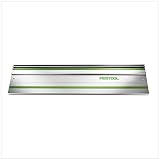

| Rail | Length | Max crosscut width* | Best for |
|---|---|---|---|
| FS 800/2 | 800 mm | ~550 mm | Cabinet parts, drawer components, narrow rips |
| FS 1080/2 | 1080 mm | ~800 mm | Upper cabinet panels, shelving |
| FS 1400/2 | 1400 mm | ~1100 mm | General-purpose; the most versatile single rail |
| FS 1900/2 | 1900 mm | ~1600 mm | Crosscutting full 4’×8′ sheets with margin |
| FS 2424/2 | 2424 mm | ~2100 mm | Ripping full 8′ sheets lengthwise |
| FS 2700/2 | 2700 mm | ~2400 mm | 8′ rips with extra lead-in; door trimming |
*Approximate maximum cut length allowing ~200 mm of lead-in and ~50 mm of tail. Actual numbers vary slightly with your setup.
For most woodworkers, the FS 1400/2 plus an FS 2424/2 or FS 2700/2 covers 95% of work — crosscut and break down sheets with the long rail, then use the 1400 for everything else. Note that the Festool track saw 75 (TS 75) uses the same FS/2 rail system as the TS 55 and TS 60, so rails you buy now carry over if you upgrade saws later.
Rail Connectors: When One Rail Isn’t Enough
Festool’s FSV connecting pieces join two rails end-to-end. Two connectors per joint (one at each edge slot) are mandatory — a single connector allows the joint to flex slightly under clamp pressure, and you’ll see it as a stepped cut line or a wavering edge on long rips.
- Best use: Joining two FS 1400/2 rails gives you a 2800 mm setup for full-sheet rips that’s far easier to transport than a single 2700 mm rail.
- Setup tip: Snug the set screws, lay the joined rails on a flat surface, and check for straightness with a long level or string line before cutting. Even well-fitted joints can introduce a fraction of a degree of angle.
- Reality check: A joined rail is never quite as stiff as a single long rail. For daily sheet-goods work, a dedicated FS 2700/2 produces more consistent results.
Splinter Guards: The Cheapest Accuracy Upgrade
The clear rubber splinter guard strip along the rail edge is a consumable, not a permanent part. It’s trimmed by the saw blade on first use to create a zero-clearance edge — that’s how the system shows your exact cut line.
- The FS-SP 5000/T replacement strip comes in a 5 m roll, enough for roughly two long-rail recuts.
- Replace it when the edge is chipped, lifted, or when you switch between a standard and fine-tooth blade — different blades can sit slightly differently against the guard.
- Cut it with a sharp utility knife at 45° at the rail end so joints don’t snag.
Adding the FS-SS “splinter guard for the workpiece” accessory — a stick-on strip on the workpiece side — matters for laminate and veneered plywood, where top-surface tear-out ruins panels. Fresh guards are one of the highest value-per-dollar accuracy improvements in the whole system.
Clamps: FSZ 120 vs. FSZ 300
Festool’s lever clamps slide into the channel under the rail and lock from below, keeping the top surface clear for the saw — a key difference from standard bar clamps that block the saw’s travel.
| Clamp | Clamping depth | Clamping force | Best for |
|---|---|---|---|
| FSZ 120 | 120 mm | ~1,100 N | Rail work on sheet goods under ~800 mm deep |
| FSZ 300 | 300 mm | ~1,100 N | Reaching past wide panels, workbench/MFT use |
For track saw work specifically, the FSZ 120 pair is the better buy — lighter, faster, and sufficient depth for virtually any rail position on a sheet of plywood. The FSZ 300 earns its keep if you also use the clamps on an MFT/3 table. When you need clamping without the bulk, low-profile screw clamps or rapid clamps from other rail-compatible systems (Kreg and several others make clamps that fit standard T-tracks) can work, but always verify the clamp head clears the saw base — this is where third-party options most often fail.
Parallel Guides: Repeatable Rip Cuts Without Measuring
The FS-PA parallel guide set mounts to the rail’s end and locks two stop arms at a set distance, letting you rip identical-width strips repeatedly — cabinet sides, shelf stock, edge banding blanks — without re-measuring each cut.
- FS-PA: Handles widths up to roughly 650 mm with the standard arms; FS-PA-VL extensions push it wider.
- FS-Rapid: A single quick stop for fast, narrower repeat cuts.
- Third-party option: Kreg track saw accessories like the Accu-Cut system offer a lower-cost path to guided cutting, and some Kreg parallel-style guides are adapted to Festool rails by users — but rail fit isn’t guaranteed, so check channel dimensions before buying. Kreg’s system is strongest for occasional users on a budget; Festool’s native system wins on speed and precision for daily use.
If you make more than a dozen similar-width rips per project, a parallel guide pays for itself in the first cabinet build — both in time and in the panels you don’t recut.
Other Accessories Worth Considering
- FS-AW deflector: Stops the hose and cord from catching on the rail end — a small annoyance fix that prevents mid-cut stalls.
- Angle stop (FS-WA or combined mitre guides): Turns the rail into an adjustable-angle crosscut fence for consistent mitres and tapers.
- Rail bag: Rails scratch and ding easily; a dented rail edge defeats the whole point of a guide system. Budget for a padded bag if the saw ever travels.
- Anti-slip strips: Replacement strips for the rail underside restore grip so you can often skip clamps entirely on heavy panels.
Decision Matrix: What to Buy for Your Situation
| Your situation | Buy first | Add later | Skip |
|---|---|---|---|
| Occasional DIYer, one sheet project at a time | FS 1400/2, FSZ 120 pair | Connectors + second rail | Parallel guide, FS 2700 |
| Cabinet/furniture maker, regular sheet goods | FS 1400/2 + FS 2700/2, clamps, FS-PA | Angle stop, deflector | Connectors (buy the long rail instead) |
| On-site work, saw travels in a van | Two FS 1400/2 + FSV connectors, rail bag, clamps | Splinter guard rolls, anti-slip strips | Single long rails (hard to transport) |
| Budget-conscious, mixed-brand setup | Compatible rail + low-profile clamps (verify fit) | Festool consumables (splinter guards fit many clone rails) | FS-PA until you confirm repeat-cut demand |
Ownership Realities
A few things listings won’t tell you. Splinter guards need replacing every few months of regular use — budget a couple of rolls a year. Rail edges dent if stored loose in a truck; a damaged edge edge means inconsistent cut lines. Connector joints loosen with vibration during transport, so re-check screws before each long cut. And the single most common accuracy mistake is insufficient lead-in: starting the plunge with the saw blade barely inside the rail end causes small kickback cuts and chews the guard.