Best Planers for Producing Smooth Hardwood Cabinet Stock
What's inside
As an Amazon Associate I earn from qualifying purchases. This post may contain affiliate links at no extra cost to you.
A planer can make cabinet parts uniform in thickness, but it cannot replace a jointer. For smooth hardwood stock, the usual sequence is: flatten one face, create one straight edge, then plane the opposite face parallel. If you skip the flattening step, the planer copies bows, twists, and cup instead of removing them.
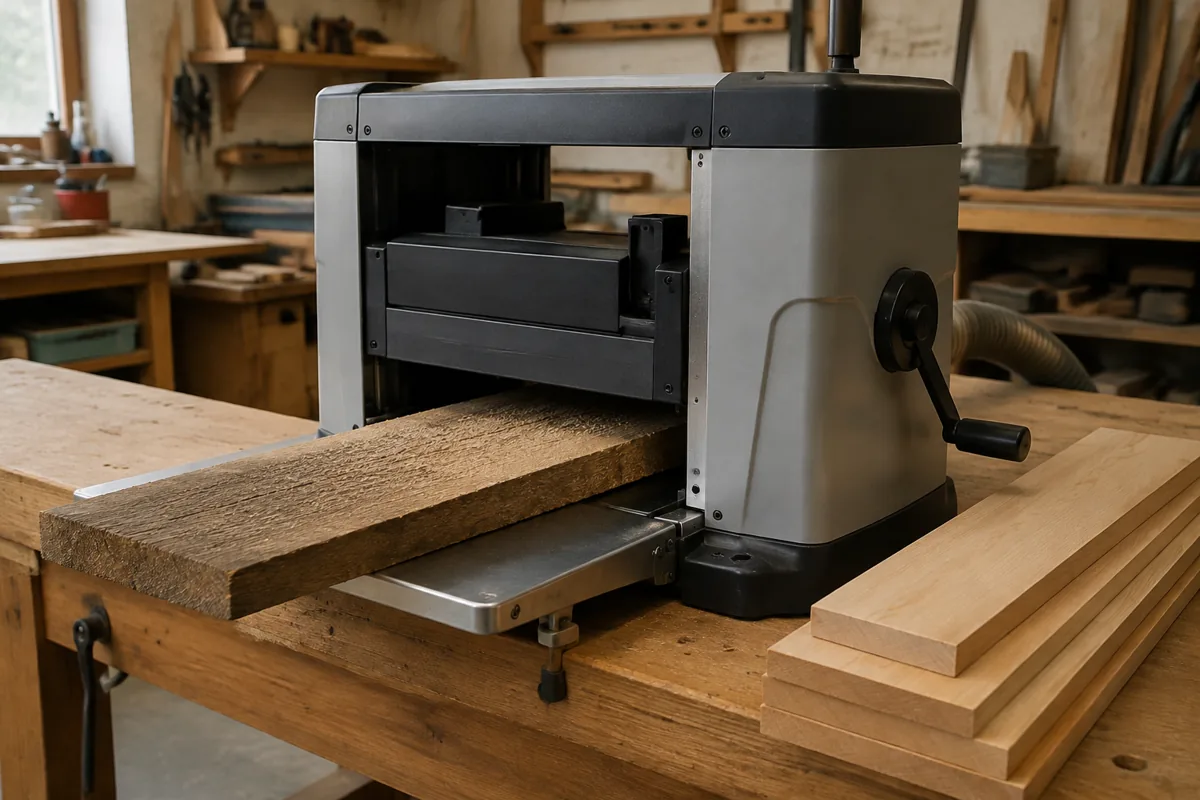
The best planer depends on how much stock you process, the width of your boards, and how much tear-out you can tolerate. A portable benchtop machine is adequate for occasional cabinet work. A heavier lunchbox planer or stationary machine is better for repeated hardwood milling, especially when you are processing wide panels or several boards for a matching set.
Contents
What to Look for in a Cabinet-Stock Planer
Start with capacity. A 12- to 13-inch planer handles most face frames, door parts, and cabinet components. A 15-inch machine is more useful for wide drawer parts, table components, and larger solid-wood panels. Check the actual maximum thickness as well; most machines accept stock roughly 6 inches thick, though the exact figure varies.
Cut depth matters more than peak horsepower. Removing 1/16 inch from a wide, hard maple board is demanding, while a 1/32-inch finishing cut is relatively easy. A planer that is rated for a 1/16-inch cut may slow noticeably in dense hardwood. For a smoother result, remove no more than 1/32 inch per pass in hard maple, cherry, or white oak. Save deeper cuts for rough softwood or the first pass on less valuable stock.
Look for a reliable feed system, a rigid cutterhead, and a method of controlling snipe. Snipe is the deeper cut often left at the first and last few inches of a board. It results when the board lifts or drops as it enters or leaves the cutterhead. Longer infeed and outfeed tables help, but proper support and feeding technique are still necessary.
Planer Types Compared
| Planer type | Best use | Advantages | Limitations |
|---|---|---|---|
| Benchtop 12- to 13-inch | Occasional cabinet parts and small shops | Lower price, portable, easy to store | More noise, more snipe, shorter service life under heavy use |
| Heavy-duty 13-inch | Frequent hardwood milling | Better feed stability, stronger drive system, improved support | Heavier and more expensive |
| 15-inch stationary | Production cabinet work and wide stock | Rigid frame, wide capacity, steadier cuts | Requires floor space, dust collection, and a larger budget |
| Helical or spiral-head planer | Hardwood, figured grain, and reduced noise | Less tear-out, quieter operation, replaceable inserts | Higher purchase price; inserts still need maintenance |
For many home shops, a 12-inch benchtop planer is the sensible starting point. The cheaper option is fine if you mill a few cabinet projects per year, mostly use straight-grained lumber, and can accept slower feed rates and some hand-planing afterward.
Straight-Knife or Helical Cutterhead?
Straight-knife planers use two or more long blades. They cost less and produce a good surface when the knives are sharp, the stock is fed correctly, and the grain is cooperative. Their main weaknesses are noise, pronounced tear-out in reversing grain, and the need to replace or sharpen a full set of knives.
Helical and spiral heads use many small carbide inserts. The inserts are arranged at an angle, so each cut is relatively small. This usually reduces tear-out in figured maple, curly cherry, and oak with changing grain direction. It also makes maintenance easier: a damaged insert can be rotated or replaced instead of removing a long knife.
A helical head is not a guarantee of a finished surface. Feed direction still matters, and heavily figured wood may require a very light final pass and sanding. If you routinely mill expensive hardwood or cannot afford to lose material to tear-out, paying more for a 13-inch helical-head planer can be justified. If your lumber is mostly straight-grained and your budget is tight, a straight-knife planer with sharp blades remains a capable choice.
How to Plane Hardwood Without Tear-Out
Joint one face first. If the board is twisted or cupped, use a jointer, sled, or router-based flattening setup to create a stable reference face. Then plane with that face down. A planer does not flatten a twisted board; it makes the top face parallel to the bottom face while preserving the original distortion.
Inspect grain direction and mark the intended feed direction with chalk. Feed the board so the cutter meets the grain at a favorable angle whenever possible. Take a shallow first cut, roughly 1/32 inch, and inspect the surface. If the machine begins tearing out, reduce the cut depth, slow the feed only if the machine allows it, and reverse the board if the grain direction permits.
Leave cabinet stock slightly oversized. For a finished 3/4-inch door part, mill it to about 13/16 inch, allow it to rest, and take the final pass later. Wood can move after machining as internal moisture equalizes. A final cut of 1/64 inch or less often produces a cleaner surface than one aggressive pass.
Dust Collection and Shop Requirements
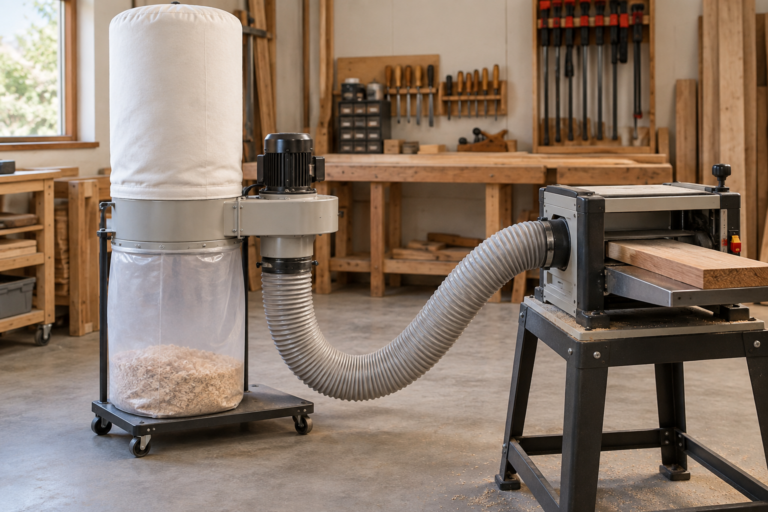
Planers produce chips quickly. A shop vacuum may handle light benchtop use, but a dust collector with a 4-inch hose is preferable for continuous hardwood milling. Without adequate collection, chips can clog the ejection chute, pack beneath the rollers, or blow back into the cutter area. Fine hardwood dust also requires respiratory protection and good ventilation.
Measure the machine footprint with its tables extended, not just the cabinet dimensions. You need several feet of clear infeed and outfeed space for long boards. A 6-foot board needs roughly 12 feet of practical travel space unless you use carefully positioned roller stands or a folding support system.
Buying Recommendations by Shop Size
Choose a benchtop machine if portability and price matter most. Look for carbide or easily replaceable knives, extension tables, a depth gauge, and a positive thickness lock. A machine in this class is generally the best value for a hobbyist making face frames, drawer boxes, and narrow door components.
Move to a heavier 13-inch planer if you process hardwood every week. Better infeed and outfeed support, less vibration, and a more durable gearbox can save time even when the cutting width is unchanged. A heavy-duty 13-inch thickness planer is often the practical middle ground between a portable machine and a floor-standing unit.
Buy a 15-inch stationary planer when cabinet work is regular, stock is wide, or production speed matters. The extra rigidity and capacity are valuable, but only if your shop has sufficient power, dust collection, and floor space. For occasional projects, that cost is difficult to justify; a good benchtop planer and a careful workflow will produce cabinet-quality stock with more setup and cleanup.