Best Planers for Producing Consistent Cabinet Door Stock
What's inside
As an Amazon Associate I earn from qualifying purchases. This post may contain affiliate links at no extra cost to you.
Contents
What the planer needs to do
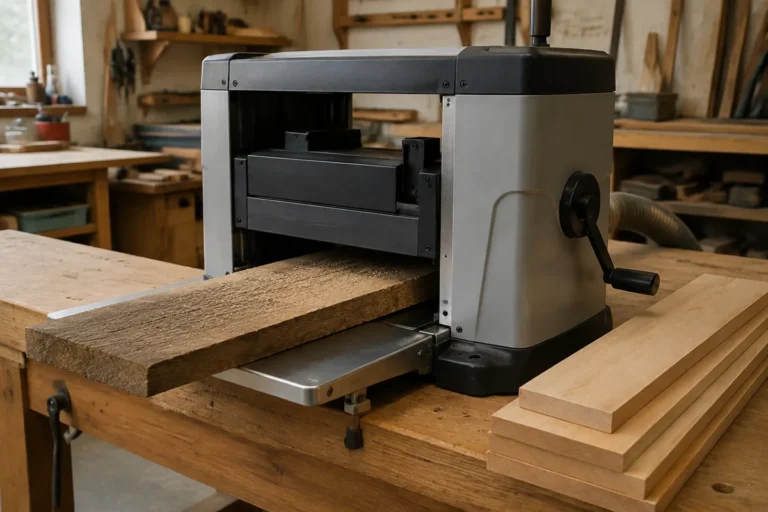
Cabinet doors show small thickness errors clearly, especially on wide panels and rails that must sit flush. The goal is not simply to remove wood quickly. It is to produce pieces of consistent thickness without snipe, tear-out, or a surface that needs excessive sanding.
A benchtop thickness planer is adequate for many small shops. A heavier, wider machine is useful when you regularly mill wide panels, process lots of stock, or need a more stable setup. Either way, accurate results depend on jointing one face flat first. A planer makes the opposite face parallel to that reference face; it does not reliably flatten a bowed or twisted board on its own.
As an Amazon Associate we earn from qualifying purchases at no extra cost to you.


Which planer type makes sense?
| Type | Best fit | Trade-offs |
|---|---|---|
| Benchtop, two-knife cutterhead | Occasional cabinet parts and modest budgets | Lower upfront cost, but louder, more prone to tear-out on difficult grain, and knives need periodic replacement or sharpening |
| Benchtop, helical or segmented cutterhead | Small shops that want better results on figured wood | Usually costs more; individual inserts can be rotated or replaced, but the head is not maintenance-free |
| Floor-standing planer | Frequent production, wider stock, and a dedicated shop | More capacity and mass, but higher purchase cost, space requirements, and often more demanding electrical needs |
For a first planer, compare benchtop thickness planers by maximum width, minimum and maximum thickness, cutterhead style, and availability of knives or inserts. Many benchtop machines accept stock around 12 to 13 inches wide, but confirm the actual specification before buying. A nominal width limit is not a safe working width for every irregular board.
Cutterhead and finish quality
Traditional straight knives can leave a good surface on straight-grained stock when sharp and set correctly. They are often the cheaper choice for clear maple, cherry, or poplar cabinet parts. Their weakness is grain that reverses direction: the knives can lift fibers and leave torn patches that take time to sand out. Dull knives make the problem worse and can burn or bruise the surface.
Helical-style heads use small carbide inserts arranged in rows. They tend to cut figured grain with less tear-out and can be quieter in use, though they still produce chips and require effective dust collection. They also cost more initially. If an insert gets nicked, rotate or replace that insert rather than changing a full-width knife. Check whether replacement inserts are easy to obtain and whether the head uses standard or proprietary parts.
For a batch of cabinet doors made from plain, straight-grained lumber, sharp straight knives are usually fine. If you often plane curly maple, highly figured cherry, or reversing grain, the added cost of a segmented head may save enough cleanup to justify it. Neither style eliminates sanding or guarantees a finish-ready surface.
Capacity and shop setup
Door components are often narrower than a planer’s full capacity, but panels may not be. Measure your widest intended blank before shopping, and remember that extra width is only useful if the machine can feed the stock safely and your shop can support it. Long boards need infeed and outfeed space: a 6-foot board may require several feet of clear support on both sides of the machine, or carefully adjusted roller stands.
Look for a stable table, accessible depth adjustment, clear thickness scale, and a repeatable way to set the cut. Scales on portable planers can be approximate; verify the output with calipers or a thickness gauge. A digital readout is convenient, not a substitute for measuring. Check whether the machine has a dust port and what size it uses. Planers make a high volume of chips, and a shop vacuum may struggle with continuous use compared with a suitably sized dust collector.
Also check voltage and circuit requirements. Many benchtop planers run on standard household power, while larger floor-standing machines may require a different circuit. A machine that trips a shared circuit is a poor fit even if its cutting capacity looks attractive.
How to plane door stock consistently
Start with dry, acclimated lumber. For interior cabinet work, wood around 6 to 8 percent moisture content is common in many heated shops, but local conditions vary. Let stock settle in the shop and check it with a moisture meter if the material’s history is uncertain. Milling wet or unevenly acclimated wood can produce parts that move after cutting, undermining careful thickness work.
Joint one face flat, then plane the opposite face. Take light passes—about 1/32 inch is a sensible starting point on a small machine, especially with wide or hard stock. Heavy cuts can strain the motor, increase snipe, and leave a rough surface. Reduce the cut when the motor slows or the board chatters. Keep hands clear of the rollers and never force a short, narrow piece through unsupported; follow the machine’s minimum workpiece dimensions and use a suitable carrier only when the manual permits it.
Plane several matching parts in sequence, then check thickness at both ends and the middle. A difference of a few thousandths of an inch can matter when parts meet in a flush frame, so measure more than one board. To limit snipe—the shallow dip near the ends—support long stock level, take a final light pass, and feed boards back-to-back when the manual allows. Sacrificial lead-in and run-out boards can help, but they must be stable and safe to feed.
A practical buying shortlist
Choose a basic 12-inch straight-knife benchtop planer if you make doors occasionally from straightforward stock and can tolerate knife changes and some sanding. It is the sensible low-cost route for a hobby shop that does not need wide capacity or daily production.
Step up to a 13-inch benchtop planer with a helical-style cutterhead if figured hardwood is routine or you value easier insert maintenance. Compare the total cost of replacement inserts, not just the purchase price. For frequent work and broad panels, consider floor-standing thickness planers; their mass and capacity are useful, but only if you have the floor space, electrical supply, and dust collection to use them properly.
Before ordering, verify capacity, minimum stock length and thickness, motor requirements, dust-port size, and local availability of cutting parts. Those details matter more to consistent cabinet stock than a long feature list.