Best Band Saws for Small-Shop Resawing and Veneer Production
What's inside
As an Amazon Associate I earn from qualifying purchases. This post may contain affiliate links at no extra cost to you.
Contents
What matters for resawing
Resawing is cutting a board through its thickness to make thinner boards or veneer. It is harder on a band saw than ordinary curved cuts because the blade stays in the wood for a long time. A small saw can resaw successfully, but only if its frame is rigid, its guides are adjusted correctly, and the blade is sharp.
For a small shop, the useful specifications are resaw capacity, throat depth, wheel size, motor power, and table height. Resaw capacity is the maximum distance from the table to the upper blade guide. A claimed 12-inch capacity does not mean the saw will comfortably cut a 12-inch hardwood board. The actual limit is lower when the motor bogs down, the fence is short, or the frame flexes.
As an Amazon Associate we earn from qualifying purchases at no extra cost to you.
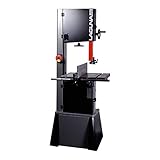
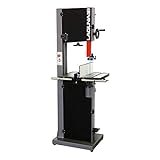

A 10-inch saw with roughly 4 to 6 inches of capacity is suitable for small stock, bowl blanks, and occasional book-matched panels. A 14-inch saw with 10 to 12 inches of capacity is a better general-purpose choice for veneer work. If you regularly want to split 10-inch hardwood boards, a robust 14-inch machine is usually the sensible minimum. Larger machines offer more capacity and power, but they also need more floor space, electrical capacity, and blade-tension discipline.
The best saw types for a small shop
For occasional resawing, a benchtop band saw can be the cheaper option that makes sense. It costs less, takes little space, and handles thin stock well. The limitations are significant: narrow tables, short fences, modest dust collection, and motors that slow down in dense hardwood. Keep cuts around 4 inches or less, use a sharp blade, and feed steadily rather than forcing the work.
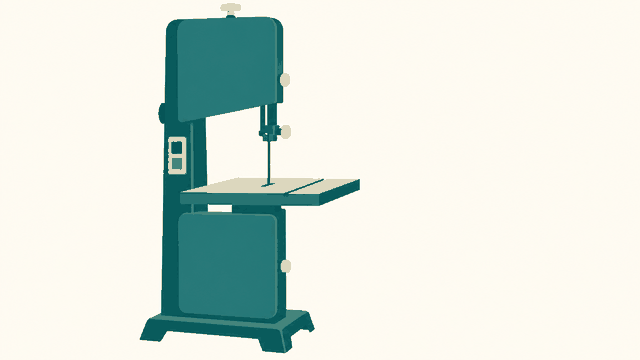
A floor-standing 14-inch saw is the better choice for regular veneer production. Look for a cast-iron or heavy steel frame, a substantial table, ball-bearing guides, a proper tensioning mechanism, and at least about 10 inches of resaw capacity. An open stand is less expensive and easier to move; a closed cabinet usually provides better storage, dust control, and resistance to vibration.
Some 14-inch saws are sold in several versions with different motor sizes. A 1-horsepower machine is adequate for many hardwoods when the blade is sharp and the cut is not rushed. Around 1-1/2 horsepower gives more useful reserve for wide, dense stock. More motor power does not fix a flexible frame, poor guides, or an incorrectly set blade.
Shop the 14-inch woodworking band saws first if resawing is a central task. If you only need occasional narrow cuts, compare 10-inch benchtop band saws instead of paying for capacity you will not use.
Quick comparison
| Machine type | Typical capacity | Best use | Main compromise |
|---|---|---|---|
| 10-inch benchtop | 4–6 inches | Small stock and occasional resawing | Limited power, guides, and fence support |
| 14-inch open-stand | 8–12 inches | General small-shop resawing | May need upgrades to fence or dust collection |
| 14-inch cabinet-style | 10–14 inches | Regular hardwood and veneer work | Higher price and larger footprint |
| 18-inch and larger | 12–16 inches or more | Frequent wide-stock production | Cost, space, and power requirements |
Choose the blade before judging the saw
Blade selection has more effect on resaw results than many small differences between machines. For straight cuts in ordinary boards, use a wide blade with a low tooth count. A 3/4-inch blade with roughly 2 or 3 teeth per inch is a common starting point on a 14-inch saw. A 1/2-inch blade is easier to tension on smaller machines and can work well for boards around 6 inches tall.
Skip-tooth blades clear sawdust effectively, while fewer teeth leave larger gullets for removing waste. A blade with too many teeth packs with dust and heats the cut. A blade that is too wide for the saw cannot be tensioned properly and may wander. Check the manufacturer’s recommended blade range; the widest blade is not automatically the best blade.
Buy coarse resaw band-saw blades in more than one width. A wide blade is useful for straight veneer cuts, while a narrower blade is easier to control for smaller stock and curved work. Weld quality matters: a bump at the weld can damage the guides and produce a repeating mark on the workpiece.
Setup for straight veneer cuts
Install the blade with the teeth pointing in the correct cutting direction, then tension it according to the saw or blade maker’s instructions. The blade should track near the center of the wheel crown, with the teeth clear of the wheel rim. Set the side guides just behind the blade gullets and bring the thrust bearing close to the blade without touching it while unloaded.
Do not rely on the fence being parallel to the table slot. Many band saws require the fence to be angled slightly to match the blade’s drift. Make a test cut in scrap, then adjust the fence until the board feeds without being pushed sideways. For a 10-inch board, even a small error becomes a tapered veneer or a blade that exits the stock.
A tall auxiliary fence helps support wide boards. It should be straight, securely attached, and low enough that you can see the cut. Use a push stick or push block once your hands approach the blade, and never pull a partially cut board backward; the kerf can close and pinch the blade.
Common problems and their causes
Wavy faces usually indicate a dull or under-tensioned blade, excessive feed pressure, loose guides, or a frame that flexes. Burning means the blade is rubbing, the teeth are clogged, the feed is too slow, or the blade is too fine. A cut that wanders only near the bottom of the board often points to insufficient tension or a blade that has been damaged by hitting a knot or metal fastener.
Expect to clean dust from the lower wheel and guide area regularly. Poor dust collection can pack the lower cabinet with chips and eventually interfere with tracking. A 4-inch dust port is preferable for a stationary saw, but a large collector will not compensate for leaks around the table insert or an open lower wheel housing.
What to buy for your work
Choose the benchtop saw if your largest practical cut is under 4 inches, your stock is mostly softwood, and you resaw only a few boards a month. Choose a solid 14-inch floor-standing saw if you want repeatable veneer, book-matched panels, or hardwood capacity around 8 to 10 inches. Spend money on a good blade, a stable fence, and dust collection before paying extra for decorative features.
If your work will regularly exceed 10 or 12 inches, or you need production speed, step up to a larger saw rather than pushing a small machine beyond its design. The right band saw is the one that keeps the blade tracking straight at a controlled feed rate; capacity printed on the cabinet matters only when the machine can use it.