Best Band Saws for Cutting Thick Curved Furniture Parts
What's inside
As an Amazon Associate I earn from qualifying purchases. This post may contain affiliate links at no extra cost to you.
Cutting thick curved furniture parts is where a band saw earns its floor space. A good machine can turn a glued-up blank into a cabriole leg, chair part, rocker, or sculpted table component with less waste than a jigsaw or router. The catch is that “thick” and “curved” create different demands: thick stock needs cutting capacity and a stiff frame, while curves need a narrow, properly tensioned blade and a table that does not flex.
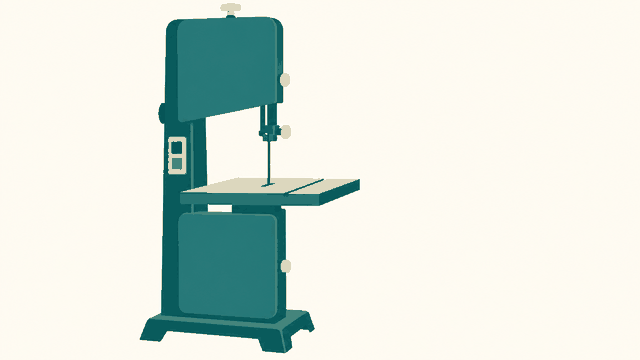
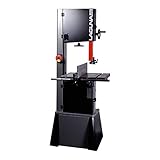
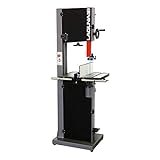
For most furniture work, I would look first at a 14-inch stationary band saw with a cast-iron table, a rigid frame, and at least 10 to 12 inches of resaw capacity. A smaller benchtop saw can cut curves in 2-inch stock, but it becomes frustrating when the blank is tall, the curve is tight, or the blade starts drifting under load.
As an Amazon Associate we earn from qualifying purchases at no extra cost to you.

Contents
What matters most for thick curved parts
Frame stiffness matters more than a large horsepower number. A flexible frame loses blade tension, and the blade then wanders through the cut. Look for a welded-steel or cast-iron frame, substantial upper and lower guides, and a table that locks securely without shifting when you push a heavy blank.
Resaw height is the maximum thickness the saw can cut below the upper guide. Ten inches is workable for many furniture parts; 12 inches or more gives useful room for oversized legs and stacked laminations. Remember that published capacity is not the same as effortless capacity. Cutting 10-inch hardwood continuously requires a sharp blade, correct tension, good dust removal, and a motor that does not bog down.
Throat depth is the distance from the blade to the frame. A 14-inch saw typically gives about 13 to 14 inches of throat, which is enough for most curved parts. A deeper throat helps with wide chair backs and large templates, but it does not compensate for a weak frame or poor blade setup.
For a serious shop, compare 14-inch woodworking band saws rather than judging machines by motor wattage alone. A nominal 1-1/2 horsepower motor on a solid saw is generally more useful than a larger advertised motor attached to a light frame.
Which band saw type fits the job?
| Saw type | Typical useful capacity | Best use | Main compromise |
|---|---|---|---|
| Benchtop 9- to 10-inch | 4 to 6 inches | Small curved parts, thin stock, occasional work | Limited tension, smaller tables, more vibration |
| 14-inch open-stand saw | 10 to 12 inches | General furniture parts and moderate resawing | May need a riser for taller work |
| 14-inch saw with riser | Up to about 16 inches | Tall legs, wide blanks, occasional deep resawing | More setup sensitivity and reduced rigidity at full height |
| 18-inch cabinet saw | 12 to 16 inches or more | Frequent thick hardwood work and production use | Higher cost, larger footprint, heavier blades |
A cheaper benchtop saw is fine if your parts are under 4 inches thick and you mainly cut outside curves in pine, poplar, or small hardwood blanks. It is not a bargain if you routinely force 8-inch oak through it. The motor may survive, but the blade will heat, the cut will drift, and the small table will make safe support difficult.
Blade selection controls the curve
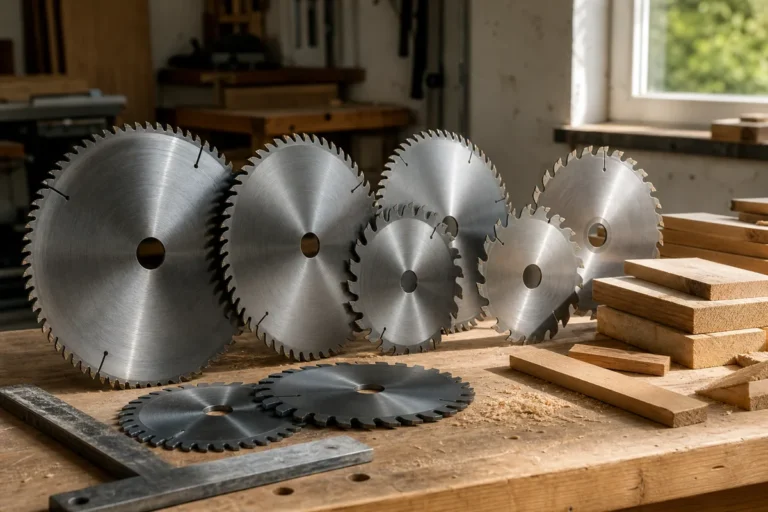
Use the widest blade that can follow the curve. For straight cuts and gentle outside curves in thick stock, a 1/2-inch or 3/4-inch blade with three teeth per inch is a useful starting point. For tighter furniture curves, move to a 1/4-inch or 3/8-inch blade with four to six teeth per inch. A narrow blade turns more easily, but it cannot remove thick chips as efficiently and is easier to twist.
Do not use a fine-tooth blade simply because the cut looks cleaner. In thick wood, a blade with too many teeth packs with sawdust and overheats. Keep at least three teeth in the material during the cut; fewer can cause grabbing and a rough, interrupted cut. For 6-inch stock, a coarse skip-tooth blade is usually more practical than a fine general-purpose blade.
Buy coarse woodworking band saw blades for thick straight sections and separate narrow blades for tight curves. Changing blades is cheaper than trying to make one blade do every job.
Setup before cutting
Set the blade tension according to the blade width and the manufacturer’s guidance, then check that the blade tracks in the center of the tires. Adjust the upper and lower guides so they sit just above the workpiece—about 1/8 inch is a practical starting point. The thrust bearing should be close behind the blade without touching it while the saw runs unloaded.
Check drift with a test cut in scrap from the same species and similar thickness. If the blade consistently leaves the line at an angle, either adjust the fence to match the drift or correct the tracking and blade setup. Do not compensate for a badly aligned saw by pushing harder.
For curved furniture parts, rough-cut outside the line by roughly 1/16 to 1/8 inch. That leaves material for a router template, spindle sander, or hand sanding. If you cut directly to the line, a small blade deflection can ruin the part. Make relief cuts into waste on tight inside corners, stopping short of the layout line. These kerfs let waste fall away instead of pinching the blade.
Features worth paying for
A cast-iron table around 16 by 20 inches or larger is valuable when the blank is heavy. A foot brake is useful, especially with large wheels and thick stock. Good dust collection should capture dust below the table as well as at the upper guard; a 4-inch port connected to a real collector is far more effective than a small shop vacuum.
Look for tool-free or easy-access guide adjustment, a reliable blade-tension indicator, and a fence that locks parallel without shifting. A riser block is useful when you occasionally need extra height, but a fixed-height cabinet saw is usually more stable for repeated thick resawing. If you need serious capacity, compare 18-inch cabinet band saws.
Safe working practice
Support long or awkward blanks with an outfeed table or roller support, but keep the support level with the band-saw table so it cannot lift the work into the blade. Keep both hands on the workpiece and out of the blade path; use push sticks or handles when the part is small. Never back a trapped workpiece out while the blade is running. Stop the saw, wait for the blade to stop, and then remove it.
For most furniture shops, the best balance is a rigid 14-inch saw, a 1-1/2 horsepower-class motor, 10 to 12 inches of capacity, and a selection of coarse and narrow blades. Step up to an 18-inch machine only when thick hardwood work is frequent enough to justify its cost and floor space.